• Driver Profiles
Charles Hamilton Barclay Montréal, Québec / April 28, 1923 Charles Hamilton Barclay drove for Kennedy Taxi which operated a fleet of 150 cars. The company marketed itself as an upscale service for business clients and placed elaborate display ads in the Montreal Gazette.
About nine o'clock on the evening of Saturday, April 28, 1923, a man telephoned for a touring car to be sent to the corner of Ontario and Fullam Streets. Mrs. George Couplin took the call and explained that cars were not usually sent to street corners. The caller, who had spoken in English, switched to French and said that he would be waiting at the corner and gave his name as "Ranger."
In 1923 taxis did not have radios but they operated from call stations strategically located around the city. Mrs. Couplin gave the address to the dispatcher who called the Kennedy Taxi sub-station at the corner of Amherst and Robin Streets. Driver Henri Laurendeau was on the point of refusing the call because he was driving a sedan when he heard Mr. Barclay pull up in his touring car.
Mr. Laurendeau handed the telephone to Mr. Barclay who accepted the trip. He was driving a new car which had not yet been painted in Kennedy fleet colours. Its only distinguishing mark as a taxi was its number, 20, which was displayed inside the car.
Mr. Barclay likely drove a block west from Robin Street to Ontario and then about 18 blocks north to Fullum. At this point his passenger directed him to an address near the corner of Hochelaga and Joliette, another three blocks west and about 25 blocks north.
The car pulled up a few houses east of Hochelaga and witnesses could hear conversation coming from the open car. The passenger asked Mr. Barclay if he could see a house number and then suddenly struck him three times on the front, back and right side of his head with an iron bar, almost severing his right ear. Apparently the killer specifically ordered an open touring car so that he would swing the bar more effectively than in the close confines of a sedan.
Mr. Barclay collapsed to his left, pulling the car into a left turn as he did so. It climbed over the curb, crossed the sidewalk and crashed into the house at 612 Joliette.
The impact was loud enough to bring out residents from 612 and also from the houses next door and across the street. Witnesses saw a young man about 21 years old climb out of the car and pause for a few moments on the sidewalk. He was wearing a dark brown overcoat and a hard hat (bowler or derby).
The accident may have foiled the killer's intent to rob Mr. Barclay but he did not panic. Witnesses saw him walk to a vacant lot next door to 612 Joliette where he dropped the murder weapon. Then he returned to the car to retrieve an umbrella and calmly walked off through the lot to Aylwin Street where he disappeared. He may have used the umbrella to conceal the iron bar.
Police soon arrested a 21-year-old man from Philadelphia who matched the killer's description. The suspect was held until he could be identified, but in the meantime he gave a satisfactory alibi and was released. The case remained unsolved.
The attack on Mr. Barclay was the worst of several recent attacks on Montréal drivers. In one case a driver narrowly escaped death when a gunman shot at him.
The aftermath of Mr. Barclay's death saw an early instance of the drama and debate that was to play out again and again down to the present day.
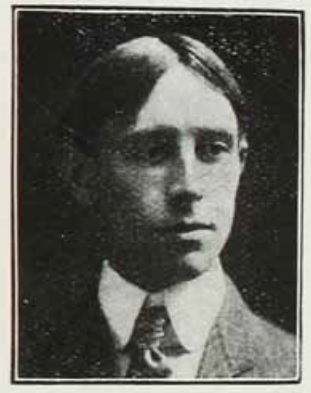
[Next column] Charles H. Barclay as a student at McGill University in 1906. (Source: Old McGill [McGill University yearbook] 1906, p. 79)
Drivers, co-workers and the general public reacted to the murder with sorrow and outrage. The funeral was attended by hundreds of people, with a large representation of uniformed drivers from Kennedy and other Montréal taxi companies. Drivers attached purple ribbons to their windshields as a sign of mourning.
As would happen in later years, debate arose over means of protection for drivers. There was discussion of the feasibility of allowing drivers to carry firearms. Most drivers doubted that this would have prevented the attack on Mr. Barclay, but some thought that the possibility of encountering an armed driver might scare off potential thugs.
For perhaps the first time in Canada the issue of protective shields was introduced, along with the predictable response:
"To the suggestion that all cars be equipped with partitions separating the driver and the passengers, and that communication between the two be made by speaking tubes, the comptroller of Kennedy taxis yesterday returned the laconic reply: 'It's impossible.'"
A sour note was struck when someone called Kennedy Taxi and requested that a car be sent to the same street corner where Mr. Barclay picked up his last fare. The driver found nobody waiting for him and the call was dismissed as a joke in bad taste.
Mr. Barclay was 42 years old and married. He graduated with a Bachelor of Science degree from McGill University in 1906 and had worked as a civil engineer. He had driven for Kennedy Taxi since the company's founding two years earlier and was popular with both co-workers and customers. His parents came to Montréal from Nova Scotia for the funeral.