• Driver Profiles
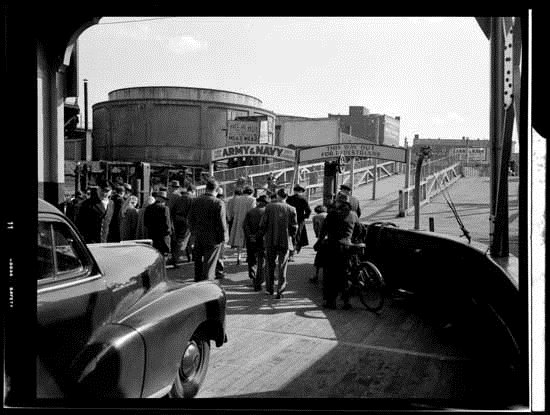
Philip Oscar Davis Vancouver, British Columbia / October 3, 1942 At about 1:50 a.m. on Saturday, October 3rd, 1943, Star Taxi driver Phil Davis phoned his dispatcher on the company's direct line from the Vancouver ferry wharf.at the foot of Columbia Street.
Cabs in 1943 were not equipped with two-way radios and drivers routinely called the dispatcher from company call stations or pay phones when they finished a trip.
Mr. Davis had picked up a fare at the Army and Navy Veterans Club at 2211 Kingsway and dropped him off at the wharf. The dispatcher told him to return to the club for another fare. A dance was winding up and several people had called for cabs. The club secretary told reporters that he himself waited for 45 minutes after calling for a taxi.
Mr. Davis accepted the trip. That was the last communication anyone had with him. His fate remained a mystery for another eight days.
Mr. Davis was 27 years old, unmarried and lived with his widowed mother. He was nearly 5 foot eleven (180 cm) but weighed only 144 pounds (65 kg) and had a chronic kidney condition that exempted him from military service. He was issued with a "military rejection" button (a small official badge that was intended to protect holders from being harrassed or abused for not enlisting). He wore glasses and had a partial dental plate.
His employers characterized him as "an exceptionally fine boy who neither smoked nor drank." He had started working for Star Taxi a month earlier as a spare driver. Prior to that he had given up a job at the Western Wholesale Drug company because he could not handle the physical labour. On September 26, a week before he disappeared, he began driving full time on the 6 p.m. to 3 a.m. shift.
Mr. Davis's mother knew something was wrong when he didn't return home by 3:30 a.m. after hs shift. The dispatcher also noticed that he hadn't checked in at the end of his shift. This was so unusual that the dispatcher notified the Star Taxi manager.
Mr. Davis's abandoned cab was noticed about 7 a.m. Saturday by a resident of the 3100 block of East Eighteenth Avenue. The block contained only two houses at the edge of a "wilderness" and nobody apart from residents or their visitors ever parked there. When the cab hadn't moved by 11 a.m. the man's wife called Star Taxi. A Star driver investigated and confirmed that it was the same cab that Mr. Davis had been driving.
There was no blood on or in the car or any sign of violence. Mud was splashed on one side above the running board and there was mud on the back seat, an indication that the cab had come from some distance as there was no mud anywhere near the car. The keys were missing and someone had rotated the meter's flag five times, registering five 35-cent trips.
According to the odometer the car had travelled 20 miles since the last trip that Mr. Davis noted on his trip sheet. This was apparently the first customer he picked up at the Army and Navy Veterans Club. Whatever happened to him presumably occurred before he got back to the club a second time. A handkerchief and a shirt were found near the car but Mr. Davis's mother said that neither belonged to him.
Mr. Davis visited several people in the hours before his disappearance, including his girlfriend and his married sister. "Phil was very pleased when he dropped in to see me for a second, about 10:45 p.m.," said his sister. "He'd driven a couple of American soldiers just two blocks and they gave him a 75-cent tip. It was the second time he'd driven them and they took his name and said they were going to ask for him again. He was quite pleased about it." A friend said that he talked about a record he wanted to buy the next day. "He was very fond of good music and was always buying records," said the friend.
Mr. Davis's disappearance dominated news coverage in the Vancouver Sun, possibly because it offered a distraction from the generally dismal war news. There were lengthy reports every day between October 3rd and the 14th, including front page stories with banner headlines. As a result Mr. Davis's mother was inundated with telephone calls from well wishers, amateur detectives and the merely curious. "The phone has been going day and night," she told reporters. "It's nearly driving me crazy.... Please tell them to stop."
The police carried out an intensive search in the bush area near where the cab was found. They brought in a tracking dog but it was unable to pick up a scent. Police began to suspect that if Mr. Davis was murdered, his body was probably dumped somewhere else during the cab's final 20-mile journey.
Two soldiers who were seen in the vicinity of East Eighteenth Street on Friday night were questioned and cleared of any involvement.
Star's chief dispatcher remembered a disgruntled customer calling from the Vancouver ferry wharf three weeks earlier and wondered if there was a connection. The man said "some night one of your drivers is going to be found in the water and we'll take the car ourselves." Police were inclined to regard the call as a coincidence.
One of Mr. Davis's brothers came from Prince Rupert to join the search. He had three brothers, one of whom was serving in the merchant marine.
In the absence of blood or signs of violence in the cab, police also considered the possibility that Mr. Davis had arranged his own disappearance. In this light, Mr. Davis's visits to friends and relatives was his way of saying farewell before vanishing. There was also a report that Mr. Davis had disappeared once before, deserting a tramp steamer on which he worked as a crew member. His mother angrily refuted this assertion:
"It's not the truth," she said. "We knew where he was. He took a job as a steward on a coastal steamship, but his health wouldn't stand up to it. The crew chipped in and paid his fare back home. There was never any question of anyone not knowing where he was. The second he arrived in Vancouver he headed straight home."
Adding to the unlikelihood that Mr. Davis deliberately disappeared was the fact that Saturday was payday and his money was still waiting for him. His bank account was also untouched.
Nor did fellow drivers believe that Mr. Davis had vanished voluntarily. They suspected that he was attacked by a fare whom he picked up at the ferry wharf or who hailed him somewhere between the wharf and the Army and Navy Veterans Club. This turned out to be what actually happened.
Meanwhile a Vancouver Sun columnist suggested that boy scouts and older school children be enlisted to help police search the dense bush near where the cab was abandoned. Mr. Davis's family supported this idea but as preparations were being made Mr. Davis's body was found five miles east of the search area in suburban Burnaby.
Sidney Cullen, a returned soldier was out for a drive with his wife and their woman friend on Sunday, October 10th. At about 4 p.m. they came to the end of a bush road and stopped to turn the car around. Mr. Cullen got out and walked through a patch of tall grass where he literally stumbled over Mr. Davis's body. An autopsy revealed that Mr. Davis had died instantly from a bullet wound to the back of his head. He was lying on his back with his arms at his sides.
The next day, Monday, October 11th, would have been Mr. Davis's 28th birthday. Monday the 11th was also Canadian Thanksgiving Day.
"It was a sight I won't forget in a while," said Mr. Cullen. "His body was more badly decomposed than I would have thought.... It looked like he had been dragged in feet first and placed there." According to the Sun "It would be difficult to find an area in Greater Vancouver more suitable for the disposal of a body. The nearest dwelling is at least a mile away."
Mr. Davis was identified by a ring bearing his initials, his military rejection button and signed trip sheet from Star Taxi. The trip sheet indicated that Mr. Davis had collected $8.35 in fares.
[Next column] North Vancouver Ferry No. 4 disembarking passengers at the Vancouver ferry wharf in the early 1950s. (Source: Vancouver Province photo, Vancouver Public Library 42254)
The accidental discovery of Mr. Davis's body was the first of two major breaks in the investigation. The second was that the police already had the killer in custody.
On September 17th a 28-year-old soldier went missing from Seaforth Barracks along with six 38-calibre Smith & Wesson service revolvers. The missing soldier had been a company storeman with a key to the lockbox containing the weaons. A former jockey, the soldier was only five foot two inches (157 cm) in height.
Vancouver police, at the request of the Provost Corps, were on the lookout for the man when his 16-year-old girlfriend approached them with a tip as to his whereabouts. The man had told the girl about obtaining a gun from a friend to use as protection after being beaten up and robbed. The girl saw the outline of the gun in his pocket and was worried that he might get involved in "murder or bloodshed". When he wouldn't go to the police about his fears she contacted them, as she thought, on his behalf.
On Saturday, only hours after Mr. Davis disappeared, two detectives spotted the man in a downtown cafe. His small stature and the fact that he was still in uniform made him easy to recognize.
Police methods in 1943 seem to have been much more casual than they are today. The two detectives first had coffee with the killer and then put him under arrest but neglected to search him. At the police station, when one of the detectives asked if he had a gun, the man obligingly pulled a loaded Smith & Wesson revolver from his uniform blouse and handed it over. When the killer was finally searched, 13 .38 calibre bullets were found in his trouser pockets.
The revolver was identified as one of the missing army weapons. The man confessed to stealing the revolver but claimed that he intended to sell it and had no thought of using it in a robbery.
While they had him in custody, detectives checked to see if he was involved in any recent crimes. The owner of a cafe and his cook, who had been beaten and robbed, were called in to look at the man but they could not identify him as one of the robbers.
On the same day that Mr. Davis's body was found, dectectives escorted the killer back to his cell after questioning. As they turned to leave he called them back. To their surprise he spontaneously confessed to the murder. "I shot Phil Davis," he told them.
He then gave a detailed statement, describing how he was at the corner of Main and Kingsway when he hailed Mr. Davis, who was apparently on his way back to the Army and Navy Veterans Club. He first told Mr. Davis to drive along Kingsway but then produced his revolver and told him to keep driving east into Burnaby. They eventually came to the wooded area which the killer was aleady familiar with, having been there on army manoeuvres the previous summer.
The killer told Mr. Davis to turn the car around, all the while holding the gun on him. He then forced Mr. Davis to walk along a trail through a nearby cemetery.
The killer ordered Mr. Davis to stop and empty his pockets. Mr. Davis put his wallet, change and watch on the ground. At that point, according to the killer, Mr. Davis attempted to run away and was shot in the back of the head. However, when initially asked by detectives why he shot Mr. Davis, the killer merely said "Davis was a smart guy."
"When he turned and ran I fired one shot. I knew I had hit him because he doubled over as though he had a pain in his stomach after he had gone ten or twelve feet. It was too dark to see whether he fell on his back or on his stomach."
The killer gathered up the wallet, coins and watch and drove away. He left the cab on East Eighteenth Street and walked back to Kingsway, discarding the car keys about half a block from the cab. He then hitchhiked back downtown where he got a room in hotel shortly before four o'clock in the morning.
He later pawned Mr. Davis's wristwatch for four dollars and sold his flashlight to a second-hand dealer for forty cents. Police retrieved these items along with Mr. Davis's car keys and the wallet which the killer had thrown away too. He had also discarded the spent shell from his revolver.
When he came to trial the killer repudiated his confession. He now claimed that another man named "Spike" had borrowed his revolver and returned it after murdering Mr. Davis. According to the killer, Spike killed Mr. Davis because he was afraid the taxi driver would identify him to police.
Spike also gave the killer the money for his hotel room, along with Mr. Davis's wallet and watch. The killer's strange explanation for pawning the watch and selling the flashlight was that Spike wanted to throw them away but the killer was afraid that the police would somehow find them and use fingerprints to trace them back to Spike and then to him. Unfortunately for the killer, neither the police nor the defence could track down the mysterious Spike.
The killer explained that his reason for confessing was fear that he and his girlfriend would be given the "third degree." He did not claim, however, that police had threatened him with this. He had merely dreamed one night of a "big policeman over me. I dreamed they used clubs on her, or whatever they use, to find out what she knew."
At the beginning of the trial the defence tried to have the killer's confession ruled inadmissable in court. This resulted in a trial-within-a-trial that lasted several hours over three days while the jury initially waited in a courthouse anteroom. As the hours dragged on the jurors became distressed and the foreman asked that they be sequestered more comfortably in a hotel. The judge granted the request, but as the jurors were being escorted to a dining room for lunch all 12 of them, with four accompanying police officers, became trapped in a hotel elevator. It took half an hour to rescue them.
In the end the jury accepted the killer's initial confession over his revised story. He was found guilty of Mr. Davis's murder and sentenced to death. A stay of execution was granted pending an appeal to the Supreme Court, but the appeal was dismissed and the killer was hanged on November 22nd, 1943.