• Driver Profiles
Gerald Edward Fischer Edmonton, Alberta / December 5, 1991 Residents of the middle-class Lymburn area of west-end Edmonton were concerned on the morning of December 5, 1991 when they noticed Yellow Cab 389 parked in a little-used alley near 76th Avenue and 181st Street. Its interior was obscured by an icy fog on the windows. Calls to Yellow cab led company safety supervisor George Shea to investigate. Inside the cab he found driver Gerald Fischer, dead from multiple gunshots to the head.
The murder, committed with a small caliber gun, is believed to have occurred in the pre-dawn at about 7:30 a.m.
Mr. Fischer, 48, who did woodworking and carpentry out of his home, had previously driven a taxi part-time and had joined Yellow Cab full-time just two weeks before the murder. He was survived by his three adult daughters.
His daughter, Colleen Abraham, called for bullet-proof shields and emergency alarms to be installed in all taxicabs.
Yellow Cab vice-president Bob Findlay said that installation of shields was up to drivers who own the vehicles and that generally they don't want shields. Driver Guriender Gill, however, said drivers did want shields and that it was the companies who said that drivers didn't want them.
Findlay said that the company was planning an alarm system to be part of a new dispatch system scheduled for July 1992. Laat Bhinder, whose best friend Manjit Singh Dhaliwal was slain in a taxi three years earlier, said that the company promised the same alarm system at that time but never carried through.
A 23-year-old man was arrested in Calgary on December 10th after a Canada wide warrant had been issued. The suspect, a convict who a few days before the killing had been released on day-parole, was charged with first-degree murder. He later pleaded guilty to second-degree murder.
The killer had 12 previous convictions, including 10 for armed robbery. He had stabbed a man, escaped from jail once, had a long juvenile record, and had only lasted 24 hours on his previous day parole. Despite a glowing recommendation for parole by a prison psychologist, the killer was described by another psychologist as a "bright psychopath" with a serious drug problem and little likelihood that he would ever respond to treatment.
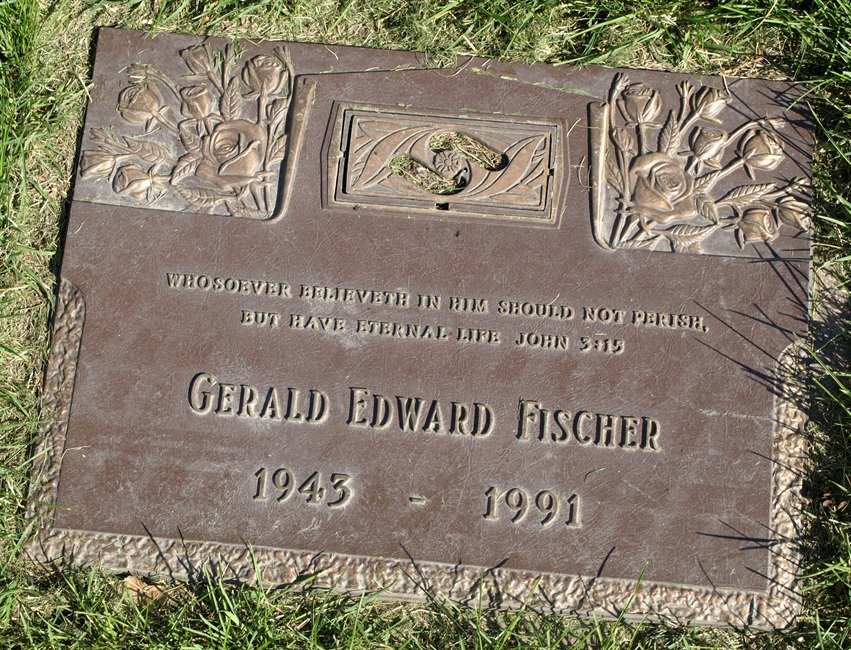
[Next column] Gerald Fischer's grave in Westlawn Memorial Gardens, Edmonton. Photo added by Darrel. (Source: Find a Grave.)
The murder of Gerald Fischer sparked a year-long furor over the release on parole of dangerous criminals. The Correctional Service of Canada psychologist who had recommended that Mr. Fischer's killer's be released on parole was later fired for incompetence. His highly-publicized appeal of the firing, initially successful but ultimately dismissed in the courts, focused attention on five disastrous releases that resulted in seven homicides in Alberta.
MPs called for the dismissal of Ghislain Bellavance, a senior member of the National Parole Board. Controversy centered on the lack of accountability of Board members, who are appointed by the Federal Cabinet. Fallout from the ensuing scrutiny included the 1995 resignation of National Parole Board chairman Michel Dagenais, and the award of $1.5 million in 1997 to the children of a man and woman who were slain by a parolee.
In 1993, after his return to prison, the killer was charged (and ultimately acquitted) of first-degree murder in the killing of a fellow inmate. In 1995 he sued prison officials for $255,000 claiming cruel and degrading punishment following a strike by prisoners.