• Driver Profiles
Fred Genessee Hamilton, Ontario / October 27, 1924 Fred Genesee, a Hamilton "jitney" driver, was murdered on the night of Monday, October 27, 1924.
The jitney phenomenon began around 1914 as large numbers of private car owners in major U.S. and Canadian cities found it profitable to cruise streetcar routes and pick up waiting passengers at a "jitney" (nickel) a head. The practice caused major revenue losses for streetcar companies and as a result many cities (including Hamilton) tried to curtail the jitneys by imposing minimum fares that prevented them from undercutting streetcar fares.
These regulations, however, were not effectively enforced and the jitneys continued to thrive, sometimes evolving into well-organized cut-rate taxi services that quickly put older, well-established firms out of business.
Between 1920 and 1924 an even more savage competitive struggle broke out in southern Ontario between rival gangs of bootleggers. In the U.S. the Volstead Act shut down breweries and distilleries but in Canada breweries and distilleries were allowed to produce an unlimited supply of alcohol for export. This turned bootlegging into a huge international industry and raised the stakes in the struggle for control. By 1922 the southern Ontario bootleg war had reportedly resulted in as many as 20 murders. Most of the dead were members or associates of feuding gangs but one victim was Meritton police chief Joseph Truman, a zealous enforcer of the Ontario Temperance Act. Another victim, found hanging from a tree, was an innocent farmer who apparently wandered too close to an active bootlegging operation.
Mr. Genesee, 28, was born in Canada of Neapolitan parents. He was married with two children aged six and three. He and his wife had a modest bank account and a house on which they were making mortgage payments.
Mr. Genesee's mother-in-law told the Toronto Star that Mr. Genesee "was awfully good to her [his wife] and gave her everything she wanted, even though I did oppose the marriage.... He was a very peaceable and likeable nature and we did not know he had an enemy in the world."
After supper on October 27th 1924 Mr. Genesee left home telling his wife that he would be returning early, at about 9:30. Usually he drove his jitney until midnight. He left with $220 in his possession. This included the $50 he normally carried and $161.50 for a mortgage payment due November 1.
Between 6:45 and 7:15 he was at the Ellis-McIntyre Garage getting a leak in his gas tank repaired.
At 7:30 p.m. he drove W.J.L. Wilson to his bank. Mr. Genesee had an account in the bank and Wilson knew him. Asked how business was Mr. Genesee replied "Not very good."
At about 11:40 p.m. Mr. Genesee bought 30 cents worth of fish and chips at a restaurant on Balmoral Avenue. He often came there alone but this time he arrived and left with another man.
The next day Mr. Genesee's abandoned jitney was found at the corner of Maple and Grosvenor Avenues. His change box containing $12.30 was intact. A day or two later a blood-spattered club was discovered nearby, but on examination (by a Doctor Deadman) the blood proved not to be human.
Mr. Genesee was still missing on the afternoon of Saturday, November 6 when a group of boy scouts decided to search for him on Hamilton's mountain. There the scouts met up with a group of children from a Sunday school and the search was quickly abandoned in favour of playing war. During the game an eleven-year-old boy found a decomposed body concealed in a bush. The Sunday school teacher called police.
The dead man was not Mr. Genesee but Joseph Boitowicz, 38, who had been missing for over three months. His skull was fractured and a racing form on his body indicated that he had attended the races on July 31, shortly before his reported disappearance. Mr. Boitowicz's widow Amelia claimed that her husband had received death threats from local bootleggers who warned him against "squealing".
Eight days later on the morning of November 15 two employees of Saltfleet Township discovered Mr. Genesee's body on the mountainside near Stoney Creek. The body had been pushed over the edge of a small cliff and lay on its back, caught in bushes, about 15 feet down the slope. The victim had been struck on the right side of the head with a blunt instrument. The blow had shattered the right eye socket and dislodged the eyeball which led to reports that Mr. Genesee's eye had been gouged out. Death was due to strangulation by a sash cord which was wound three or four times around his neck. Newspaper reports also referred to multiple gunshot and stab wounds, torture and mutilation, none of which were borne out by the autopsy.
The police, mindful of the ongoing bootleg war, initially suspected that there might be a connection with the two disappearances. Primed by hints from the police and by Amelia Boitowicz's statements, local reporters concocted lurid tales that had little or no basis in fact. These stories were picked up by the press in Toronto and other cities.
The Toronto Globe reported that on the night following the discovery of Mr. Boitowicz's body a woman with a "foreign" accent called the Hamilton police and asked if Fred Genesee's body had been found on the mountain near Ancaster. Later the same woman called again and declared that Fred Gensee's body had indeed been found. She denied that she was confusing Fred Genesee with Joseph Boitowicz. Pressed for her name she called herself "Mrs. Elliott" and hung up.
On the same night the woman supposedly twice called Mrs. Genesee who was staying with her mother. The caller told them, "not without a touch of malice", that "Fred Genesee's body is lying on the side of the mountain." According to the Globe, Mrs. Genesee phoned the police to ask about the truth of this report. The police allegedly told her that the caller must have mistaken Joseph Boitowicz for Fred Genesee.
At first Mrs. Genesee and her mother, at the request of the police, had refused to talk to reporters but they soon became exasperated by the media circus and broke their silence.
The Star reported that "Mrs. Genesee indignantly denied that her husband had any connection whatsoever with the illicit liquor traffic. 'That is nothing but lies,' she declared to the Star. 'He was a fine husband. Everybody knows what a good reputation he had.' Mrs. Genesee also denied that threatening letters and mysterious phone calls had been received. 'There is not a word of truth in these reports,' she said.
Nevertheless, the Star followed up with a sensational story claiming that Mrs. Genesee had vowed revenge on her husband's killers and that "Since the finding of the Genesee body a dagger, emblematic of unredeemed vengeance, has remained jabbed to the hilt in the centre of a cheap wooden table in the Genesee home."
Mrs. Genesee responded to this nonsense through her lawyers and forced the Star to print a retraction. The Star lamely explained that the "error" arose from "a transposition of names made by a Hamilton newspaperman who acts as a correspondent for The Star."
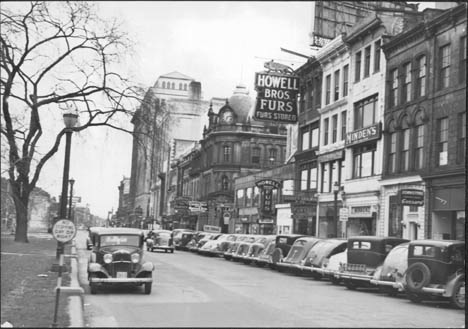
[Next column] King Street, Hamilton, Ontario, 193-? Photo by John Boyd (Source: Archives of Ontario, item 205050 (c) Queen's Printer for Ontario 2012-2015)
Mrs. Genesee protested again when a Star photo caption referred to Mr. Genesee as having been stabbed several times. Ironically, the photo accompanied a report on the inquest that revealed no evidence of stab wounds.
Mr. Genesee was buried on Nov. 18. About 30 jitney drivers joined the procession to the cemetery.
The newspapers, which had not paid much attention to the earlier rash of murders in southern Ontario, now had the bootlegging angle in their teeth and would not let it go. A Star article on November 17 pointed the finger of suspicion at Rocco Perri, the self-proclaimed bootleg king of Canada, who then controlled most of the illicit liquor traffic from Ontario into the U.S. On November 18 Perri surprisingly agreed to an interview with crime reporter Dave Rogers. Rogers began by asking Perri point blank "Who killed Joe Baytoizae [i.e., Mr. Boitowicz] and Fred Genesee?"
"How came these two men to be killed?" He repeated, "I know not, but from what I have heard and from what I have read, I would say that Joe Baytoizae was put out of the way because he was a squealer. He was a Polack. I have been told that he was a stool pigeon. There was a case some time ago in which he helped the police. There may have been others. He has paid the price. That's what I think, but I don't know."
"And Fred Genesee?"
"Fred Genesee, yes, but I do not known [sic] him. Maybe I have seen him. I don't remember. But he was not a bootlegger. I don't think. I have not heard that he was. Why was he killed? I don't know, but I think there was a woman in the case. I think it was spite."
As it turned out Perri was not involved in either murder and his speculations on what had happened were as wide of the mark as anyone else's.
The Boytowicz case broke open when his two sons, aged seven and nine, told police how their father had come home from the race track on July 31 and announced that he had lost all his money. Amelia, in a rage, struck him down with a poker and then hit him again as he lay on the floor. Boytowicz managed to stagger to his bedroom in the basement. The next day the older boy saw men cleaning a red stain from the basement floor and then shoving a bundle out of the basement window. His father's shoes protruded from the bundle. Amelia Boitowicz was charged with murder but was ultimately acquitted due to insufficient evidence and contradictory testimony.
The Genesee case was never officially solved but the police were fairly confident that they knew how Mr. Genesee came to be murdered and who had done it.
When they learned that Mr. Genesee was carrying over $200 when he disappeared the police began to pursue robbery as a possible motive. They discovered that Mr. Genesee frequented a blind pig (speakeasy) run by a notorious bootlegger named Pete Brassi about two miles from Stoney Creek and that he had met with two "bad, good-for-nothing fellows" there on the night of his disappearance. He had lent his car to these men on previous occasions. (At the inquest, Mrs. Genesee testified that he sometimes rented his car to customers who didn't need him as a driver).
Police questioned one of the two suspects when he turned up in January, 1925 with a brand-new $50 overcoat and no good explanation of where he got the money for it. However, despite their suspicions police did not have enough evidence to charge him or anyone else with Mr. Genesee's murder.
The lurid fabrications continue to this day. A preposterous version of the Boitowicz and Genesee murders was published in Gord Steinke's Mobsters and Rumrunners of Canada: Crossing the Line (Folklore Publishing, 2003). In this version "Big" Joe Boytovich [sic] and Fred Gennessee [sic] are two small-time crooks who arrive in Hamilton in October, 1923 [sic] and decide to compete with Rocco Perri's bootlegging empire. Using a Detroit undertaker as a contact they import rubbing alcohol from the U.S. by rail "a ton at a time" and run it through a still on a farm outside of Hamilton to turn it into booze. Perri, enraged at the success of the interlopers, orders their execution. Boytovich and Gennessee are kidnapped on November 19 by two gunmen as they leave the Queen's Hotel for their habitual breakfast at a nearby cafe. The men are tortured by Perri himself before being shot to death and their bodies dumped miles apart on Hamilton mountain.
In Steinke's tale the Dave Rogers interview with Rocco Perri is attributed to none other than Ernest Hemingway. Hemingway actually worked for the Star from 1920 through 1923, mostly as a foreign correspondent based in Paris. He resigned on January 1, 1924, months before the disappearances of Mr. Boitowicz and Mr. Genesee.
In short, his carefree distortion of fact and the intrusion of fanciful detail may give Steinke's book some small value as light entertainment but it is worthless as history. In a page of "Notes on Sources" Steinke says "The dialogue in this book are [sic] true to the sources, and the accounts described are fictionalized as little as possible." Whatever that means.
For a more believable account of bootlegging in Canada, see James Dubro and Robin F. Rowland, King of the Mob: Rocco Perri and the Women Who Ran His Rackets (Markham, Penguin Books Canada, 1987).