• Driver Profiles
Richard Giguère Québec, Québec / December 5, 1975 Richard Giguère was a 20-year-old law student who drove a taxi part time to pay for his university tuition.
Around 3:30 a.m. on December 5, 1975, he picked up a fare at a restaurant in St. Jean Street. The passenger, a 24-year-old man, was an unemployed labourer awaiting trial on two counts of armed robbery. He had no prior criminal record and was released on his own recognizances. The man had spent the evening drinking and was heavily intoxicated.
At about 4 a.m. the Co-op Taxi dispatcher, Nicole Marcoux, received a distress call from Mr. Giguère: "257! 257! I need help!" When she tried to ascertain his location there was no response.
Mr. Giguère made the call from the intersection of Franklin and Durocher streets while standing outside the open driver's door. His passenger was inside the car with the engine running.
Suddenly the passenger put the car into reverse and pressed the accelerator. The car hurtled backward for 132 feet (41 metres), hitting a house. Mr. Giguère was dragged along by the open car door and slammed into a hydro pole. He died at the scene.
The killer suffered facial cuts but was otherwise uninjured and fled before police arrived.
Several hours later, after the police had gathered evidence and towed away Mr. Giguère's car, another Co-op driver drove by the scene and noticed a man with cuts on his face walking back and forth as though he were looking for something. After a while the man entered a house on Durocher street. His suspicions aroused, the cab driver called the police.
The police had found a partial denture at the scene and surmised that it probably belonged to Mr. Giguère's passenger. When the cab driver reported the man's behaviour and the address of the house he entered they quickly realized who they were looking for.
Six police officers surrounded the house. They found the killer inside, armed with a knife. He claimed that he had seen the Co-op cab driver watching him and feared retaliation. The police arrested him on a charge of murder. He claimed not to know that Mr. Giguère was dead.
At the coroner's inquest on December 24, 1975 and at his trial in September, 1976, the killer vehemently denied trying to rob Mr. Giguère. He claimed that during the trip they got into an argument because the killer was too drunk to give his home address clearly. At one point Mr. Giguère supposedly said, "Do you take me for an idiot? I'm well able to sort you out."
When they reached the corner near the killer's house the killer challenged Mr. Giguère to a fight. He then got out of the car and walked around the rear to the driver's side where he said Mr. Giguère punched him several times, knocking him back into the cab through the driver's door, and then beat him with the cab's microphone. He claimed to have put the car into reverse "instinctively."
The Crown's version was that the killer attacked Mr. Giguère and that if Mr. Giguère hit him, it was in trying to fend him off while he made his distress call.
As to the killer not trying to rob the driver, and fleeing without realizing that he was dead, Mr. Giguère's wallet had been emptied and discarded at the scene and his clothing was spotted with drops of the killer's type B blood. This indicated that the killer stood over Mr. Giguère's body.
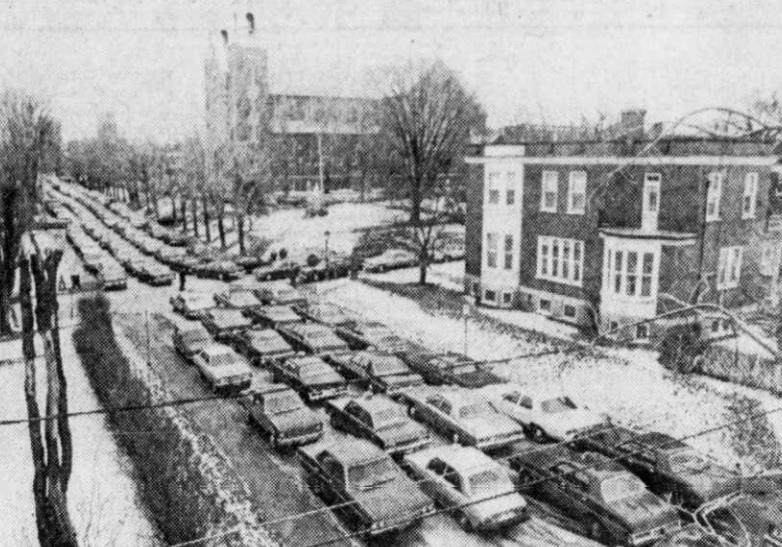
[Next column] An estimated 500 to 600 taxis took part in Richard Giguère's funeral procession. Drivers made up most of the mourners who filled Saints-Martyrs-Canadiens church to near-capacity. Photo by J.-M. Villeneuve (detail). (Source: Le Soleil, December 10, 1975, p. 1, via Bibliothèque et Archives nationales du Québec.)
According to the Crown, the motive was the same as in the killer's two other robberies. He was jobless, subsisting on unemployment insurance and spending his cash on alcohol.
To refute the Crown's claim of financial straits, the defence called a bank manager who testified that the killer's wife had faithfully made payments on a loan that the couple had taken out to buy furniture. She was living with her parents during the last stage of her pregnancy and gave birth to the couple's first child two days after Mr. Giguère's death and the killer's arrest.
The coroner's jury found enough cause to have the killer committed for trial, but recommended that he be charged with manslaughter rather than murder due to his (till then) clean record and the fact that his drunken state caused him to do something that he would not have done sober.
The killer was found guilty of manslaughter on September 24, 1976 and on October 13 he was sentenced to 10 years in prison. Minutes after the sentence, the killer pleaded guilty to one of his prior armed robbery charges, that of robbing a woman of $35 at knife point. He received an additional year in prison.
Mr. Giguère's death occured at time when the debate over safety measures for taxi drivers, particularly bullet-proof shields, was heating up due to recent attacks. Drivers packed Saints-Martyrs-Canadiens church for Mr. Giguère's funeral on December 9 and between 500 and 600 cabs joined the funeral procession to St. Charles cemetery.
Some of the drivers expressed anger over the fact that the killer had been released despite two charges of armed robbery by posting his picture in their cab windows.