• Driver Profiles
Francis (Fritz) Grosso and Bruce Spiers Huntsville, Ontario / June 17, 1959 At about 8:15 p.m. on Wednesday, June 17, 1959 Charles Calvin, a co-owner of C & H Taxi in Huntsville, Ontario, received a call asking for a cab to come to nearby Dwight.
Mr. Calvin called cab owner Francis (Fritz) Grosso, 29, and gave him the trip. Mr. Grosso told his mother about the call and left to pick up his driver, Bruce Spiers, 22, to accompany him. This suggests that he and Mr. Spiers anticipated trouble but if so they did not mention their concern to anyone else.
Both cab drivers were well known in Huntsville and belonged to families with well-established roots in the community. Mr. Spiers was the son of Huntsville police constable Gordon Spiers. As a result there was an immediate reaction when they failed to return from the out-of-town call.
On the following day, Thursday, three or four members of a construction crew working near a gravel pit close to Dwight were called on to help free a taxi that was stuck in mud. Two men and a young woman were in the taxi and the roof light had been removed. One of the crew thought it was an odd place to see a Huntsville taxi, expecially when none of the three occupants looked like taxi drivers. He wrote down the license number and called the police.
The alarming news triggered a search for the two taxi drivers and the suspicious trio. When the Huntsville police could not locate them they called in the Ontario Provincial Police for assistance.
Meanwhile, local police turned their attention to likely suspects within Huntsville and learned of another well-known resident, aged 20, who had disappeared at the same time as the taxi drivers. They questioned the man's 16-year-old friend who quickly confessed to his involvment in a double murder. He also pointed police in the direction of Elk Lake, about 190 miles (300 km) north of Huntsville.
On Friday, June 26, the cab's ownership license was found in a cottage near Elk Lake. The cab had been in the area for several days and was discovered abandoned shortly afterward at nearby Osseo.
Eleven days after the two taxi drivers answered their last call, the 16-year-old accomplice led police to a wooded area near the Dwight gravel pit and about three miles (5 km) east of Highway 35. There they found Mr. Grosso and Mr. Spiers buried in shallow graves.
Reconstructing the crime, police concluded that the two drivers were marched about a mile to the top of a "cliff-like" hill and shot in the back. Mr. Grosso died of gunshot wounds but Mr. Spiers was killed afterward when his skull was crushed by a large rock. The two victims were robbed of about $150.
The accomplice told police how he and the 20-year-old killer planned to ambush and rob Mr. Grosso and Mr. Spiers. He said he supplied the killer with a 22-calibre rifle which they took to the vicinity of the Huntsville Reservoir where they sawed off the stock and part of the barrel. they threw the discarded pieces into the reservoir.
After murdering Mr. Grosso and Mr. Spiers the killer and his accomplice drove to Oshawa and picked up the killer's 17-year-old girlfriend. The trio then drove to Elk Lake where they stayed with the killer's uncle.
Before going to Elk Lake, however, the two perpetrators returned to the murder scene to see if they had overlooked any money. They found Mr. Spiers still alive and the killer crushed his skull with a rock. While they were driving away the cab became stuck and the members of the contstruction crew came to their assistance.
The accomplice hitchhiked back to Huntsville while the killer and his girlfriend stayed in Elk Lake. Subsequently the girlfriend learned that the police were looking for them and told the killer. By now the money they had taken from Mr. Grosso and Mr. Spiers was all gone and they had little or none left to buy gas or food. They were unable to get money from the killer's relatives so they abandoned the cab and stole the uncle's motorboat, planning to escape via the Montreal River.
The uncle reported the boat theft to police who mounted an intensive search along both banks of the river. On Monday, June 29, two police officers found the abandoned boat and quickly tracked down the two fugitives who were suffering from hunger, exposure and fly bites.
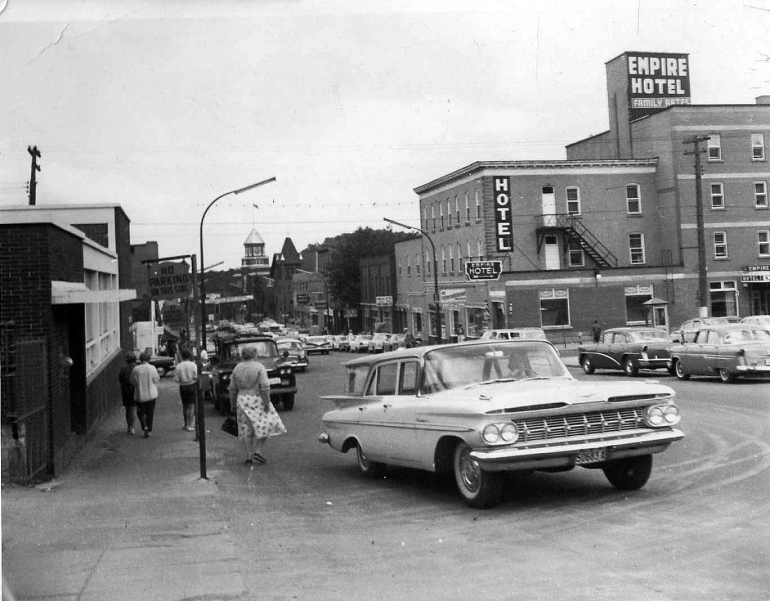
[Next column] Huntsville, Ontario, circa 1960. The Empire Hotel, 1 Main Street East, was built in 1947. The hotel was refurbished and turned into an apartment block but was gutted by fire in 2009 and torn down the following year. (Source: Side Roads of Muskoka: History Revealed.)
The girl later testified that she was staying with a friend in Oshawa on the night of the murder. At about 10:30 p.m.the killer called her saying that he was coming to pick her up. He arrived with his accomplice at about 3 o'clock in the morning but instead of going directly to Elk Lake they headed back in the direction of Huntsville. They did not go into town but drove along a bush trail and stopped. Here the killer and accomplice left the girl in the car for 20 minutes to half an hour.
She also told how the car got stuck and how they were helped by the men from the construction crew. The three travelled in the taxi for days, sleeping in barns. After they abandoned the cab she and the killer spent four days on the Montreal River, travellling by night and sleeping on the shore. She said that the killer was the leader and made all the decisions for the trio.
In exchange for his testimony the accomplice was allowed to plead guilty to manslaughter and was sentenced to 15 years in prison. A psychiatric assessment concluded that he had limited mental capacity and was easily led. The girl was not charged.
The killer claimed that the murder weapon belonged to Mr. Spiers and that he shot the victim in self-defence while they struggled for the gun. The jury rejected his story and convicted him of both murders. He was sentenced to death.
On hearing the verdict he angrily shouted "You call this justice?" and as he was leaving the court told his brother "I'll be back." An appeal to the Supreme Court of Canada was denied on February 8, 1960 and the killer was hanged on the following day.
Like Mr. Grosso and Mr. Spiers, the killer and his accomplice were well known in Huntsville and had family there. They and their victims knew one another.
While in prison the killer found religion. He willed his corneas to the Eye Bank of Canada and made a plea for the abolition of capital punishment. He also requested that his body be buried in the yard of the district jail at Parry Sound as a deterrent to other young men tempted by a life of crime.
The burial request was granted by jail officials and carried out immediately after the execution. This provoked anger in Parry Sound, especially since the killer had no connection with the town. The mayor of Parry Sound wrote a letter of protest to the Minister of Justice on behalf of the town council.