• Driver Profiles
David Wayne Krick Kingston, Ontario / July 17, 2007 Like many other taxi companies, Kingston's Amey's taxi has divided its service area into several geographic zones. Trips originating inside a zone are dispatched to taxis that are actually located in that zone. The object of the zone system is to encourage drivers to spread out over the service area to provide a reasonably uniform level of service to customers anywhere in town.
At 6:30 a.m. on Sunday, June 17, 2007 -- Father's Day -- David Krick was the second car in 7 zone, waiting for a call from dispatcher Ken Osborn. Krick, 50, loved taxi driving and had done it since he was 19 years old. A couple of months earlier he had taken a job with an auto parts firm but he continued to drive on weekends.
Unmarried, he lived with his mother Shirley. His brother, sister-in-law, nephew and niece made up the rest of his close family. Mr. Krick was tall and thin -- he was over six feet but weighed only 140 pounds -- and in Shirley's words "wasn't a fighter".
The man in the number one car in 7 zone that morning was a cab owner filling in for one of his drivers.
"Having driven Taxi in the same city I knew Dave fairly well," he later wrote to the taxidriver.ca web site. "He was a very reliable worker who you always knew would show up. He loved to play golf and enjoyed playing darts once the golf season ended."
The number one driver soon saw an opportunity to move out of 7 zone. "I saw that 5 zone was open and I moved to #1 on 5 zone which is a busier zone. That moved Dave up to #1 on 7 zone. I received a call right away and it went to Verona for $50. As I was driving I was thinking how lucky I was that I moved and got a $50 call. About 10 min into the trip I saw the emergency call on our gps system. It was not until after I got back to town that I heard Dave had been killed. I quickly realized that if I had not moved to 5 zone it would have been me that would have taken the fare."
At 6:33 a.m., about the same time as the 5 zone driver got his trip, Mr. Krick responded to a 7 zone call to pick up a single male passenger on Wright Crescent, near the Kingston YMCA.
Something apparently went wrong right from the beginning. It should have taken him only a couple of minutes to get to the pickup point but it was 6:44 a.m. -- 11 minutes later -- before Mr. Krick turned on his meter. "They could tell by looking at the trip on the gps that it had taken a very long time to go only a few blocks," wrote the 5 zone driver. "I feel that an argument or discussion must have been going on for a while."
At 6:45 Mr. Krick hit the dashboard alarm button that Amey's had installed on all company cabs a year earlier. Ken Osborn saw a flashing emergency message on his computer screen. Residents on Durham Street heard shouts for help and the squealing of tires as Mr. Krick's white 2007 Impala sped away.
Mr. Krick had suffered 31 stab wounds, nine of which were serious enough to be fatal. Nevertheless, he managed to call Kingston police on his cell phone, giving them his name and cab number before he lost consciousness. Mr. Osborn had just sent out an alert to other drivers about a cab in trouble when he received a call from Kingston police dispatch asking for Mr. Krick's whereabouts.
Mr. Osborn looked up the GPS record for Mr. Krick's cab and saw it suddenly start moving again. He monitored the cab's progress and relayed it to the police.
Police cars and taxis raced to Wright Crescent. Amey's driver Michael J. Hartson was the first to spot Mr. Krick, who was lying partly on the south side of Durham Street, just south of Princess Street. He was partly on the sidewalk and partly on the lawn of a white bungalow with his head toward the curb. He was in a fetal position with one arm extended, holding a cell phone.
As Mr. Hartson approached the phone rang. It was Kingston police dispatch, asking for his name and location. Before Mr. Hartson could answer police cars rounded the corner.
While Constable John Stanistreet carried out chest compressions on Mr. Krick, Amey's driver Shelley Scott applied mouth-to-mouth resuscitation. "I was doing what I could to help," she said. "It seemed like forever, but I bet it was only a couple of seconds, or a minute or something, and the ambulance arrived and [paramedics] took over." Mr. Krick was rushed to Kingston General Hospital where he was pronounced dead.
Meanwhile, with Mr. Osborn watching on his computer screen, the suspect drove south, north and west along various streets before heading toward the An Clachan apartment complex eight blocks away.
Constable Mike Campbell was on his way to Wright Crescent but diverted to the apartment complex when he heard that Mr. Krick might be there. As he pulled into the An Clachan parking lot just ahead of Constable Lester Tang, he heard Constable Tang radio that he was in pursuit of a suspect. Constable Tang had spotted a white male, aged 20 to 30, crouching next to Mr. Krick's cab. The man started running before the police cars came to a stop.
Both police officers gave chase but lost him in the labyrinth of low-rise buildings. The area was quickly cordoned off but the suspect managed to elude capture.
Police and taxi drivers immediately began patrolling the area where the suspect was last seen. At around 7:30 a.m. Amey's driver Jai Scouten spotted a man who, except for his clothing, resembled the description provided by Constables Campbell and Tang. He was walking along Palace Road near Wright Crescent.
Mr. Scouten became suspicious when he drove by the man three times and the man avoided looking back at him. When Mr. Scouten pulled over to talk to him, the man seemed a little too forthcoming in explaining what he was doing there. He claimed that he had just returned from an employer's home on Wright Crescent.where he had asked about upcoming work.
Police later interviewed the employer who said he was not at home on Sunday morning and did not talk to the suspect. The suspect, however, later told him that he had "dropped by" to ask about work. The employer said this was odd because the man had never done this before. Nevertheless the employer liked and believed him. The two sometimes smoked cocaine-laced cigarettes together.
Mr. Scouten met Constable Edward Gaulton a little further down Palace Road and pointed out the suspect. Constable Gaulton questioned the man at 7:43 a.m. and found his story unconvincing but let him go because there were no grounds to arrest him.
Nevertheless it was decided to question the suspect further. He was not home when police came to see him on the afternoon of the murder so they came back at midnight hoping to "wake somebody up."
The police banged on the door and shone flashlights through windows but were unable to rouse anyone. They were on the point of leaving when they were approached by a resident of the neigbhouring apartment block. He and his wife lived in a top floor apartment overlooking the suspect's house and earlier in the evening they had noticed a man in the bathroom apparently burning strips of fabric.
The officers at the scene kept watch until reinforcments arrived. When there was still no answer to their knocking one of the officers attempted to kick in the door, at which point the suspect's girlfriend opened it. Officers noticed a haze of smoke in the air and retrieved bits of burned fabric from the toilet and bathroom sink. Some of the fibres were later identified as denim. The man who fled from Mr. Krick's taxi was described as wearing blue jeans.
The suspect had been on parole since 2005 from a four-year, eight month sentence he received in 2003. He had randomly kidnapped a woman at knifepoint from a doughnut shop parking lot, forced her to perform oral sex and then forced her to withdraw money from an ATM.
At the time of Mr. Krick's murder the suspect was one of three "persons of interest" under investigation. Police were not yet ready to charge anyone and therefore had no grounds for making an arrest. The man continued to go free until August 1, when he was imprisoned for violating the conditions of his parole. His sentence was to expire in November.
David Krick's funeral took place on Friday, June 22. Most of Kingston's taxi drivers joined the funeral procession. One of them was the driver who moved from 7 zone to 5 zone on the fatal morning:
"Almost all of Kingston's aprox 180 cabs were in the funeral procession that went about 5 km north of the city. When people see a funeral procession they don't always know who it is for, but in this case they all knew.
"Because of that, most of the cars pulled over and a lot of them got out of their cars and work vehicles and stood there for the full procession to go by. Most pedestrians stopped and a lot of people came out of their houses to watch. That was nice to see in a day and age where most people don't pull over for funerals. Most understood the violent way in which he died and felt the family's pain."
One of Mr. Krick's regular passengers posted her condolences on the Whig-Standard web site:
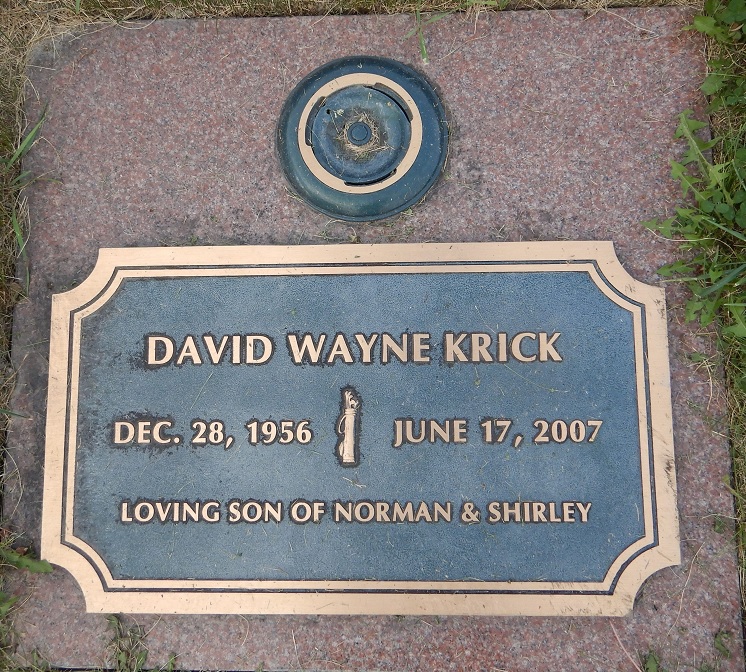
[Next column] David Krick's grave stone in Glenhave Memorial Gardens, Kingston Ontario. Photo by Barbara G37. (Source: Find a Grave.)
"I have taken a taxi for many of the years David has driven. Every time he picked me up, he remembered who I was, asked with deep concern how my health was holding up. He was a great listener and as I left the car, he always gave my hand a gentle squeeze as he wished me a better lot in life. I left that cab every time with a smile. Knowing him was a pleasure and I will miss him. I wish strength and love during this hard time for his family and friends."
As far as anyone could remember, Mr. Krick was the first Kingston taxi driver to be killed on the job. His death sent shock waves through Kingston and brought the issue of taxi driver safety onto the front pages. Newspaper articles reviewed recent taxi robberies and attacks, reported on safety measures instituted in other cities and interviewed drivers for their ideas and opinions on the subject.
At its regular meeting on June 27 the Kingston Area Taxi Commission formed a special 12-member subcommittee to deal with the safety issue and to come up with proposals by mid-August. The subcommittee included the owners of the three largest Kingston taxi companies and six other owner-drivers. It scheduled a public meeting on July 9 to discuss shields, cameras and other options.
In August Amey's Taxi and Wisky Willy's restaurant held a fund-raising benefit for Shirley Krick, but otherwise there was little news about the murder. Police were unable to report any progress during July, August and September. Tips had completely dried up.
Nevertheless police continued to work the case out of the public eye, questioning the suspect's friends and acquaintances. One of these was a female cocaine addict who was serving time in the Quinte Detention Centre for a parole violation. Two Kingston police officers visited her in jail but she could not give them any useful information.
At the end of July, however, the woman was released and immediately went looking for cocaine. She wound up at a Joseph Street apartment where she renewed her acquaintance with the suspect. She later said that when she entered the apartment the suspect and some other men were evidently talking about the murder of Mr. Krick. They stopped talking when she arrived but later, when she and the suspect were alone, he bragged about the stabbing as a way of impressing her.
The woman thought that their drug binge lasted for as long as four days before they ran out of cocaine and she went home. When she woke up a day later she felt compelled to report the confession but was afraid to call police because she would have had to confess to yet another parole violation.
Instead, on July 30, she phoned Amey's taxi anonymously and told Brian Nesbit, who was taking calls, that she knew who Mr. Krick's killer was. She could provide only the suspect's first name and last initial and she did not know the address of the Joseph Street apartment. She could only describe the location in terms of landmarks.
Mr. Nesbit wrote down the information and passed it on to Amey's owner Mark Greenwood who called the Kingston police. The police logged the tip but, ironically, seem not to have pursued it.
In August the police interviewed one more of the suspect's acquaintances, the owner of the Joseph Street apartment. He identified the same woman as the suspect's friend and fellow addict. She left Kingston soon after making her anonymous call to Amey's, but police tracked her to Nova Scotia and finally learned of the suspect's alleged confession. The suspect, who was still in jail for his own parole violation, was formally charged with Mr. Krick's murder on October 11, 2007.
The arrest coincided with a campaign launched by Mr. Krick's fellow drivers to refocus public attention on the case and to prod the memories or consciences of anyone with information. Kingston cabs began displaying black, white and yellow bumper stickers with David Krick's name, his birth and death date, his cab number (71) and the epitaph "Let his spirit ride with you." The sticker was designed by Mr. Krick's family.
At a the news conference held to announce the arrest police chief Bill Closs "sounded off on the high price citizens pay in a city that houses so many prisons." (Kingston and Collins Bay penitentiaries and Millhaven, Bath, Joyceville and Pittsburgh penal institutions are all located in the Kingston vicinity.)
"I believe David Krick would be alive today if Kingston were not the prison capital of Canada. David would be alive today if Corrections Canada could better rehabilitate people, if Canada did not have a revolving door leading in and out of the criminal justice system and David Krick would be alive today if Kingston Police could monitor every violent offender 24 hours a day, seven days a week. That is the cost of prisons to all of us who live in Kingston.... It cost David Krick his life. It cost his family a son, a brother, [an uncle]. It cost the taxi industry a friend and employee. It cost my police department 4,500 staff hours. It has cost Kingston taxpayers just under $200,000 with more to come."
It took three more years for the case to reach a courtroom. The trial lasted a month, from October 12 to November 12, 2010.
The Crown's case was hampered by a lack of forensic evidence. All the blood evidence came from Mr. Krick himself and none from his assailant. There were no usable fingerprints retrieved from the cab -- not from the suspect and not even from Mr. Krick. As retired Ontario Provincial Police forensic analyst Norman Sneddon ruefully told the jury, "I wish it was like on TV, but it's not. The surfaces of a vehicle are not very good for fingerprint identification."
Two knives were found, one near Mr. Krick's body and the other near the front entrance of the apartment complex in which the suspect evaded capture. Both were consistent with Mr. Krick's wounds, but neither could be positively linked to the murder or to the suspect.
Witnesses testified to the fact that the suspect frequented the vicinity of the murder, but nobody could place him at the scene at the time.
The key witness was the woman who reported the suspect's confession. Although she claimed she was now free of drugs for three years, she admitted to being severely addicted at the time of the murder.
The other important witness was Constable Lester Tang, who saw the suspect clearly for only a second or two and failed to identify him in court at the preliminary hearing in October, 2007.
After deliberating for a day and a half, the jury concluded that there was reasonable doubt and brought in a verdict of acquittal.
Lead investigator Detective Bill Kennedy announced that he was "absolutely disgusted" the verdict and, turning to the suspect, said "Go out and do it again!"
After his acquittal the suspect moved to Hamilton, his hometown. At about 12:30 a.m. on Saturday, August 23, 2013, after a night of drinking, the suspect was ejected from a bar after "multiple disturbances" with patrons and staff. He then walked to a parking lot where four taxi drivers were waiting for fares and began threatening them with a knife.
One of the drivers, Naseem Tahir, took refuge in his cab but it wouldn't start. The suspect attacked him through the open driver's window, slashing Mr. Tahir's wrist. When Mr. Tahir slid over to the passenger seat, the suspect slashed his leg. The wounds were not severe and Mr. Tahir was treated at the scene.
When the other drivers came to Mr. Tahir's assistance the suspect ran away. Police found him hiding in a bush about 1:30 a.m., "belligerent, aggressive and swearing."
In November the suspect was found guilty of attacking Mr. Tahir and was sentenced to 15 months, less three months already spent in custody.
Mr.Tahir was not in court for the sentencing but a fellow cab driver, Asif Abbas, called the sentence "a joke".