• Driver Profiles
Donald Lanthier Sault Ste. Marie, Ontario / June 30, 1978 Donald Lanthier, 24, drove off and on for Steel City Cabs after he was laid off his job at the Algoma Steel plant in February, 1978. He lived with his parents and four younger siblings, two brothers and two sisters.
Mr. Lanthier was targeted for revenge when he dated the former girlfriend of a ruthless killer and aroused the man's murderous jealousy.
Three men were eventually convicted of murder for killing Mr. Lanthier: the jealous former boyfriend, aged 22, who strangled Mr. Lanthier with a wire garrote and stabbed him nine times in the chest with a hunting knife; an accomplice, aged 20, who claimed he was coerced into stabbing Mr. Lanthier four times with a small steak knife; and an accessory, aged 23, who was not present at the scene but who was convicted for his part in planning and abetting the murder.
At about 11:45 p.m. on June 29, 1978, a man called Steel City Cabs and asked if cab number six was working. When 16-year-old dispatcher Shirley Lewis said it was, the man asked for the cab to be sent to the White Eagle Club on Goulais Avenue. Ms Lewis asked for the caller's name but the man hung up. The call came from a phone booth on the street outside the club.
Ms Lewis relayed the message to Mr. Lanthier who was parked on the company's cab stand. A few minutes later he called back to say that he was taking a fare from the White Eagle to 239 Third Line East.
At this point Ms Lewis finished her shift and was relieved by Marian Taylor-Bailey, 20. When Mr. Lanthier hadn't called in by 1 a.m. Ms Taylor-Bailey became concerned and asked another driver, Pete Gavin, to look for him.
Mr. Gavin searched along Third Line East but saw no sign of Mr. Lanthier or his cab. He knocked on the door of 237 Third Line and the woman who answered told him that there was no such address as 239. Mr. Gavin reported this to Ms Taylor-Bailey and told her "You better call in help."
Ms Taylor-Baily notified the company manager and then called the police. By now it was well after 2 a.m.
As police were searching along Third Line East at about 3 a.m., officers in a patrol car caught a glimpse of a small light at the bottom of a ravine formed by a creek running beside the road. When they shined a spotlight into the ravine they discovered Mr. Lanthier's cab. The cab's interior and meter lights were still on.
When no trace of Mr. Lanthier was found near the cab the Search and Rescue unit was called in. Four hours later, about 7 a.m., they discovered Mr. Lanthier's body in a small gully behind a vacant house on Third Line East.
Evidence showed that the cab was parked in the driveway of the vacant house when Mr. Lanthier was strangled and stabbed. His body was dragged to the gully after which the cab was driven to the ravine and pushed in. Footprints indicated that two people were involved in the murder.
The autopsy revealed that Mr. Lanthier had been stabbed twelve times in the chest with one wound penetrating his heart.
Cut marks in his shirt showed that two knives were used in the attack. Nine of the wounds were made by knife blade 1.25 inches (3.8 cm) wide, while three were made with a smaller blade 1/4 inch (.6 cm) wide. The small knife had made another wound in Mr. Lanthier's upper thigh.
Ligature marks in Mr. Lanthier's throat and neck showed that he had struggled desperately before he died. The medical examiner thought Mr. Lanthier was unconscious when he was stabbed.
A witness passing by the White Eagle Club shortly before midnight reported seeing two males, possibly Indigenous, between the ages of 18 and 25 in the back seat of Mr. Lanthier's cab at the time he picked up his fare. This remained the only real clue that turned up during the following month.
Five days after the murder the Sault Ste. Marie police commission authorized a $1,000 reward for information leading to the arrest and conviction of Mr. Lanthier's killers, the first time in memory that such a reward was offered. A group of local citizens added another $1,000 soon afterward.
When the reward was announced one of the investigating officers said that police had not yet hit a dead end "but we are running out of leads." Unfortunately the reward failed result in any arrests.
Police had, however, received tips about people who might know something about the murder and when one of them was arrested on an unrelated charge at the beginning of August, he immediately came under scrutiny.
The man had a month-old cut on his arm and explained that he sustained it during a game in which he and a friend tossed knives back and forth. Police questioned the friend who denied being with the suspect.
When Detective Paul Doiron confronted the prisoner with his friend's denial and then asked him about Mr. Lanthier, the man spontaneously confessed that he was cut accidently during Mr. Lanthier's murder and that his friend was the jealous former boyfriend who garrotted and stabbed the cab driver.
The man claimed he was coerced by the killer into stabbing the victim with a small steak knife. "If I didn't do it, I knew I wasn't going to walk away either." He also stabbed Mr. Lanthier in the thigh to prevent him from driving away.
Up to that point in the investigation neither man was a murder suspect. Detective Doiron said he was "quite surprised" by the sudden confession.
The accomplice made a detailed statement decribing how the murder was carried out. He had understood that the original plan was to have a cab driver take them to Nettleton's Lake, just north of Sault Ste. Marie at the end of Goulais Avenue and about ten kilometres (six miles) from the White Eagle Club.
The accomplice said he was surprised when the killer directed Mr. Lanthier to Third Line East instead of Nettleton's Lake. When they got to the vacant house, Mr. Lanthier asked for the fare and the accomplice said he would have to go to the house to get the money.
The accomplice said he loitered outside the house for about five minutes and that when he returned to the car the killer was strangling Mr. Lanthier with nunchaku sticks (two sticks connected at one end by a length of wire).
The accomplice also accompanied detectives to the crime scene and described how Mr. Lanthier had been killed, confirming what police had deduced from the evidence.
The accomplice later repudiated his signed statement, claiming that he didn't remember making it. Nevertheless the statement led to the arrest of the other two suspects.
Here Detective Doiron and his fellow investigators got another surprise: all three men were in police custody on the day after Mr. Lanthier's murder.
On June 30 police were called to an apartment where half a dozen young men, including the three suspects, were involved in a drunken brawl. Everyone in the apartment was taken to the police station for questioning and one of them, the accessory who was later charged with helping plan Mr. Lanthier's murder, was convicted of assault causing bodily harm for hitting another man over the head with a heavy glass mug.
In the month between Mr. Lanthier's murder and the arrests the killers had had plenty of time to dispose of physical evidence. However as police began questioning their circle of acquaintances, people who had been silenced by fear or guilt began, sometimes reluctantly, to tell what they knew.
A girlfriend of the accomplice told of washing blood out of his clothes, and revealed that she and another woman retrieved a hunting knife that the killer had abandoned in the apartment when police arrived to investigate the brawl.
In all, the evidence was strong enough that the killer and his accomplice, faced with first-degree murder charges, both acknowledged killing Mr. Lanthier. However all three accused claimed that Mr. Lanthier's death was an unforeseen and unintended result of a "plain armed robbery." There had been no plan or conspiracy targeting the victim, they said.
The killer also denied having garrotted and stabbed Mr. Lanthier, blaming the murder on his accomplice who he said panicked during the robbery.
The Crown had little difficulty convincing the jury that Mr. Lanthier had been targeted for death. Why, if only a "plain armed robbery" was intended, had Mr. Lanthier had been personally called to the White Eagle, and why he hadn't been robbed there instead of being directed to a remote murder scene?
The killer admitted to wearing gloves so as not to leave fingerprints (although his palm print was found on the trunk of the cab) and that he had hidden his face while riding in the cab to prevent witnesses from recognizing him. Yet he made no attempt to conceal his identity from Mr. Lanthier.
The killer claimed that he did not know Mr. Lanthier, but his former girlfriend testified that he had seen her with Mr. Lanthier at a party. Another witness testified that the killer talked about Mr. Lanthier's relationship with his former girlfriend and vowed to "fix" Mr. Lanthier or "do him in."
Meanwhile the accessory claimed he was completely uninvolved in Mr. Lanthier's murder and that when it took place he was miles away at Nettleton's Lake fishing with his 20-year-old brother-in-law.
The brother-in-law confirmed the alibi, but he also divulged information that cast a dubious light on the accessory's innocence. The killer and the accomplice were both at the accessory's residence shortly before the murder and the brother-in-law and the accessory dropped them off near the White Eagle Club on their way to Nettleton's Lake.
As the foursome parted company, the killer told the accessory, "We'll see you in 15 minutes." The brother-in-law asked what this meant and the accessory told him that the killer and the accomplice were going to rob a cab and meet them at Nettleton's Lake, "but nobody is going to get hurt."
The remark tied in with the accomplice's understanding that the original plan was for a taxi driver to be robbed and/or killed at Nettleton's Lake and for the the accessory and the brother-in-law to meet the killers there and bring them back to town.
Both the brother-in-law and the accomplice stated that the accessory had supplied the killer with Mr. Lanthier's cab number, enabling him to lure Mr. Lanthier to the White Eagle Club. The court also heard testimony that the accessory had recruited the accomplice to help the killer with the robbery.
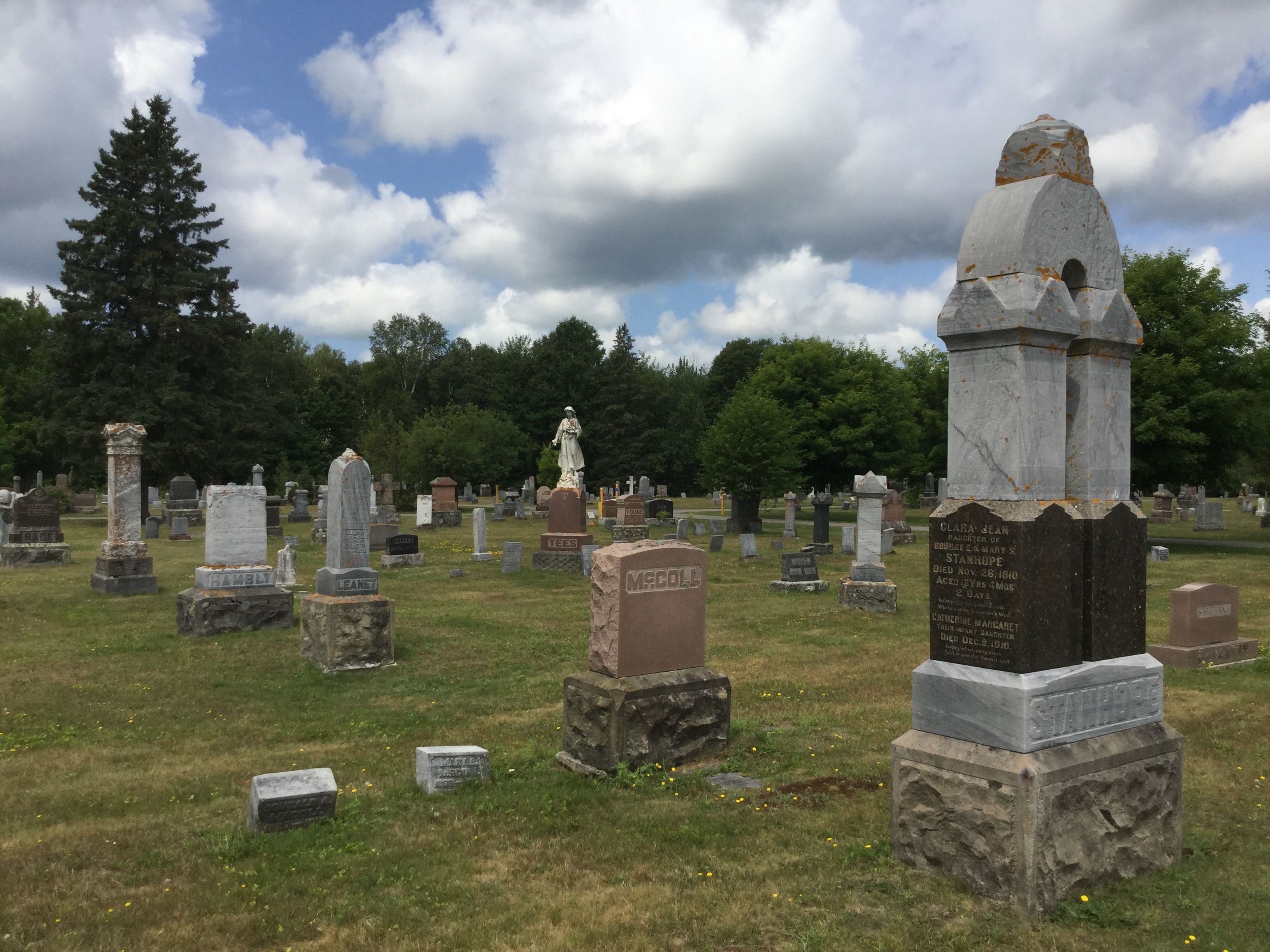
[Next column] Donald Lanthier is buried in Greenwood Cemetery, Sault Ste. Marie. (Source: Find a Grave)
The brother-in-law also testified that on the day of the murder he took the killer and the accessory for a drive that took them along Third Line East. The killer remarked that the ravine would be "a good place to ditch something." When the brother-in-law asked what this meant the accessory said he was planning to steal a car in Toronto and ditch it.
The brother-in-law and the accessory did little or no fishing at Nettleton's Lake and after driving around for about three hours they met up with the killer and his accomplice at the apartment of a female friend. Here the brother-in-law heard the killer say that "the cab driver gave up his life for a lousy $15." This was the amount of money the killer and accomplice found on Mr. Lanthier's body.
When the brother-in-law later asked the killer about Mr. Lanthier's death, the killer acknowledged murdering him and threatened to kill the brother-in-law's wife and children if he didn't keep his mouth shut. When the brother-in-law asked the accessory what would happen if he went to the police, the accessory said he could do what he wanted, but the killer "might keep his promise."
When they were first arrested, the killer and the accessory were placed separate jail cells with solid metal walls. A police officer was concealed in a third cell between them and made notes of their conversation which revealed how closely they were associated in the murder.
Among other things they talked of coordinating their testimony to absolve the accessory, getting rid of the accomplice and the brother-in-law, and escaping from jail by disarming and handcuffing a police officer.
The jury was convinced that the killer murdered Mr. Lanthier deliberately and convicted him of first-degree murder. He was sentenced to life imprisonment with no parole eligibility for 25 years.
Although the accomplice was the one who called Steel City Cabs, the jury was not convinced that he was involved in the murder plot. He was convicted of second-degree murder and sentenced to life imprisonment with no parole eligibility for ten years.
On the other hand the jury was convinced that the accessory was deeply involved planning and abetting Mr. Lanthier's death and convicted him of second-degree murder. He too was sentenced to life imprisonment with no parole eligibility for ten years.
All three accused appealed their convictions. In December, 1981 the appeals of the killer and the accomplice were dismissed, but the accessory was granted a new trial.
A second jury heard the same evidence and came to the same verdict. In September, 1982, the accessory was once again found guilty of second-degree murder and his sentence of life without parole eligibility for ten years was confirmed. His appeal of this sentence was dismissed by the Ontario Court of Appeal in September, 1984 and leave to appeal to the Supreme Court of Canada was refused in February, 1985.
Twenty years after the first trial the killer, now 46, applied for early parole under Canada's so-called "faint hope clause," (Section 745.6 of the Criminal Code, Revised Statutes of Canada 1985, chapter 46). The clause allows anyone convicted of first-degree murder to apply for early parole providing they have served at least 15 years of their sentence. The application must be approved by a jury at a public hearing. The killer's emotional week-long hearing took place in September, 1999.
During his 20 years in prison he committed 30 "serious" infractions, but none involving violence. In June, 1997 he was assessed as a "public safety risk" and in 1998 while in medium-security Collins Bay Institution he was caught making a knife, allegedly for friend whose life was in danger. This, plus a refusal to give a urine sample and verbal abuse to staff caused his transfer back to maximum-security Millhaven.
After his return to Millhaven he began for the first time to participate in prison rehabilitation programs designed to transition offenders through medium and minimum security institutions to eventual parole.
The killer expressed remorse and apologized to Mr. Lanthier's family. Referring to how he dealt with "Donald Lanthier's ghost in my head" he said "I've sort of adopted him like a family member. I like to think he's up there with my parents and grandparents."
After deliberating for a day, the jury granted permission for the early parole application and recommended that the killer be eligible for parole in 2002, a year earlier than the eligibility mandated by his first degree murder sentence.
Meanwhile, the accessory was released on parole after serving nine years rather than the mandated minimum of ten. He still insisted on his innocence and began a decades-long public campaign to be exonerated, or at least pardoned, and be freed from supervision by a parole officer.
The campaign attracted considerable support from journalists, social justice advocates and politicians. Parliament was presented with a petition containing 2,000 signatures demanding that the accessory's conviction be reviewed.
The accessory based his claim to innocence on the undisputed fact that he did not participate directly in the murder, on his assertion that all the testimony regarding his involvement in planning and facilitating the murder was perjured, and on his belief that the jury accepted the Crown's theory of his role in the murder because they were blinded by racism (the accessory was Indigenous and all the members of both juries were white).
The cornerstone of his argument, however, was that the section of the Criminal Code under which he claimed to have been convicted was struck down by the Supreme Court of Canada in 1987. Had Mr. Lanthier's murder occurred subsequent to this ruling, he argued, the Crown could not have brought charges against the him, much less won a conviction.
The offending section of the Criminal Code was section 213 in the Revised Statutes of Canada 1970, chapter 34, reenacted as section 230 in RSC 1985, chapter 46. Parts of the section were struck down by the Supreme Court of Canada in 1987 and 1990 but though a dead letter, it was not finally repealed until 2019.
Section 213 / 230 incorporated a widely adopted principle of law called the felony murder rule which held that any death caused by a offender in the course of a robbery or other felony, even unintentionally or accidently, is murder. The covering rationale is that the offender "ought to have known" that his or her action would likely result in death.
The felony murder rule has been controversial ever since it was first articulated by the British jurist Sir Edward Coke (1552-1634) because it automatically made anyone who was guilty of such a felony also guilty of murder without the need to prove criminal intent. In essence it put a reverse onus on the accused to prove themselves innocent.
Prior to 1981 the Parliament of Canada had full authority over criminal law and section 213 / 230, incorporating the felony murder rule, was the law of the land because Parliament said so.
This is still the case in other jurisdictions. For example, in the U.S. where authority over criminal law belongs to the individual state legislatures, 46 out of 50 states retained the felony murder rule as late as 2008. (Wikipedia).
In Canada everything changed in 1981 with the enactment of the Canadian Charter of Rights and Freedoms. Parliament and the provincial legislatures are now required to respect the principles set forth in the Charter and provincial and federal courts have the authority to determine if legislation is in accordance with the Charter.
The first appeal case that partially overturned Section 213 / 230 was Regina v. Vaillancourt in 1987 (the case cited by the accessory in his claim to innocence). The accused, Vaillancourt, was convicted of murder when his accomplice shot and killed a man in a struggle during the robbery of a pool hall.
The Crown never alleged that Vaillancourt himself was involved in the shooting. He was armed with a knife and in fact, when he discovered prior to the robbery that his accomplice had a gun, he confiscated what he thought were all the bullets. He was convicted of murder under Section 213 / 230 simply because he was present when a death occurred.
The Supreme Court ruled that Vaillancourt's mere participation in the robbery was not enough to justify the murder charge, and that it was up to the Crown to prove criminal intent and complicity. The Court cited Section 7 of the Charter which states that nobody can be deprived of life, liberty and security of person "except in accordance with fundemental justice," and Section 11(d) which states that everyone must be presumed innocent until proven guilty in a court of law.
In Mr. Lanthier's murder the question is this: was the accessory convicted of second degree murder solely because of the felony murder rule in Section 213 / 230? Or was he also convicted, on evidence, of being a party to murder under Section 21 of the Criminal Code? Section 21 (RSC 1970 chapter 34 and RSC 1985 chapter 46) states that anyone who aids or abets another in the commission of an offence is a party to that offence.
In both of the accessory's trials the Crown Attorney referred to Section 213 / 230, suggesting that even if the accessory had only aided and abetted an armed robbery he "ought to have known" Mr. Lanthier's death would likely result.
However, the Crown Attorney also presented considerable evidence pointing to the accessory's involvement before and after Mr. Lanthier's murder. Enough evidence, that is, to convince two separate juries.
This, presumably is why federal Justice Minister Jody Wilson-Raybould stated in October, 2016 that the accessory's case had been reviewed and that "although there was a change in the law, that change did not serve to exonerate him."