• Driver Profiles
René Lapointe Montréal, Québec / May 19, 1968 In 1968 the borough of Saint-Léonard on the Island of Montréal was an independent municipality. It was amalgamated with the city of Montréal in 2002.
At about three o'clock in the morning of Sunday, May 19, 1968 two Saint-Léonard patrol officers, Pierre Leclerc and Claude Pigeon, saw a Métropole taxi parked crosswise on Rue Pascal-Gagnon. As they approached, a 17-year-old youth exited the taxi and took off running.
Officer Leclerc sprinted after the fugitive and quickly chased him down. Meanwhile officer Pigeon investigated the taxi and found the driver, 51-year-old René Lapointe, bleeding from multiple stab wounds.
The victim was rushed to hospital but was pronounced dead on arrival. He was the father of four children.
The murder weapon, a Boy Scout knife, was found about 100 feet (30 metres) from the cab.
The killer, who had $21 in bloodstained bills in his pocket, was the son of a well-to-do family in Saint-Léonard. He told police that he hailed Mr. Lapointe at La Ronde amusement park with the intention of robbing him.
When they got to Saint-Léonard he held the knife to Mr. Lapointe's neck and demanded his money. When Mr. Lapointe seemed to resist, the killer began stabbing him.
The autopsy revealed that Mr. Lapointe had been stabbed 19 times, six of the wounds penetrating his heart.
At the coroner's inquest on May 10, the defence lawyer, Paul Aubut, instructed his client not to say anything in court although the Coroner's Act required him to give testimony or face a jail term.
Mr. Arbut objected to this provision, declaring that it forced the accused to testify against himself even though the testimony could not be used against him in court.
When coroner Laurin Lapointe threatened to find both Mr. Aubut and his client in contempt, Mr. Aubut retorted "So send me to prison."
Nevertheless the killer seemed happy to make a statement. "Grinning from ear to ear," he told how Mr. Lapointe "made a sudden movement and I hit him... he went down holding onto me and I hit him again and again and again."
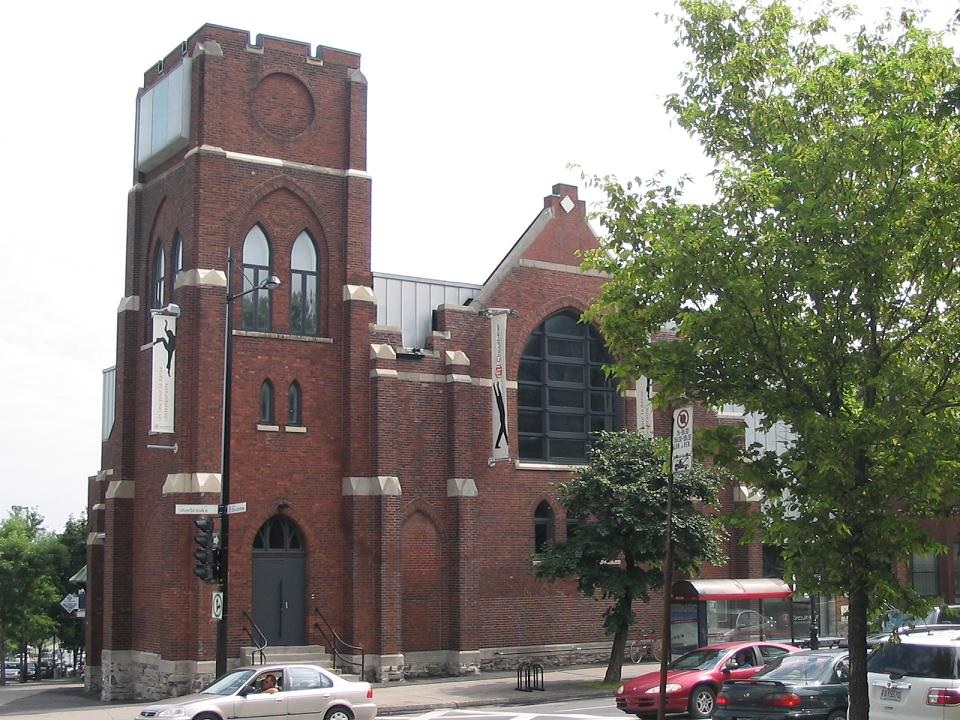
On the same day as the inquest, Mr. Lapointe's funeral took place at Saint-Robert-Bellarmin church.
Responding to a call from the Comité d'entraide des chauffeurs de taxi de Montréal (Montréal Taxi Drivers Self-Help Committee), more than 2,000 taxi drivers showed up at the church, ostensibly to pay their respects and protest Mr. Lapointe's murder.
Police estimated that at one point 2,300 cars jammed the streets surrounding the church, bringing traffic to a standstill.
[Next column] Saint-Robert-Bellarmin church where René Lapointe's funeral took place. Over 2,000 taxi drivers showed up to pay their respects and to protest both his murder and the evils of the Montréal taxi industry, paralysing traffic in the surrounding streets. (Source: Originis, "Montréal: Saint-Robert-Bellarmin.")
The demonstration had a political motive beyond Mr. Lapointe's death. The self-help committee was formed in 1966 by a group of Montréal taxi drivers. They were led by Germain Archambault, himself a driver and the author of Le Taxi: Métier de Crève-faim (Taxi Driving: Career of Starvation), a book that denounced the exploitative conditions under which drivers were forced to work.
By 1969 the committee had evolved into the Mouvement de Libération du Taxi, a radical organization that quickly allied itself to other social and political protest movements in Québec.
The MLT's hostility focused on the airport monopoly enjoyed by the Murray-Hill company, which operated buses and limousines. MLT sympathizers began vandalizing Murray-Hill vehicles and on October 7, 1969, during a strike by Montréal police, they attacked the Murray-Hill garage and burned it to the ground. During the attack one of the rioters was shot to death.
After a psychiatric examination Mr. Lapointe's killer was declared fit to stand trial. His case was raised from Juvenile Court to Criminal Court where he faced trial as an adult.
In September, 1968, the killer pleaded guilty to murdering Mr. Lapointe and was sentenced to life imprisonment.
His lawyer announced that he would try to have his client sent to an institution that would provide psychiatric treatment in the hope that he would eventually be granted parole.