• Driver Profiles
René Raymond Bellefeuille, Québec / October 23, 1996 René Raymond was the third Taxi Saint-Jérôme driver to be murdered in eight years (the others were Claude Wilson and Fernand Lachance).
Mr. Raymond, 60, had driven taxi for 25 years and was one of the company directors. He had survived three robbery attempts in one year by bailing out of his cab and fleeing on foot.
Interviewed by a Montréal Gazette reporter at Fernand Lachance's funeral he declared that he wasn't going to give up his job for fear of "punks looking for a few easy dollars." I'll continue driving until retirement, he said.
After his wife's death in 1996 Mr. Raymond had met another woman and was now looking forward to retiring. He was the father of two children, one of them a daughter in her 20's.
A few minutes after midnight on October 22/23, 1998 Mr. Raymond answered a call from a phone booth in front of the Pâtisserie Maisonneuve at the corner of Ouimet and Fournier streets in Saint-Jérôme. Two young men aged 18 and 16 directed him to Roi street in nearby Bellefeuille.
The two killers later claimed that they had no intention of harming or robbing Mr. Raymond. They simply intended to skip without paying the fare, but when Mr. Raymond anticipated them by locking the cab doors they panicked.
The 16-year-old strangled Mr. Raymond from behind (the autopsy noted a cut on his throat) while the 18-year-old pummeled him with a cigarette lighter shaped like an antique pistol. Mr. Raymond received 27 severe wounds to the head though none of them were life-threatening. He died of strangulation.
During the struggle Mr. Raymond was pulled into the back seat. The killers' panic did not prevent them from going through Mr. Raymond's pockets where they found $189 in bills and change. They missed a further $267 in Mr. Raymond's shirt pocket.
Mr. Raymond was in the habit of accepting taxi coupons and vouchers from other drivers in exchange for cash which explains why he was carrying so much money.
After robbing Mr. Raymond the killers concealed his taxi in small wooded area near Roi street a few blocks from where the 18-year-old lived.
At about noon on the same day the two killers showed up at a high school. The 16-year-old gave a girl he knew several 20 dollar bills and told her to hide them and not tell anyone. Some time afterward the girl talked to the 18-year-old's girlfriend and learned that he had hinted about having committed a robbery. The girlfriend gave the first girl a roll of one-dollar coins that the 18-year-old had given her.
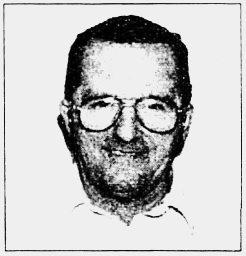
[Next column] René Raymond. (Source: La Presse, October 24, 1996, p. A3)
The first girl went to the local police station with her mother and turned in the money. Police subsequently brought in the two killers and the girlfriend for questioning.
Meanwhile a search had already begun for Mr. Raymond. The taxi dispatcher and fellow drivers had become alarmed when he failed to report himself clear after his last trip and called the St. Jérôme police. The Sûreté du Québec joined the search at about 9:30 a.m. with about 20 officers and a helicopter. It was the helicopter crew who found Mr. Raymond's car at about 3 p.m.
With the discovery of Mr. Raymond's body murder charges were laid against the two killers. The 16-year-old was the first person affected by a recent amendment to the Criminal Code that required juveniles charged with murder to be tried as adults unless it could be shown that juvenile court was a better option. However, based on reports from two psychologists, a psychiatrist and a social worker, the judge refused to refer the case to adult court.
Both killers were allowed to plead guilty to a reduced charge of involuntary homicide. The 16-year-old was sentenced to two years in prison followed by a year of "open custody".
The 18-year-old was sentenced to nine years and ten months, taking into account the 11 months he had spent in preventive detention.
Mr. Raymond's family were disappointed in the sentence, noting that the 18-year-old was likely to be released on parole in about three years.