• Driver Profiles
Conrad Ricard Trois Rivières, Québec / September 30, 1968 Conrad Ricard was the targeted victim of a personal vendetta.
On the cold afternoon of October 1, 1968 Clément Thibeault was in charge of a provincial work crew doing maintenance on Range Road Two near Sainte-Anne-de-la-Pérade, 38 km northeast of Trois Rivières and almost half way to Québec City.
The tractor his crew was using developed mechanical problems and Mr. Thibeault decided to have it driven to a local garage for repairs.
As he slowly followed the tractor in his truck, Mr. Thibeault noticed what appeared to be a piece of bright orange rag in the ditch along the road. It seemed so out of place that he stopped to investigate.
The "rag" turned out to be a sweater. The man wearing it was lying on his back, his face covered in blood, and obviously dead. An autopsy later revealed that the victim was shot in the head.
By the time Mr. Thibeault found a telephone and called the Sûreté du Québec at Sainte-Anne it was 3:30 p.m.
Bernard Blais was the first police officer on the scene. He went through the victim's pockets but there was no wallet or identification. Neither Mr. Thibeault nor his crew recognized the man.
Not far down the road the police found a 1965 model station wagon. The hood was up and the radiator cap was lying on top of the engine. There was no roof light or markings so it was not immediately evident that the car was a taxi.
It was soon determined that the car belonged to Mrs. Marguerite Laflamme of Cap-de-la-Madeleine, across the Saint-Maurice River from Trois-Rivières. She had reported it missing along with her driver, Conrad Ricard who had not returned from his last trip on the afternoon of September 30.
In their canvas of the vicinity police turned up several witnesses who described two men who they saw on foot a little after 4 p.m. on September 30 near where Mr. Ricard's body was found. From the descriptions a police officer in Trois Rivières recognized one of the men as a local towtruck driver.
Four years earlier the suspect was charged with stabbing another man in a shabby rooming house in Trois Rivières. The defence claimed that the stabbing victim was drunk on rubbing alcohol and simply fell on the suspect's knife, which the suspect claimed he used only to butter potroast. The large, double-edged knife was an unlikely cooking utensil but the suspect was acquitted nevertheless.
A few days before Mr. Ricard's body was found, the suspect was arrested for dangerous driving after colliding with another vehicle. He was aquitted of this charge as well, although the judge remarked that he had serious doubts about the suspect's claim that the collision was simply an accident.
Police were able to track the suspect down in Québec City at the Foyer Saint-Joseph, a hostel for unemployed men. He was placed in a lineup on October 7, 1968 and out of a dozen witnesses who claimed to have seen the two men near the murder scene, seven identified him positively as one of the men.
One witness claimed that he found the suspect hitchhiking on Range Road Two on September 30. The driver said the suspect seemed nervous and at one point rolled down his window and appeared to toss something into the ditch.
Pursuing this lead police spent a month and a half, between October 2 and November 15, clearing brush from a four-mile stretch of road by burning it. They went over the charred ground with two metal detectors borrowed from the Canadian Army but were unable to find the murder weapon.
A few hours after appearing in the lineup on October 7 the suspect broke his silence by giving a detailed version of what happened to Mr. Ricard. However, he refused to sign a statement and at trial repudiated his confession.
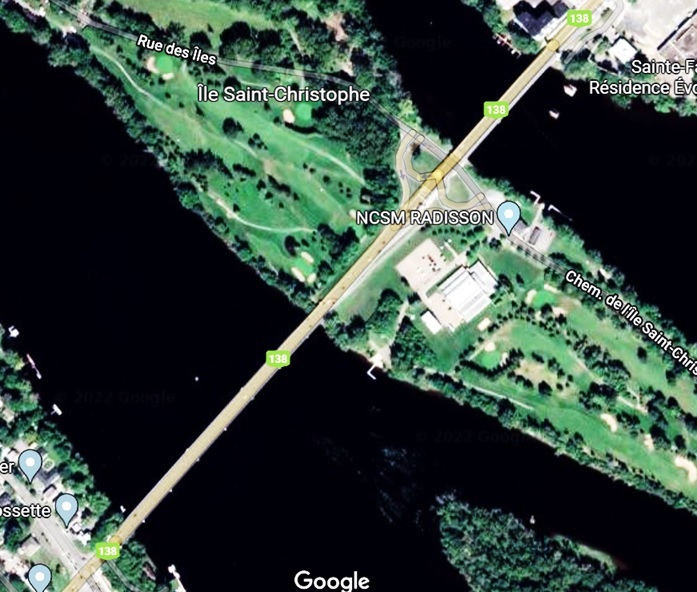
[Next column] Duplessis Bridge from Trois Rivières (lower left) to Cap-de-la-Madeleine (upper right). (Source: Google Maps)
According to the man's account, Mr. Ricard was a former friend but a year earlier, while attending a circus in Québec City, they got into a fight and Mr. Ricard beat him up in front of the suspect's friends. Ever since then he held a grudge against Mr. Ricard.
Aware that Mr. Ricard was a taxi driver, the suspect maintained vigil at the Cap-de-la-Madeleine side of the Duplessis Bridge from seven o'clock in the morning of September 30.
At about 4:30 in the afternoon (he said) Mr. Ricard drove by, crossing the bridge into Trois Rivières with a passenger. The suspect waited for Mr. Ricard's return and hailed him as he crossed back into Cap-de-la-Madeleine.
The suspect persuaded Mr. Ricard to drive him toward Sainte-Anne-de-la-Pérade, but before they got to his destination, wherever it was, the car overheated and Mr. Ricard pulled to the side of the road. As he cautiously removed the radiator cap a jet of steam erupted from the radiator which had boiled almost dry.
The men searched the ditches for water but could not find any. The suspect then told Mr. Ricard that he lived nearby and that he could use his tractor to tow Mr. Ricard's taxi to a garage. At this point Mr. Ricard stepped into a nearby bush to answer a call of nature.
By the time Mr. Ricard returned, the suspect had decided to confront him then and there. Calling him a "damned dog," the suspect said he was going to beat Mr. Ricard black and blue, just as Mr. Ricard had done to him the year before.
A fistfight ensued. Once again Mr. Ricard, who was short and stocky, got the better of his taller opponent. After receiving several punches the suspect pulled out a .22 calibre pistol and shot Mr. Ricard in the face.
He dragged the body into the ditch, emptied Mr. Ricard's pockets to make the murder look like a robbery, and then walked off down the road. He walked all night and then hitchhiked his way to Québec City.
A coroner's inquest was held in Trois Rivières from December 5 to December 10, 1968 and heard from 23 witnesses. At its end the suspect was found crinimally responsible for Mr. Ricard's death and was charged with murder.
A preliminary inquiry (to determine if there was enough evidence to go to trial) was originally scheduled for December 19 but due to a series of delays it was not held until January 24, 1969.
The witnesses from the coroner's inquest were called back to testify again. At the end of the inquiry a murder trial was set for March 17 but there was more delay and the trial did not actually open until April 28.
Meanwhile the Crown learned that the defence was going to call alibi witnesses who placed the suspect far away from the murder scene on the afternoon of September 30.
The witnesses were the suspect's sister, brother-in-law, niece and nephew who all claimed that the suspect was eating a moose-meat supper with them on the afternoon of September 30.
The police naturally questioned these new witnesses who at first stuck to their story. However, under grilling the niece and nephew became increasingly nervous and at last refused to submit their statements under oath.
On May 6, 1969, after hearing from 33 witnesses (20 for the prosecution) the jury deliberated only 30 minutes before returning a guilty verdict. The suspect was sentenced to life in prison.
On the evening of November 11, 1969, the suspect was found dead in his cell at Saint-Vincent-de-Paul Penitentiary. He had hanged himself.