• Driver Profiles
John Grant Rolland Toronto, Ontario / November 3, 1919 John Grant Rolland was born in Paisley, Scotland, in 1889. On April 29, 1905, at the age of 13, he left his mother in Scotland and came to Canada with 101 other boys, 90 percent of whom were under 15 years of age. They arrived at Quebec aboard the S.S. Corinthian after a 10 day ocean voyage and then went their separate ways. Mr. Rolland was sent to his new home in Brockville, Ontario, probably to work on a farm.
The boys were a shipment of Home Children sponsored by Quarrier's Orphan Homes of Scotland. Between 1869 until well into the 1960s the Home Children program sent over 100,000 U.K. children to Australia, Canada, New Zealand and South Africa.
The intent of the program was to rescue orphaned children from a life of poverty, crime or exploitation in the home country and give them the chance of a better life in the dominions. Few of the children were actually orphans though all were poor. Recent assessments have exposed the fact that many of these children and their parents were brought into the program by force or deception and that many of the children were abused or exploited in their new homes.
By the time Mr. Rolland joined the Canadian Army in World War I he was living in Toronto and working as a delivery man. He served for three years with the 2nd Battalion Machine Gun Corps. His tour of duty came to an end when he was wounded and gassed at the front and invalided home with an honourable discharge.
Mr. Rolland was not quite five foot five inches tall (165 cm). The landlady of the rooming house where he lived described him as quiet and retiring. He started driving his own taxi on his return to Toronto and had recently made his last car payment. He was looking forward to giving up night driving.
At about 11:30 pm on Monday, Nov. 3, 1919, Mr. Rolland was parked on the Union Station stand in downtown Toronto. A fellow driver saw a "foreigner" get into his taxi, but was unable to give a good description.
Early the following morning in suburban Leaside a Mr and Mrs. Turner found Mr. Rolland on their verandah bleeding from ten slashes to his face and throat. He had managed to walk 200 yards over an open field from McCrae drive near the corner of Bayview Avenue where the taxi was found. There was blood on both the back and front seats and on the car's side curtains.
The Turners called the police and Mr. Rolland was rushed by car to the Davisville Military Hospital where he died of his wounds a few days short of his 30th birthday.
Although he could only speak with great difficulty Mr. Rolland was able to tell the police constable that he had been attacked by a lone passenger who was a large man and a foreigner. When the constable asked what nationality the attacker was, Mr. Rolland uttered the word "Rush". He indicated that he had picked up his last fare in Leaside.
Police carried out a search of construction camps and "bunks" in Leaside and Agincourt. A few days later some boy scouts who seem to have been called in to search the murder scene discovered a bloodstained jackknife in some bush. The knife was of the sort issued to the Canadian Army.
Because the taxi was found in high gear the police theorized that Mr. Rolland was racing back to Toronto when he was attacked. High gear required the driver to keep his foot on the accelerator and if the accelerator were released the car would stall. This appeared to be the reason why the car had stopped.
A local resident came across the taxi some time before Mr. Rolland was discovered by the Turners. The car's lights were on and the "flaps of the cover" (side curtains) were up, but the resident did not notice any blood or see Mr. Rolland. He did hear voices and the sound of a woman's laughter coming from a nearby field, but thought nothing of it because "occurrences of this kind were frequent in the vicinity."
Police apparently linked this report with a report of a woman who was supposedly seen in Mr. Rolland's car on the evening of his disappearance. She was arrested for vagrancy and when her testimony at the coroner's inquest proved "unsatisfactory" she was remanded in jail for a week. When she finally told her story she denied driving with Mr. Rolland although she admitted to having dinner with him on several occasions.
The inquest returned a verdict of death at the hands of person or persons unknown. The coroner noted that he had investigated three or four murders in the county and as yet none of the perpetrators had been found. "I don't know what it is, but I think it may be due to the foreigners coming to town."
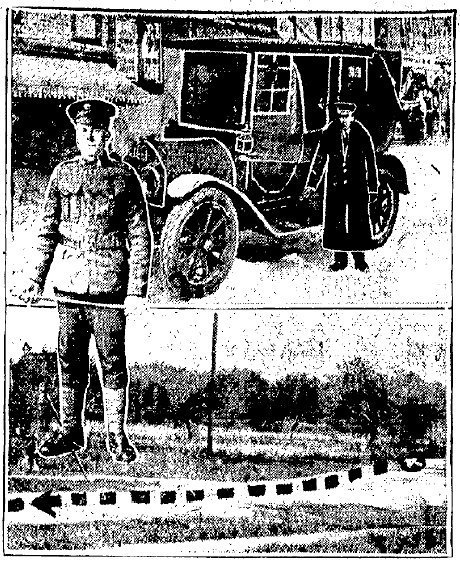
[Next column] John G. Rolland, his taxi and the murder scene. (Source: Toronto Daily Star, November 5, 1919, p. 3)
As a rider the jury recommended that lights be placed on McCrae Drive "in order to make it freer and safer from the objectionable element who frequent it."
The murder had a major impact on the community. A Leaside minister reported that since the murder women were afraid to go out at night without a male escort. He stated that better and more police protection was necessary in "the far outlying section."
Taxi drivers were reported to be "slightly nervous" at the recent rash of crimes and holdups. Several drivers on the Union Station stand said they were refusing trips outside the city limits after 10 p.m.
Among the rash of assaults at around the same time, Mike Maynac was attacked in July, 1919 on the way to Weston by two men whom he picked up at Union Station. He was still in hospital with a fractured skull when one of the men was arrested three weeks later.
Sometime before February, 1920, Toronto driver Donald Selvege was beaten and robbed by two men and a woman who first squirted ammonia over him. At their trial one of the men and the woman claimed to have been under the influence of drugs. In February another Toronto driver, Nathan Peritz, suffered a scalp wound when he was hit over the with a whiskey bottle and robbed of thirty dollars.
In August, 1920, Hamilton driver Frank Carter was shot in the thigh by robbers. Also, at the time of John Mr. Rolland's murder, police were seeking a Toronto cab driver who disappeared after shooting a man to death on a taxi stand in an apparent dispute over a woman. According to witnesses the victim jumped onto the running board of the taxi and tried to stab the driver with a knife.
Mr. Rolland's murder was still unsolved in August, 1923, when Carmine Lapello was killed. At that time the Toronto Star reported that a former British sailor convicted of killing a London taxicab driver had spent time in Canada and speculated that he might have committed one or more of the Rolland, Lapello or Harry Strom murders.