


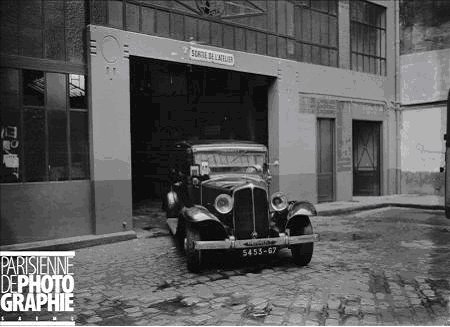
One of a fleet of 600 taxis leaving the garage at the beginning of a shift, March 1941.
Source:
Paris en Images, copyright LAPI / Roger-Viollet (LAP-1877A):
Click here to view source.
Gaito Gazdanov's Paris / 50
The taxi driver's third preoccupation is taxi driving itself, which both fascinates and repels him. Taxi driving provides him with a living, allows him more free time than does any other available occupation and gives him valuable insights into people and their lives, but at a terrible cost:
"I would not have learned as much � and only half of what I know would be enough to poison many human souls forever � if I had not become a taxi driver." [46]
Fifty years later another Russian emigre, Vladimir Lobas, used this quote as the epigraph for Taxi from Hell, his 1991 book about life as a cab driver in New York City.
As well as being a major novel by a renowned writer, Night Roads has a another claim on our attention. It�s an early example of a genre that first emerged with books like Robert Hazard�s Hacking New York (1930) and Herbert Hodge�s Cab, Sir? (1939).
The genre, a mix of anecdotes, reflections and autobiography, might best be called the taxi driver memoir. Since the 1930�s all sorts of taxi drivers in many countries have published these memoirs and examples, good and not so good, are now legion.