
Dilawar
December 10, 2002
Bagram, Afghanistan
International Herald Tribune
Army file details deaths of Afghan detainees
By Tim Golden The New York Times
SATURDAY, MAY 21, 2005
NEW YORK Even as the young Afghan man was dying before them, his American jailers continued to torment him.
The prisoner, a slight, 22-year-old taxi driver known only as Dilawar, was hauled from his cell at the detention center in Bagram, Afghanistan, about 2 a.m. to answer questions about a rocket attack on an American base. When he arrived in the interrogation room, an interpreter who was present said, his legs were bouncing uncontrollably in the plastic chair and his hands were numb. He had been chained by the wrists to the top of his cell for much of the previous four days.
At the interrogators' behest, a U.S. military police guard tried to force the young man to his knees. But his legs, which had been pummeled by guards for several days, could no longer bend.
An interrogator told Dilawar that he could see a doctor after they finished with him. When he was finally sent back to his cell, though, the guards were instructed only to chain the prisoner back to the ceiling.
"Leave him up," one of the guards quoted one of the interrogators, Specialist Joshua Claus of the U.S. Army, as saying.
Several hours passed before an emergency room doctor finally saw Dilawar. By then he was dead, his body beginning to stiffen.
It would be many months before army investigators learned a final horrific detail: Most of the interrogators had believed Dilawar was an innocent man who had simply driven his taxi past the American base at the wrong time.
The story of Dilawar's brutal death at the Bagram Collection Point - and that of another detainee, Habibullah, who died there six days earlier in December 2002 - emerge from a nearly 2,000-page file of the army's criminal investigation into the case, a copy of which was obtained by The New York Times.
Like a narrative counterpart to the digital images from Abu Ghraib, the Bagram file depicts young, poorly trained soldiers repeatedly abusing prisoners. The harsh treatment, which has resulted in criminal charges against seven soldiers, went well beyond the two deaths.
In some instances, testimony shows, it was directed or carried out by interrogators to extract information. In others, it was punishment meted out by military police guards. Sometimes, the torment seems to have been driven by little more than boredom or cruelty, or both.
In sworn statements to army investigators, soldiers describe one female interrogator with a taste for humiliation stepping on the neck of one prostrate detainee and kicking another in the genitals. They tell of a shackled prisoner being forced to roll back and forth on the floor of a cell, kissing the boots of his two interrogators as he went. Yet another prisoner was made to pick plastic bottle caps out of a drum mixed with excrement and water as part of a strategy to soften him up for questioning.
The Times obtained a copy of the file from a person involved in the investigation who was critical of both the methods used at Bagram and the military's response to the deaths.
Although incidents of prisoner abuse at Bagram in 2002, including some details of the two men's deaths, have been previously reported, American officials have characterized them as isolated problems that were thoroughly investigated.
And many of the officers and soldiers interviewed in the Dilawar investigation said the large majority of detainees at Bagram were compliant and reasonably well treated.
Yet the Bagram file includes ample testimony that harsh treatment by some interrogators was routine and that guards could strike shackled detainees with virtual impunity.
Even though military investigators learned soon after Dilawar's death that he had been abused by at least two interrogators, the army's criminal inquiry moved slowly. Meanwhile, many of the Bagram interrogators, led by Captain Carolyn Wood, were redeployed to Iraq and in July 2003 took charge of interrogations at the Abu Ghraib prison. According to a high-level army inquiry last year, Wood instituted harsh techniques there, including stripping prisoners, depriving them of sleep and using dogs to frighten them, that were "remarkably similar" to those used at Bagram.
Last October, the army's Criminal Investigation Command concluded that there was probable cause to charge 27 officers and enlisted personnel with criminal offenses in the Dilawar case, ranging from dereliction of duty to maiming and involuntary manslaughter. Fifteen of the same soldiers were also cited for probable criminal responsibility in the Habibullah case.
So far, only seven soldiers have been charged, including four last week. No one has been convicted in either death. Two army interrogators were also reprimanded, a military spokesman said. Most of those who could still face legal action have denied wrongdoing, either in statements to investigators or in comments to a reporter.
With most of the legal action pending, the story of abuses at Bagram remains incomplete. But documents and interviews reveal a striking disparity between the findings of army investigators and what senior military officials said after the deaths.
Military spokesmen maintained that both men had died of natural causes, even after military coroners had ruled the deaths homicides.
The Bagram Collection Point was a clearinghouse for prisoners captured in Afghanistan, Pakistan and elsewhere. It typically held between 40 and 80 detainees while they were interrogated and screened for possible shipment to the Pentagon's longer-term detention center at Guantánamo Bay, Cuba.
A new interrogation unit arrived in July 2002. Only two of its members had ever questioned prisoners.
"There was nothing that prepared us for running an interrogation operation" like the one at Bagram, the noncommissioned officer in charge of the interrogators, Staff Sergeant Steven Loring, later told investigators.
The detainee known as Person Under Control No. 412 was a portly, well-groomed Afghan named Habibullah.
He was identified at Bagram as an important prisoner and an unusually sharp-tongued and insubordinate one. One of the guards, Sergeant Alan Driver Jr., told investigators that Habibullah had risen after a rectal examination and kneed him in the groin.
On his second day, Dec. 1, the prisoner was "uncooperative" again, this time with Specialist Willie Brand. The guard, who has since been charged with assault and other crimes, told investigators he had delivered three peroneal strikes, potentially disabling blows to the side of the leg, just above the knee, in response.
By Dec. 3, Habibullah's reputation for defiance seemed to make him an open target. One guard said he had given him five peroneal strikes for being "noncompliant and combative." Another gave him three or four more for being "combative and noncompliant." Some guards later asserted that he had been hurt trying to escape.
When Sergeant James Boland saw Habibullah on Dec. 3, the prisoner was in one of the isolation cells, tethered to the ceiling by two sets of handcuffs and a chain around his waist. His body was slumped forward, held up by the chains.
When Boland returned to the cell about 20 minutes later, he said, Habibullah was not moving and had no pulse.
Finally, the prisoner was unchained and laid out on the floor of his cell.
Habibullah died on Dec. 3. His autopsy showed bruises or scrapes on his chest, arms, head and neck. There were deep bruises on his calves, knees and thighs. His left calf had been marked by what appeared to have been the sole of a boot.
His death was attributed to a blood clot, probably caused by the severe injuries to his legs, which traveled to his heart and blocked the blood flow to his lungs.
On Dec. 5, Dilawar arrived at Bagram.
Four days before, on the eve of the Muslim holiday of Id al-Fitr, Dilawar set out from his tiny village of Yakubi in a prized new possession, a used Toyota sedan that his family bought for him a few weeks earlier to drive as a taxi.
After picking up three passengers, he passed a base used by American troops, Camp Salerno, which had been the target of a rocket attack that morning.
Militiamen loyal to the guerrilla commander guarding the base, Jan Baz Khan, stopped the Toyota at a checkpoint.
Dilawar and his passengers were detained and turned over to American soldiers at the base as suspects in the attack. The three passengers were eventually flown to Guantánamo and held for more than a year before being sent home without charge.
At Bagram, Dilawar was quickly labeled "noncompliant."
One of the guards, Specialist Corey Jones, said the prisoner spat in his face and started kicking him. Jones responded, he said, with a couple of knee strikes to the leg of the shackled man.
"He screamed out, 'Allah! Allah! Allah!' and my first reaction was that he was crying out to his god," Jones said to investigators. "Everybody heard him cry out and thought it was funny."
"It became a kind of running joke, and people kept showing up to give this detainee a common peroneal strike just to hear him scream out 'Allah,"' he said. "It went on over a 24-hour period, and I would think that it was over 100 strikes."
On Dec. 8, Dilawar was taken for his fourth interrogation. It quickly turned hostile.
The interpreter who was present, Ahmad Ahmadzai, recalled the encounter. "About the first 10 minutes, I think, they were actually questioning him; after that it was pushing, shoving, kicking and shouting at him," Ahmadzai said. "There was no interrogation going on."
The military policemen were instructed to keep Dilawar chained to the ceiling until the next shift came on.
By the time Dilawar was brought in for his final interrogation in the first hours of Dec. 10, he appeared exhausted and was babbling that his wife had died. He also told the interrogators that he had been beaten by the guards.
When Dilawar was unable to kneel, said the interpreter, Ali Baryalai, the interrogators pulled him to his feet and pushed him against the wall.
"It looked to me like Dilawar was trying to cooperate, but he couldn't physically perform the tasks," Baryalai said.
Soon afterward he was dead.
The findings of Dilawar's autopsy were succinct. He had had some coronary artery disease, the medical examiner reported, but what killed him was the same sort of "blunt force trauma to the lower extremities" that had led to Habibullah's death.
One of the coroners later translated the assessment at a pretrial hearing for Brand, saying the tissue in the young man's legs "had basically been pulpified."
"I've seen similar injuries in an individual run over by a bus," the coroner, Lieutenant Colonel Elizabeth Rouse, added.
After the second death, several of the army interrogators were temporarily removed from their posts. On orders from the Bagram intelligence chief, interrogators were prohibited from any physical contact with the detainees. Chaining prisoners to any fixed object was also banned, and the use of stress positions was curtailed.
In February, a U.S. military official disclosed that the Afghan guerrilla commander whose men had arrested Dilawar and his passengers had been detained. The commander was suspected of attacking Camp Salerno and then turning over innocent "suspects" to the Americans in a ploy to win their trust, the military official said.
The three passengers in Dilawar's taxi were sent home from Guantánamo in March 2004, 15 months after their capture, with letters saying they posed "no threat" to American forces.
Ruhallah Khapalwak, Carlotta Gall and David Rohde contributed reporting for this article, and Alain Delaqueriere assisted with research.
++++++++++++++++++++++++++++++++++++++++++++++
New York Times
The Bagram File
Years After 2 Afghans Died, Abuse Case Falters
By TIM GOLDEN
Published: February 13, 2006
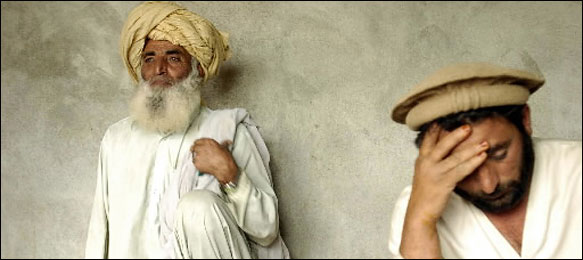
Photo caption: In Yakubi, Afghanistan, Asaldin and Shahpoor, the father and a brother of a taxi driver who died in American custody at Bagram, mourned last year. "God will punish" the abusers, Shahpoor said. Photo by Keith Bedford for The New York Times.
FORT BLISS, Tex. — In the chronicle of abuses that has emerged from America's fight against terror, there may be no story more jarring than that of the two young men killed at a United States military detention center in Afghanistan in December 2002.
The Army last month abandoned its case against Capt. Christopher M. Beiring, the former military police commander at Bagram. The case would have been a "loser for the government," an Army judge wrote.
The two Afghans were found dead within days of each other, hanging by their shackled wrists in isolation cells at the prison in Bagram, north of Kabul. An Army investigation showed they were treated harshly by interrogators, deprived of sleep for days, and struck so often in the legs by guards that a coroner compared the injuries to being run over by a bus.
But more than a year after the Army began a major push to prosecute those responsible for the abuse of the two men and several other prisoners at Bagram, that effort has faltered badly.
Of 27 soldiers and officers against whom Army investigators had recommended criminal charges, 15 have been prosecuted. Five of those have pleaded guilty to assault and other crimes; the stiffest punishment any of them have received has been five months in a military prison. Only one soldier has been convicted at trial; he was not imprisoned at all.
While military lawyers said the pleas were negotiated in exchange for information or testimony against other soldiers, the prosecution has gained no evident momentum. Four former guards accused of assaulting detainees were all acquitted in recent courts-martial. Charges against a fifth former guard were dropped.
In one of the prosecutors' most important tests, the Army last month abandoned its case against Capt. Christopher M. Beiring, the former military police commander at Bagram and one of the few American officers since 9/11 to face criminal charges related to the abuse of detainees by the officers' subordinates.
"If this case were to go to trial, it would be a big, ugly loser for the government," Lt. Col. Thomas S. Berg, the Army judge who oversaw Captain Beiring's pretrial inquiry, wrote in a report on the evidence.
In recommending dismissal of the case, Colonel Berg argued that the prosecutors had overreached, charging Captain Beiring with command failures that they could not prove. The judge also highlighted a problem that has frustrated the prosecutors in their effort to hold soldiers accountable for breaking the rules at Bagram: those rules were not at all clear.
Indeed, more directly than any other episode since 9/11, the Bagram cases have exposed the uncertainty and confusion among military interrogators and guards about how they were required to treat terror suspects after President Bush decided in February 2002 that they would not be protected by the Geneva Conventions.
Although the administration issued a general order that detainees should be treated humanely, internal military files on the case show that officers and soldiers at Bagram differed over what specific guidelines, if any, applied. That ambiguity confounded the Army's criminal investigators for months and left the prosecutors vacillating over strategy. It also gave the accused soldiers a defense that has seemed to resonate with some military judges and jurors.
"The president of the United States doesn't know what the rules are!" said Capt. Joseph Owens, a lawyer for one of the accused interrogators, Pfc. Damien M. Corsetti, who is one of two former Bagram soldiers still facing court-martial. "The secretary of defense doesn't know what the rules are. But the government expects this Pfc. to know what the rules are?"
The prosecutors have stumbled over a series of other obstacles as well, some of them plainly visible. After a criminal inquiry that took almost two years, witnesses in the case were scattered, their memories dimmed. A crucial witness in three of the trials changed his story repeatedly, leading to acquittals in each case. Other potentially important figures who had left the military were largely ignored.
In the modest Fort Bliss courtrooms where the trials have been held, the two Afghan victims have rarely been evoked, except in autopsy photographs. But much testimony focused on hardships faced by the soldiers themselves: the poor training they received, the tough conditions in which they operated, the vague rules with which they had to contend. As in other recent abuse cases, Army judges and jurors also seemed to consider the soldiers' guilt or innocence with an acute sense of the sacrifices they had made in serving overseas.
Lt. Col. Joseph A. Simonelli Jr., who sat on the jury for a former Bagram guard who admitted to repeatedly striking one of the detainees who died, was asked after the trial how he had viewed the defendant. The soldier, convicted of maiming, assault and other crimes, was sentenced to only a demotion in rank, and honorably discharged.
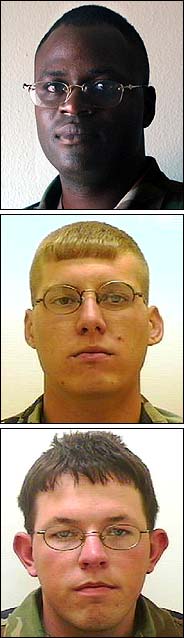
Photo caption: From top, Willie V. Brand was convicted in connection with abuses at the Bagram prison, but received no prison time; Joshua R. Claus and Glendale C. Walls II pleaded guilty. All held the rank of specialist.
"This individual was an American citizen who had been called up," Colonel Simonelli, a Fort Bliss battalion commander, said in an interview. "He had volunteered, and when they called upon him to perform his duties in a time of war, he did it without question."
Standard Procedure
In the first case they filed, in August 2004, Army prosecutors charged a Reserve military police sergeant, James P. Boland, with assaulting and maltreating one of the detainees who died at Bagram "by shackling him in a standing position with hands suspended above shoulder level for a prolonged period of time."
The detainee, a 22-year-old taxi driver who used the single name Dilawar, had been picked up as he drove some passengers past a remote American fire base that had come under rocket fire hours before. He was found dead in a cell at Bagram on Dec. 10, 2002, a victim of what Army medical examiners later concluded were "blunt-force injuries" to his legs. The prolonged shackling had also contributed to his death, coroners ruled.
Another detainee, known as Mullah Habibullah, had been found dead six days earlier under similar circumstances. Many guards from Sergeant Boland's Reserve unit acknowledged to investigators that they had kneed the two prisoners in the thighs for being unruly or disobedient; they said the technique had been widely used.
But by charging Sergeant Boland for his role in the overhead shackling, a common method to keep prisoners from sleeping or to punish them, the prosecutors were effectively arguing that one of the standard procedures at Bagram had itself been criminal.
That assertion raised the possibility that senior officers at Bagram and even Pentagon officials could also be held liable for authorizing the practice or acquiescing in it.
According to one of dozens of confidential Army documents recently obtained by The New York Times, agents of the Army's Criminal Investigation Command made it a high priority in the summer of 2003 to determine "who authorized the forced-standing and no-sleep practices" at Bagram. In a later internal report, a special task force of agents from the division reported that "the responsibility of supervisory personnel" in the Bagram officer corps remained "under continued investigation."
Yet, for reasons that are unclear, it was not until April 2004 —16 months after the two deaths — that investigators even began to question officers who had served on the command staff at Bagram, the documents show.
Most of the senior officers were eventually questioned. But the possibility that the Bagram prosecutions might lead to higher-ranking authorities — or to a clarification of the rules — did not materialize.
Army investigators had recommended charges of assault, maltreatment and dereliction of duty against the former noncommissioned officer in charge of the Bagram interrogators, Staff Sgt. Steven W. Loring. But Mr. Loring, who left the Army at the end of 2003, was rarely mentioned in court and never charged.
A military official familiar with the Loring case said the Army referred it to the Justice Department, which declined to prosecute. Prosecutors at Fort Bliss would say only that Mr. Loring "left the Army prior to the transfer of the Bagram cases to Fort Bliss."
Nor is the Army expected to prosecute the officer who led Mr. Loring's platoon, Capt. Carolyn A. Wood, despite a formal recommendation by the Criminal Investigation Command that she be charged with dereliction of duty, Defense Department officials said.
Last spring, the Bagram prosecutors dropped all charges against Sergeant Boland, who has since left the military, arranging instead for a letter of reprimand. That letter, dated June 22, 2005, said his failure to seek medical help for the prisoner or prevent his assault by other military policemen "contributed to the death of Mr. Dilawar," a copy of the document shows. In the charges they later brought against 10 other former Bagram guards, they never again cited the overhead shackling as evidence of maltreatment or assault. They declined to say why.
An Honorable Discharge
Throughout the trials, the prosecutors cast the Bagram abuses as straightforward crimes: whatever the soldiers may have lacked in training or guidelines, the prosecutors said, they were never allowed to strike shackled prisoners merely because they were, as many guards had insisted, "noncompliant."
At the same time, several Army lawyers familiar with the case said, the prosecution never had much hope of pressing murder charges. So many guards had admitted to striking the two men, the lawyers said, that it would be almost impossible to fix blame on one or even several of them. Moreover, there were few witnesses to the beatings, and almost none who were not themselves implicated in wrongdoing.
The closest the prosecution team came to assigning responsibility for the deaths were charges of involuntary manslaughter, maiming and other crimes against one of the military policemen, Specialist Willie V. Brand. He had spoken openly with Army investigators long after others had invoked their right to remain silent, and the story he told was chilling. By his own admission, Specialist Brand, then 24, had repeatedly struck both of the detainees who died, kneeing them in the thigh with a technique that some of the unit's reservists had taught to others.
Specialist Brand had told investigators that he kneed Mr. Dilawar more than 30 times, because "I was fed up with him," and added that he struck "a lot of other" detainees as well. He said "90 percent" of the other guards who worked the Bagram isolation cells on the night shift also used knee strikes, including some who struck Dilawar because they were amused to hear him cry out, "Allah!"
Army prosecutors described Specialist Brand's actions as brutally excessive. But jurors also heard Mr. Boland, testifying for the defense, describe the "fuzzy" and "inadequate" training of the reservists.
The jurors also asked questions of their own, as they are allowed to do in courts-martial. Many of them centered on the guards' rules for using force, how they were trained and how they were supervised. They also heard six other soldiers testify that they, too, had used knee strikes and had been trained to do so.
"To me what he did may have been a contributing factor" in Mr. Dilawar's death, Colonel Simonelli, a juror in the case, said of Specialist Brand. "But was it the most important factor? Based on my limited knowledge, I cannot confirm that to be the case."
The prosecutors did not mention the young wife and a 2-year-old daughter that Mr. Dilawar left behind, or that interrogators had concluded before his death that he was almost certainly innocent of any involvement in the rocket attack on the American base. The jury convicted Specialist Brand of maiming, assault, maltreatment and making a false statement and could have sentenced him to 16 years in a military prison. Instead, after hearing about his sick wife and their indigent family of four children, they declined even to give him a bad-conduct discharge. The most serious charge against him, involuntary manslaughter, was dropped before the trial began.
Even Specialist Brand's civilian lawyer, John P. Galligan, said he was stunned by the sentence: his client was reduced in rank to private, but not jailed or fined; he left the Army with an honorable discharge.
Questions Not Asked
The former Bagram interrogators who were prosecuted, all members of the 519th Military Intelligence Battalion from Fort Bragg, N.C., were not accused of any direct role in the two deaths. But their cases raised further questions about the possible responsibility of higher-ranking officers.
One interrogator who pleaded guilty to reduced charges, Specialist Glendale C. Walls II, acknowledged having pushed Mr. Dilawar against a wall and standing by as his partner, then-Specialist Joshua R. Claus, forced another prisoner to roll back and forth on the ground, kissing their boots.
Specialist Walls explained his misconduct in part by saying his superiors at Bagram had pushed him to be more aggressive in his interrogations. But he gave few details and prosecutors did not press him, saying later that his claims had been "fully investigated."
But nor did they mention a secret memorandum showing that around the time of the two deaths, interrogators at Bagram were using new, aggressive methods that were not authorized for use in Afghanistan.
The 10-page memorandum, a copy of which was obtained by The Times, was written by the military's acting chief lawyer at Bagram, Lt. Col. Robert J. Cotell Jr., on Jan. 24, 2003. It indicates that interrogators there adopted some of the more extreme interrogation methods that Secretary of Defense Donald H. Rumsfeld approved on Dec. 2, 2002, exclusively for use at Guantánamo Bay, Cuba.
(Mr. Rumsfeld rescinded those methods barely a month later, after complaints by the Navy general counsel, Alberto J. Mora, and other officials.)
Although military lawyers said the Bagram prosecutors were aware of Mr. Cotell's memorandum, the document was never cited in court. Nor do the prosecutors or Army investigators appear to have asked intelligence officers at Bagram to specify what those harsher methods were, when they were used, who authorized them — or whether they had any effect on the treatment of the two men who died, documents showed.
The prosecutors told The Times that the charges filed against former Bagram interrogators "were based on acts which exceeded the scope of the tactics permissible even under the referenced memorandum.
"Consequently," they said, "the memorandum has no legal relevance to the Bagram prosecutions." They did not answer questions about whether the harsher tactics were improperly used at Bagram or whether they might have contributed to the two deaths.
Shackling 'Looked Bad'
The prosecutors had perhaps the hardest time with Bagram's uncertain rules in the case of Captain Beiring, the only officer to face criminal charges.
Captain Beiring, the military police company commander, was charged with one count of making a false statement to investigators and two of dereliction of duty. Prosecutors said he had failed to properly train and supervise soldiers in the legal use of force and "the approved tactics, techniques and procedures in detainee operations."
Colonel Berg, the judge who reviewed pretrial evidence, ruled that the dereliction charge was too broad and too vague, and he noted that the overhead chaining of detainees was "an approved practice" that was at least "acquiesced in by higher commands." But he cited a more basic problem with the accusation.
"The government failed to present any evidence of what are 'approved tactics, techniques and procedures in detainee operations,' " he wrote.
In recommending dismissal of the second dereliction count, Colonel Berg concluded that although both a senior detention officer and one of the command-staff lawyers at Bagram had instructed Captain Beiring to stop shackling prisoners after the death of Mr. Habibullah, the officers' reasons "were not based on law, regulation or policy." Rather, the two officers suggested in their testimony, they had acted simply because the shackling "looked bad."
In an interview, Captain Beiring acknowledged that Mr. Dilawar, even if he was unruly, had not represented much of a threat to his soldiers, some of whom, he said, "clearly chose to do wrong."
"Soldiers probably got tired of his [expletive]," he said. "Others probably said, 'Let's shut him up.' He was thrashing about. Was he posing a death threat? Probably not. But are you going to take a spit in the face? I'm not."
In the Afghan village where Mr. Dilawar lived, there has been little news of the Bagram trials. But members of his family responded serenely when told about the results of the prosecutions.
"We do not think that people should be in prison," said one of Mr. Dilawar's brothers, Shahpoor. "My brother is dead. If they arrest 10,000 Americans, what good will that do me?
"I am angry with them, but this was the will of God," he added. "God is great, and God will punish them."
Ruhallah Khapalwak contributed reporting from Kabul for this article.
This news digest is for informative purposes only. In accordance with Title 17 U.S.C. Section 107 and The Berne Convention on Literary and Artistic Works, Article 10, news clippings on this site are made available without profit for research and education.
[ Back to top ]