• Driver Profiles
Mohammadullah Saighani Toronto, Ontario / December 30, 1999 Mohammadullah Saighani was a 51-year-old father of five. He had been a doctor in his native Afghanistan but since his credentials were not recognized in Canada he turned to cab driving to support his family. He worked long hours, sometimes seven days a week.
At 6:15 a.m. on December 30, 1999, Dr. Saighani left his home in Etobicoke and checked in with the Beck Taxi dispatcher. That was the last that anyone heard from him.
At about 6:50 a.m. factory employees at 37 Iron Street in west-end Toronto saw the distinctive orange and green Beck taxi in the company parking lot where Mr.. Saighani's body was later found. Other factory employees saw the taxi speed away, presumably driven by the killer.
Dr. Saighani's body was discovered in the parking lot shortly before 9 a.m. He had been stabbed and slashed 40 to 50 times and he was almost completely decapitated. His hands were covered with defensive wounds and his thumb was almost severed.
The taxi was found that evening in the parking lot at the Kipling Heights Plaza shopping center. Surveillance video showed the taxi arriving about eight minutes after the murder and parking next to a minivan. The killer got out of the taxi and drove away in the minivan, but as he backed out of his parking space he nearly collided with an approaching sedan.
The surveillance video was too grainy to see any detail, but police made it public in hopes that the sedan driver would come forward and provide a detailed description of the van and perhaps the killer.
Dr. Saighani's wallet and cash were missing, so police initially believed that robbery was the motive for the murder. The investigation apparently stalled until on September 18, 2000, ten months after the murder, police announced the arrest of a 34-year-old butcher who, like Dr. Saighani, was originally from Afghanistan.
The butcher had been having an affair with Dr. Saighani's wife at the time of Dr. Saighani's murder. The break in the case occurred when Mrs. Saighani called police and said that the butcher had confessed to killing Dr. Saighani and that he had threatened to kill her as well.
The police had already suspected the pair of being involved in Dr. Saighani's death. The butcher was formally notified that he was a suspect two months before his arrest and police had collected wiretap evidence from phone calls that the lovers had made following the murder.
Meanwhile, the woman who drove the sedan that almost collided with the fleeing minivan contacted police a week after the murder. Unfortunately her testimony complicated the investigation.
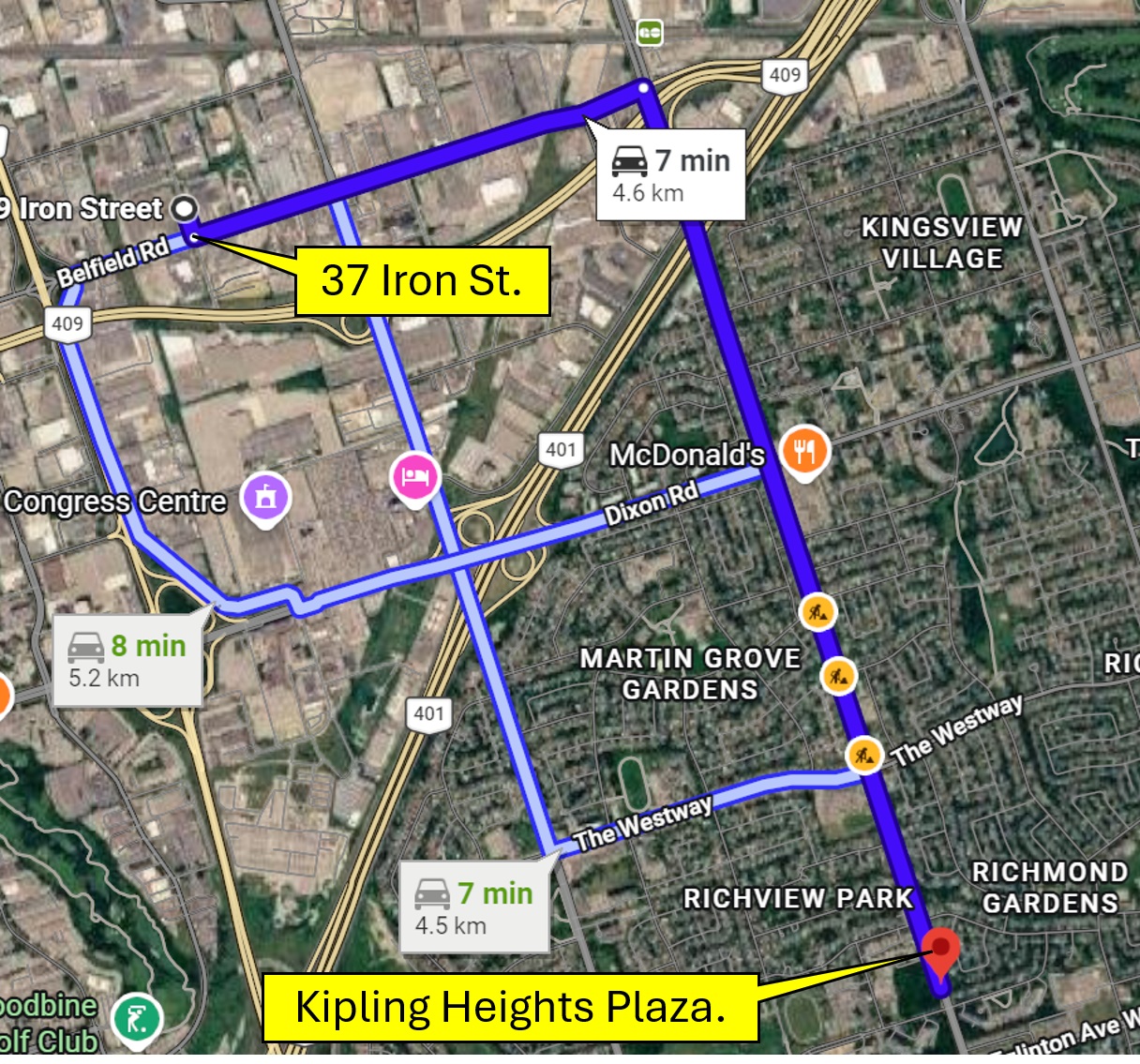
Routes from 37 Iron Street where Dr. Saighani's body was found to the Kipling Heights Plaza where his cab was abandoned. Source: Google Maps.
She described the minivan as dark blue in colour, possibly a GMC model, with a square back. The butcher, however, drove a light green Plymouth Voyager with a rounded back. The police were now tasked with refuting evidence that they had hoped would support a murder charge.
The police used the Kipling Heights Plaza surveillance camera to create four different videos of dark- and light-coloured minivans captured in the headlights of an approaching sedan as they backed out of a parking space in the winter morning darkness. At trial the videos were admitted as evidence for the jury to compare with the original surveillance video.
In 2003 the butcher was convicted of first degree murder and sentenced to life with no possibility of parole for 25 years. His appeal was dismissed in 2007. In 2016 the killer applied for early parole under the Canadian criminal code's so-called "faint hope" clause. His application was denied in January, 2017.
Mrs. Saighani was not charged in connection with Dr. Saighani's murder.
A year after the murder, Toronto city council enacted a bylaw requiring that taxicabs be equipped with emergency lights and either a security camera or GPS tracking technology. The bylaw was largely prompted by the murders of Dr. Saighani and Baljinder Singh Rai two days later on New Year's Day 2000.
See also Morteza (Johnny) Khorassani.