• Driver Profiles
Thomas Man Tang Vancouver, British Columbia / March 29, 1978 On Wednesday, March 29, 1978 Thomas Man Tang was parked on a cab stand in the 700 block of Robson Street when he was approached by a man who asked to be driven to the Bayshore Inn, about 2 kilometers away. Soon afterward Mr. Tang's cab was spotted near the Bayshore with Mr. Tang slumped over the steering wheel. He had been shot above the left eye with a .22 calibre revolver.
Witnesses saw a man fleeing from the cab and were able to give a remarkably detailed description to the police: between 18 and 22 years old, six feet two inches tall, slightly built with sandy-coloured shoulder length hair and sideburns that flared at the earlobes, a longish, clean-shaven face, a long prominent nose with a deep cleft below it and close-set eyes.
The assumption was that Mr. Tang was shot after refusing to hand over between $60 and $70 to the killer, although Mr. Tang's brother Raymond was certain that he would have surrendered his money if given a chance.
Police quickly arrested a parole violator whose features matched the description, but they were unable to connect him to the murder. He was returned to Oakalla Correctional Centre to complete his sentence.
Like Muk Chee Tam who was murdered five years earlier, Mr. Tang was born in Hong Kong and was 26 years old. Also like Mr. Tam he had lived in Vancouver for eight years. In addition to driving a cab he was an apprentice auto mechanic and planned to take formal training courses when he could afford it.
In the meantime he sent most of what he earned to Hong Kong to help support his mother, brother and two sisters. His father had died ten years earlier. Mr. Tang was scheduled to be interviewed by an immigration officer on April 3 with regard to his application for Canadian citizenship. He hoped to bring his family to Canada.
Mr. Tang was taken to St. Paul's Hospital but doctors could not operate to remove the bullet and gave him little chance of survival. He was still alive when his mother and other family members arrived from Hong Kong. With their consent Mr. Tang was removed from life support and his kidneys were donated to renal disease patients awaiting transplants.
Mr. tang's funeral procession stretched for over a mile and included nearly 200 cabs, each with a black ribbon tied to the radio aerial. He was cremated and his ashes were taken back to Hong Kong by his family.
The family paid their way to Vancouver using some of the money that Mr. Tang had been sending them. Various Chinese organizations, cab companies and individuals donated money to pay his funeral expenses and to enable his family to return to Hong Kong. By April 26 donations totalled $23,000.
Vancouver mayor Jack Volrich said that he would recommend that the Vancouver Police Commission post a $10,000 reward for information leading to the arrest and conviction of the murderer. The Commission was absolved from considering the recommendation when the Vancouver Taxi Owners Association posted its own reward of $10,000.
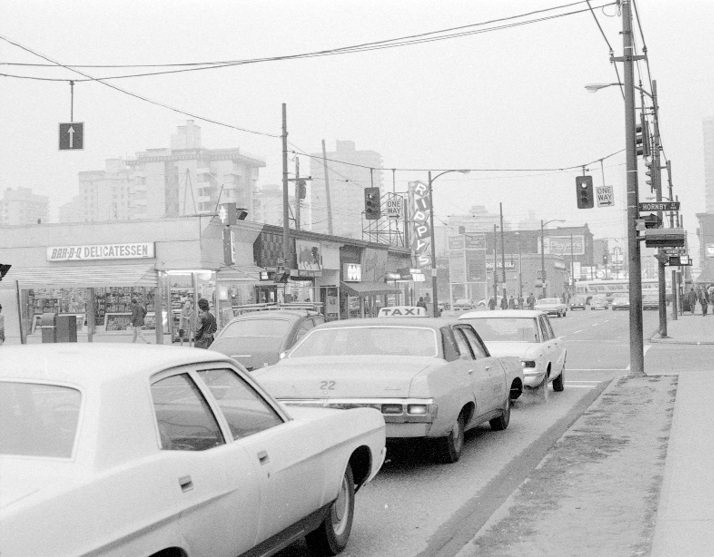
A taxi in the 800 block of Robson Street at the intersection of Hornby Street, circa 1972-1974 (detail). The buildings across Hornby are in the 900 block of Robson . Source: City of Vancouver Archives CVA 69-20.07
Mr. Tang's murder raised the issue of cab driver safety. Police Inspector Vic Lake sent invitations to ten Lower Mainland cab companies to meet and discuss means of improving driver safety, but only three of them sent representatives.
Inspector Lake met separately with representatives of Vancouver cab drivers because the Taxi Owners Association did not recognize the Greater Vancouver Taxi Driver Employees Association and refused to attend the same meeting.
Earlier Jim Dawson, president of the Taxi Owners Association said he doubted that shields or any other "drastic" security measures would be implemented by Vancouver cab companies. "'I don't think it [the murder] warrants that, not at this time,' he said, saying this type of incident is infrequent in Vancouver."
"'This one incident is very serious and very bad but we don't feel it's a problem in our industry,' Dawson said. 'We feel it's a police matter.'" To Dave Flint of the GVTDEA, Dawson's statements showed "that owners care little about the city's drivers and are unwilling to spend money on their safety."
"'We've been going to the companies ever since our inception four years ago and we've got nothing,' Flint said. 'We need protection.'" The safety meetings discussed various safety measures but seem to have produced no concrete results. Oddly enough, the owners and drivers were unanimous on one thing: neither side wanted shields.
"There would be no personal contact with the customers and that would cut into profits, the drivers complained."
According to Al Camp, secretary-treasurer of the GVTDEA, "You make a lot of money by personal contact. That's where we make our profits. We're a service industry."
In 1995 the Vancouver Police "historical homicide squad" tracked down a suspect in the murder, but as a result of the investigation the suspect was cleared of any involvement.