




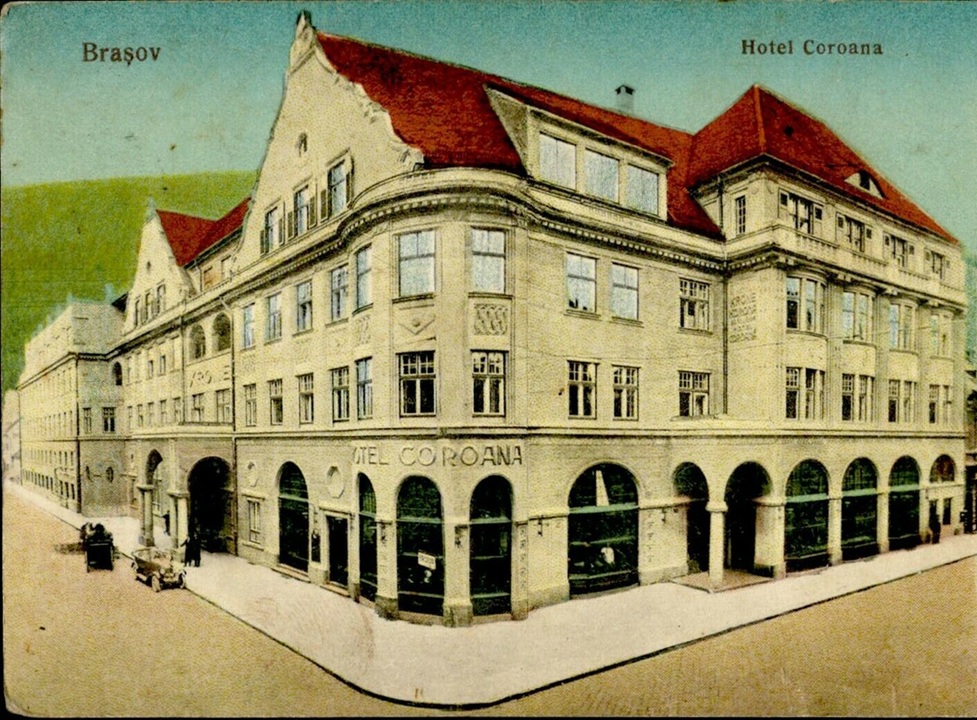
Above: The Hotel Coroana (also known as the Korona) in Braşov (detail) where Rachel was feted with a banquet and probably stayed overnight.
Source: HipPostcard.com
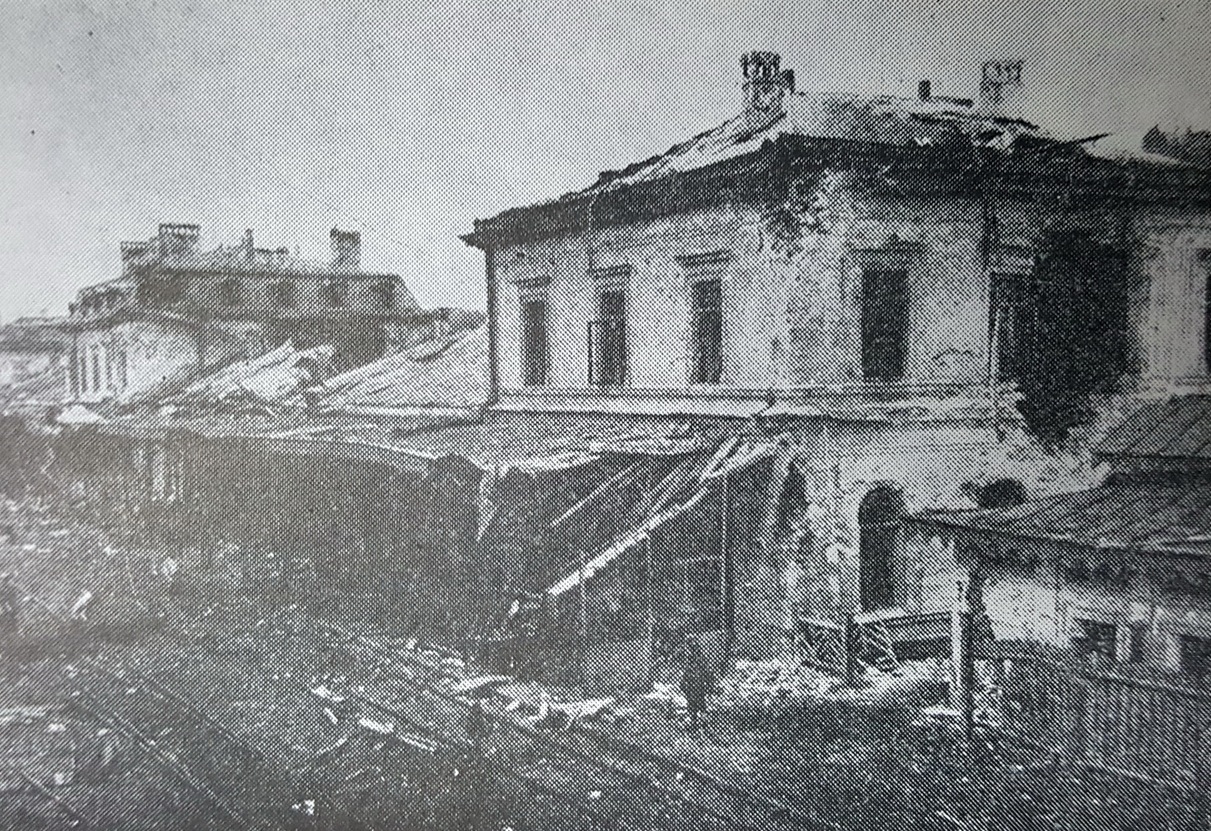
Above: In October, 1916 Predeal was captured by German and Austro Hungarian forces during an unsuccessful attempt to push through passes in the Carpathian Mountains. This photo shows the remains of the Predeal railway station, destroyed by artillery fire.
Source: "Battle of the Predeal Pass," Wikipedia.
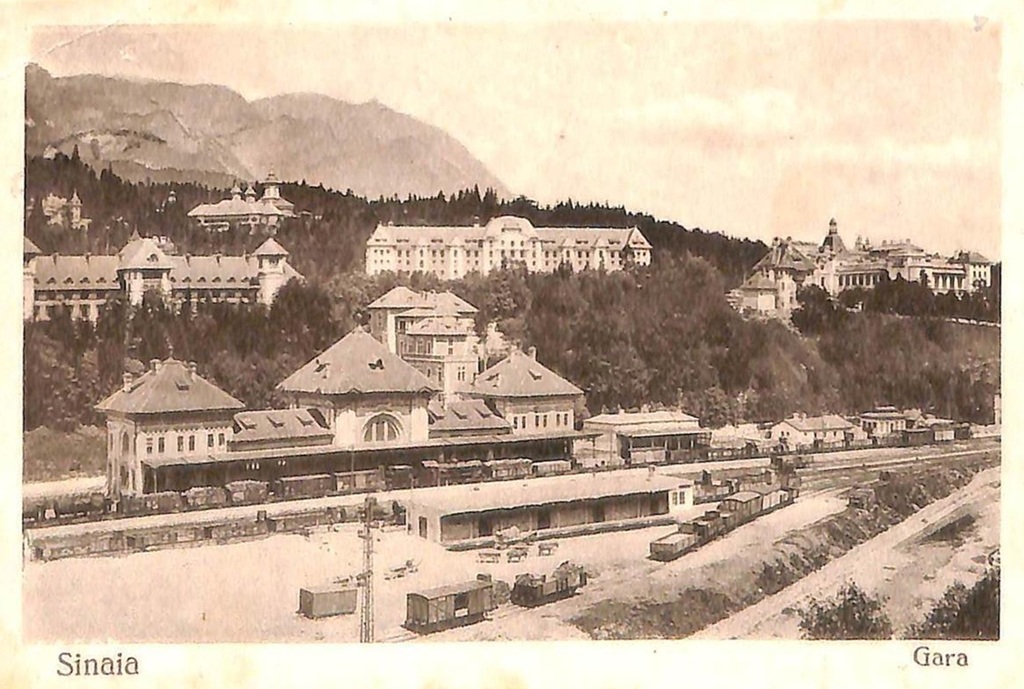
Above: Sinaia: Gara. The Sinaia railway station, shown with hotels in the background, was built in 1913 and is still in operation. An earlier station was reserved exclusively for the Romanian royal family on their visits to the mountain resort town. The Orient Express luxury train stopped here regularly between 1883 and 1998, with service resuming in 2014. A plaque on Platform 1 marks the spot where Prime Minister Ion Duca was assassinated by the Iron Guard in 1933.
Source: HipPostcard.com.
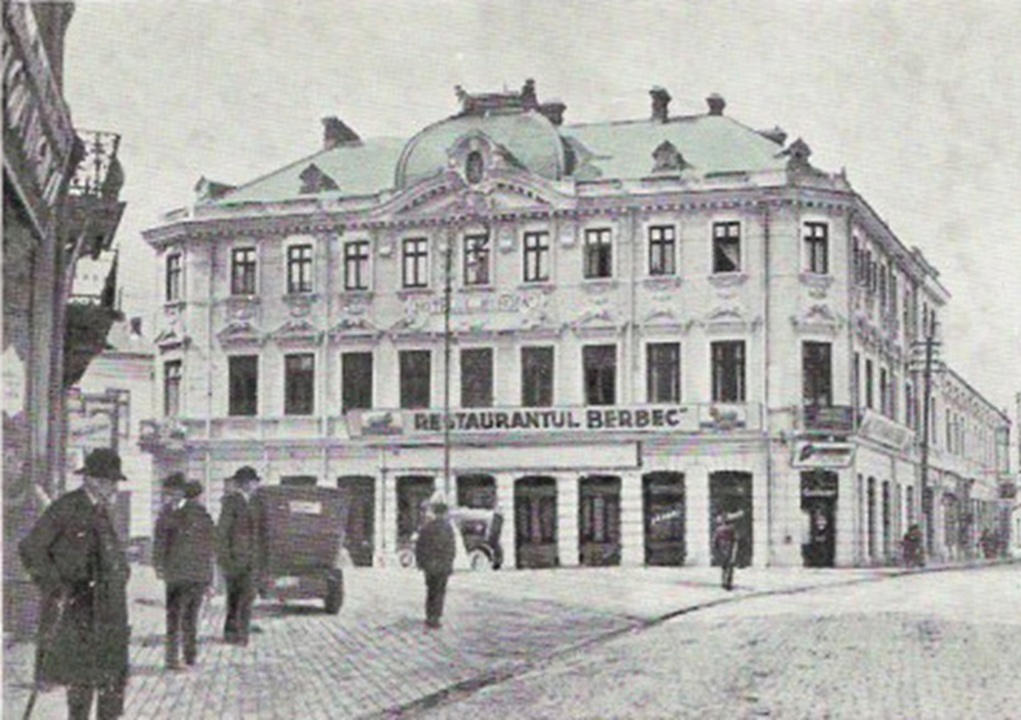
Above: Hotel Europa in Ploiesti (detail) where Rachel likely stayed the overnight and where, at the Berbec restaurant, she experienced yet another banquet. The hotel is gone, but the Berbec restaurant is still in operation.
Source: Republica Ploiesti: Hotel Europa.
9. Bucharest, 1928 (continued)
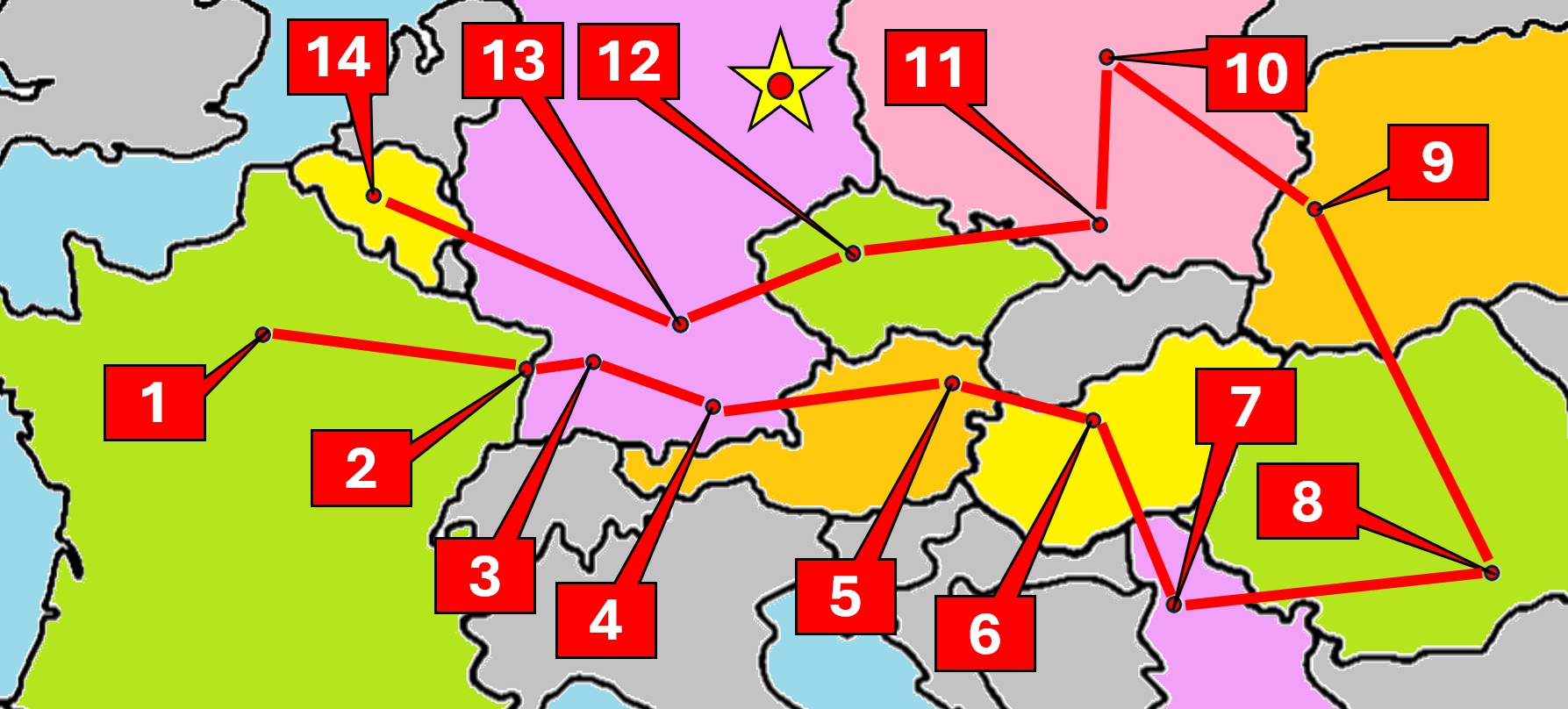
Belgrade to Bucharest (Map 7-8)
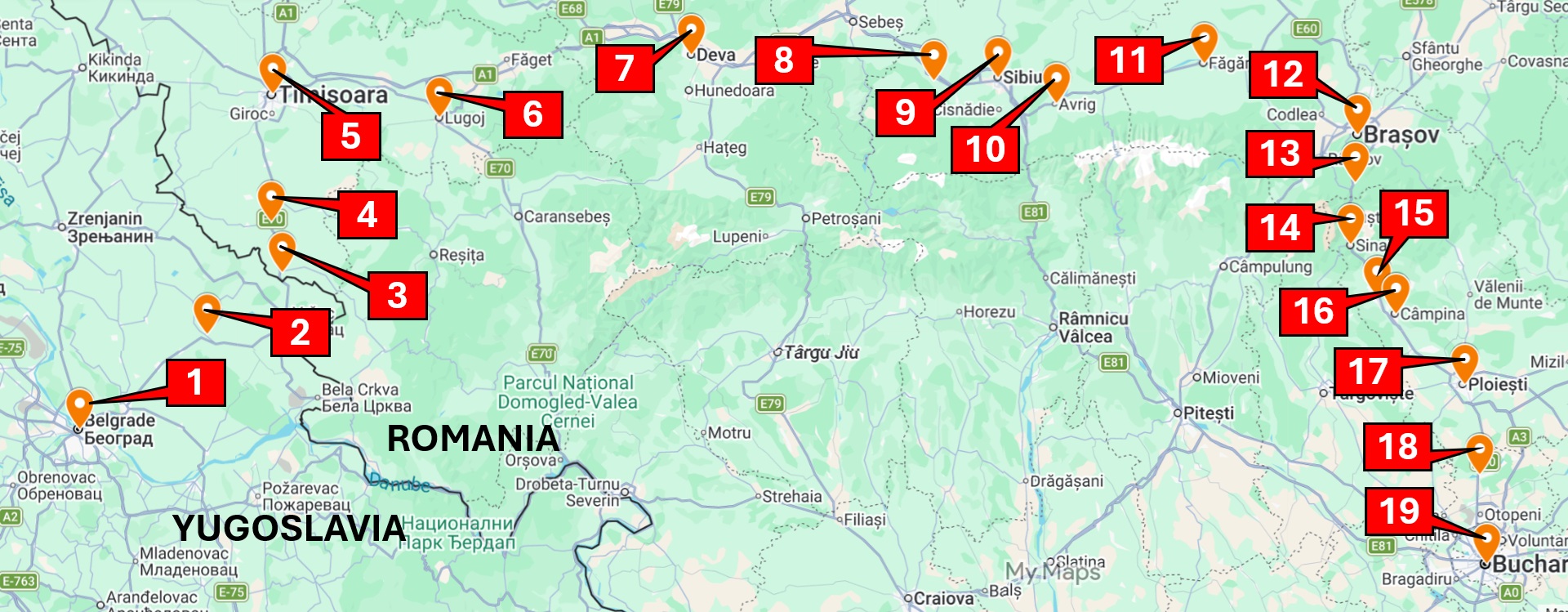
12. Braşov. (23 km) "Miss D Dange has arrived in Braşov. They report from Braşov that Miss D'Orange, the famous French Amazon who travels around the world on horseback, arrived in Braşov this morning. Miss D'Orange was hosted in Braşov by the officers of the 41st Artillery Regiment" (Aradi Közlöny).
On the other hand, the Brassói Lapok reported that she entered the city on Saturday afternoon, not morning, and was greeted by an official delegation that escorted her into town, but this may have been an "official" welcome, staged after Rachel had time to freshen up. In any case:
"The delegation, led by General Olteanu and Lieutenant Colonel Popovici, accompanied Miss Orange into the city in a real triumphal procession, who, together with her horse, walked through the city, exhausted, between the double line of cheering fans. In the courtyard, the usual ceremonies that are repeated at every rest stop were held: photography on horseback and on foot, from the front and from the side, from the back, en face and in profile. The lady did not disdain this popularity and smiled kindly at the sight of the cameras.."
The Brassói Lapok report included an account of the banquet held that evening at the Korona hotel, where Rachel was greeted by an orchestra that "intoned" La Marseillaise. This was followed by a series of speeches from civil and military dignitaries. By now Rachel had had enough of photographers and "constantly shows her swift white back towards the lens."
Perhaps the writer had seen too many official banquets. Whatever the reason, they included a somewhat jaundiced assessment of Rachel's accomplishment:
"By the way, no matter how extraordinary Miss D'Orange's idea is, it will soon wear out. The first imitator is already knocking on the door. Her name is Ceneta Stanciu who went up to the editorial office of Dimineaţa yesterday and announced a return trip from Bucharest to Paris on horseback. She will soon set off. The reception, the escort, the photography, everything starts again according to the template but with increasingly worn-out interest."
13. Predeal. (68 km) – According to an Aradi Közlöny report, Rachel left Braşov at dawn on Sunday morning, June 24. In late June in Braşov dawn occurs at about 5:30 a.m. If she averaged 10 kilometers an hour she could reach Predeal by about 12:30 p.m., but she likely arrived some time later assuming that she made one or more rest stops along the way.
Even at this distance from Bucharet, reporters, sightseers and well-wishers had gathered to meet her. By now Rachel had learned how to handle reporters, fending off intrusive personal questions with startling inventions, such as her newly-discovered aristocratic heritage and her plans to ride Le Huppé around the world.
It was a skill that would serve her well ever after. Aradi Közlöny is worth quoting at length:
"In Predeal, reporters and the gilded youth of Bucharest were waiting for Miss D'Orange in cars, carriages and on horseback. She told the reporters about her travel adventures so far and told them what prompted her to circumnavigate the globe on horseback. "'I am a descendant of an ancient French aristocratic family,' said Miss D'Orange. 'My father was knighted by Louis Éliqué and later became a baron. "'One of my ancestors, Philippe D'Orange, was the ambassador of the Sun King [Louis XIV] to Madrid when war broke out between the two states. According to family tradition, Philippe, who had learned of the Spanish king's war intentions a day earlier, secretly escaped from the Spanish capital and made the journey from Madrid to Paris in four days on horseback at a gallop. "'Sixteen horses fell out from under him, but Philippe was back in another saddle the next minute and continued his journey to Paris without rest, hungry and thirsty. When he reached the Tuileries Palace before the king, he could only just tell the king about the Spanish war preparations. He then collapsed dead. "'In our family both men and women were first-rate and wonderfully hardy horsemen. I have been riding since I was two years old, and out of respect for my late and daring ancestor, I have determined to ride around the globe on horseback. I am, of course, a woman, and therefore somewhat more fond of comfort than my ancestor Philippe, and I have therefore set myself five years for the circumnavigation of the globe, not a moment more. "'I left Paris on May 9th. You will see, on May 9, 1933, at six o'clock in the morning, I will be back in Paris again, unless I am devoured by cannibals somewhere in the interior of Africa.' "Miss D'Orange finished her announcements with a laugh, then jumped into the saddle and, accompanied by her companions, continued her journey towards Bucharest, after which Russia, Asia, Africa, Australia, America and finally Europe will follow."
14. Sinaia. (23 km) – If Rachel stopped for an hour in Predeal and left between 2 and 3 p.m., she would be about two and a half hours from Sinaia and could reach there by early evening.
Since Rachel left Braşov at dawn on Sunday, June 24 and arrived in Ploieşti at 3 p.m. on Monday, June 25, it is clear that there must have been an overnight stop somewhere, but where? If we divide the 161 kilometer distance roughly in half, Sinaia (at 91 kilometers from Braşov) seems the most likely candidate, though of course Rachel might have stopped overnight at a place not listed on Colonel Păun's itinerary.
15. Breaza. (24 km) – If Rachel left Sinaia at 6 a.m. on Monday, June 25, she could reach Breaza at 8:30 a.m.
16. Câmpina. (11 km) – If Rachel spent an hour in Breaza and left at 9:30 a.m., she could reach Câmpina at 10:30 a.m. If she spent an hour in Câmpina and left at 11:30 a.m., she could reach Ploieşti on the dot at 3 p.m.
17. Ploieşti. (35 km) – Rachel arrived in Ploieşti from Câmpina at 3 p.m. on Monday, June 25. Once again she was greeted by a delegation of civil and military officials, including the prefect and chief of police and the entire officer corps of the local cavalry regiment, "as well as numerous ladies and gentlemen who offered the guest numerous bouquets of flowers.
"A beautiful procession was then formed with Miss Dorange in the middle who walked the streets of Campina, Unirii and Mihail Kog─âlniceanu Squares, where a crowd of citizens waited as far as the fire station, in whose garden the necessary presentations were made. Miss Dorange, led by representatives of the authorities, then toured the city.
"In the evening, a banquet was given to her in the hall of the Berheci restaurant."
"Berheci" is probably a misprint for the historic Berbec restaurant, which was located in the Hotel Europa (left).
During World War II nine oil refineries made Ploieşti a major supplier of petroleum products to the German war effort and a target for Allied bombing attacks. On August 1, 1943, "Operation Tidal Wave" proved to be the single costliest air raid by the U.S. Army Air Force during the war. Out of 177 bombers a total of 54 were destroyed with 310 air crew killed or missing and another 190 captured. One downed bomber crashed into a women's prison, accounting for about half of the 101 civilians killed.
18. Tâncăbeşti. (33 km) – In Tâncăbeşti Rachel was "received at the manor house of Mr. Bàiecoanu, director of the National Bank" of Romania.
Since Rachel was in Otopeni, 15 kilometers south of Tâncăbeşti at 10:15 a.m. she must have left Tâncăbeşti, assuming a speed of 10 kilometers an hour, at about 8:45 a.m. If she spent an hour visiting with Mr. Bàiecoanu, she would have arrived in Tâncăbeşti about 7:45 a.m. Therefore, allowing a little over three hours to cover the 33 kilometers from Ploieşti, she must have left that city at about 4:30 a.m.
Tâncăbeşti seems to have served as a marshalling point for her grand entry into Bucharest. Everything was carefully timed for her to arrive at a reception at Bucharest's Chateaubriand Restaurant at 12 noon.
19. Bucharest. (31 km) – At 10:15 a.m. Rachel was in Otopeni on the last leg of her journey to Bucharest, sixteen kilometers away. Here she was greeted by officers from the Royal Escort Regiment and a unit from the 4th Red Regiment, one of Romania's elite cavalry regiments called "Reds" from their red uniforms. Closer to Bucharest Rachel was met by Colonel Stoilov, commander of the 4th Reds, and a retired cavalry general, Nicolae Sinescu. The two officers joined Rachel at the head of the procession.
And what a procession! In addition to military escort, people who had waited along the route on horseback, in cars and on bicycles joined the cavalade. As if this were not enough, several airplanes circled overhead to bring Rachel "the homage of Romanian aviation."