


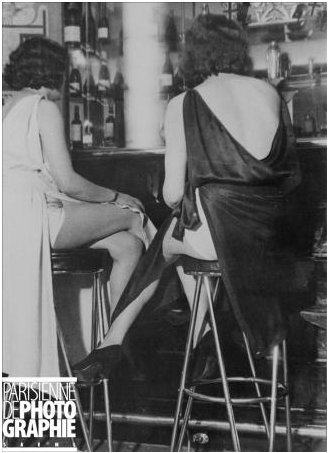
Prostitutes at the bar of the Sphinx, a "maison close" or brothel.
Paris XIVth district, boulevard Edgar-Quinet, about 1930.
Source:
Paris en Images, copyright Roger-Viollet (RV-58954):
Click here to view source.
Gaito Gazdanov's Paris / 22
The notary
One evening, toward ten o’clock, I was hailed by proper old gentleman, with grey hair, who was – as I learned later – a notary in a little town about thirty kilometres from Paris.
With a kindly smile he announced that he was going to hire my services for a few hours. Having arrived in the capital that day, he was ready to make his grand tour. He pulled out his wallet and counted his money in front of me. He had eleven thousand-franc notes, several 100-franc bills, and change.
"Let’s go!"
And away we went. He knew the addresses of all the high-class brothels and cabarets by heart. He entered them only to come out again with his step a little less steady, while his speech became more and more disjointed.
I saw that everybody was robbing him, beginning with the doormen who helped him out of the car and to whom he unwisely handed a large-denomination bill: they counted out his change slowly, almost painstakingly while he waited patiently, looking at the money with glazed eyes – in the end they gave him back only a few 20-franc coins – and ending with the chambermaids and chance strangers who suddenly became his boon companions and counselors, who embraced him, accompanied him into the brothels from which their laughter came down to me, mixed with that of the naked girls.
[….]
It all ended at five o’clock in the morning. He was unable to say anything except "a-a-a" – and I understood that in spite of his deadly fatigue and complete incomprehension of all that had happened to him, he still wanted to go to Les Halles.
I asked him where he was staying; he gazed at me with the empty and pitiable look of a drunk and was unable to reply. I didn’t want to take him to the police station; I stopped beside the first police officer I saw and explained the situation.
We had to find the old man’s address so we could take him home. We raised up his slight body, pulled the wallet out of his pocket, and found a business card for his hotel.
He had very little money left, only about two hundred francs; he must have spent very nearly seven thousand, the rest had been stolen from him.
We drove him to the hotel, helped him out of the car and gave him into the care of the staff. The police officer paid me with what remained of this fortune and I left.
At the last moment the old man opened his eyes wide and repeated in a voice that was even more strained: "a-a-a".
"What’s he talking about?" asked the policeman.
"You won’t believe it. He wants to go to Les Halles."
"He’d be better to take himself off to Père Lachaise," the officer said with a laugh and we parted company. It was nearly seven o’clock, the sun had already risen. [81-84]