


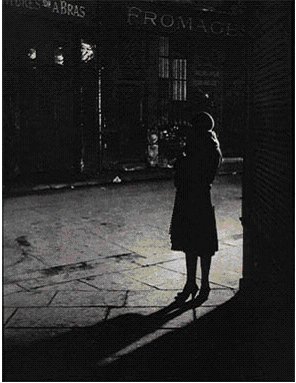
Brassai: Prostitute at angle of rue de la Reynie and rue
Quincampoix, From "Paris by Night", 1933
.
Source:
Fine Art Photography Gallery & Forum: Brassai:
Click here to view source.
Gaito Gazdanov's Paris / 33
Raldi
[The most compelling character in Night Roads is Raldi, the aging courtesan down on her luck who endures her fate with dignity and courage. She is on the street when she flags down the taxi driver and mistakes him for a former lover.]
On the night after my meeting with Fedortchenko, coming down avenue Wagram, I saw in the distance, at the edge of the sidewalk, a tall female silhouette draped in a fur mantle. I slowed down, she hailed me and I stopped.
She approached, scrutinized me, and gaped in astonishment.
“Dédé, how did you come to be a taxi driver?”
I looked back at her, stunned. She was about fifty years old, her face withered and rouged, but the soft, reserved expression of her large black eyes and her singularly youthful allure testified that this woman must once have been very beautiful.
I didn’t know what she wanted of me, and I didn’t know why she addressed me in this way. It was certainly no way to attract a client: her voice and her expression seemed too sincere.
“Madam, you’re mistaken.”
“Dédé , why don’t you want to recognize me,” she replied in a listless voice. “I never did you any harm.”
“No doubt, but that would be because I’ve never had the pleasure of your acquaintance.”
“Aren’t you ashamed, Dédé?”
“Madam, I assure you …
[….]
She had tears in her eyes and shivered with cold. She proposed that I come with her; that made me feel sorry for her and I shook my head.
“Today I haven’t had a single client. I’m cold and I can’t even buy myself a coffee.”
The bistro on the corner still seemed to be open. I invited her to eat and drink something there.
“And you won’t ask anything of me?”
I hastened to tell her that I would ask absolutely nothing.
“I’m beginning to believe that you really are a Russian. But you still don’t recognize me?”
“No, I’ve never seen you before.”
“My name is Jeanne Raldi”.
I wracked my memory, but the name meant nothing to me.
“No, I don’t know it.”
She asked my age and I told her.
“Yes,” she said pensively, “you must be right, your generation doesn’t know me. But haven’t you heard anyone speak of me? I was the mistress of the duc d’Orleans and the king of Spain; I’ve lived in Spain, in America, in England, in Russia, I had a chateau at Ville-d’Avray, a fortune of twenty million francs and a mansion in rue Rennequin.”
As soon as she said “rue Rennequin” I understood. I knew the name of this street. I had learned it in Russia, several years earlier.
Immediately I saw once again the little provincial station, the sidings, the rails covered with snow, the cadavers of horses from which the dogs tore the entrails with a characteristic gobbling sound, the feeble light of the station lanterns around which the powdery snow whirled in the cold and inimitable air of my homeland.
It was then – in the last year of the Civil War – that a gentleman dressed in a suit came one evening into our railway car: Prince Nerbatov.
[….]
[At] the end of the evening, the prince always came back to the same story, which must have profoundly shaken him, and if he’d happened to drink one glass too many, this memory would make him weep. It concerned a woman whose name I’d forgotten, who lived in Paris, in rue Rennequin.
They’d had a long affair, of which he would relate, without a shadow of embarrassment, the most indecent details, and it was precisely those details that made him weep.
If not for those details, the woman he described would have been a veritable goddess, blessed with extraordinary charm, irresistible, of rare intelligence, of infallible taste, a woman who, in short, embodied all the qualities except virtue.
He told us of her career, notably her liaisons with the duc d’Orleans, the king, bankers, ministers, which he referred to as her “fleeting caprices”.
[….]
“Forgive my indiscretion, but how did it happen that with such a fortune, instead of sitting in a warm apartment at this moment, reading a book if books interest you, instead of that, you…”
She shrugged her shoulders. It was a long story. [63-69]