



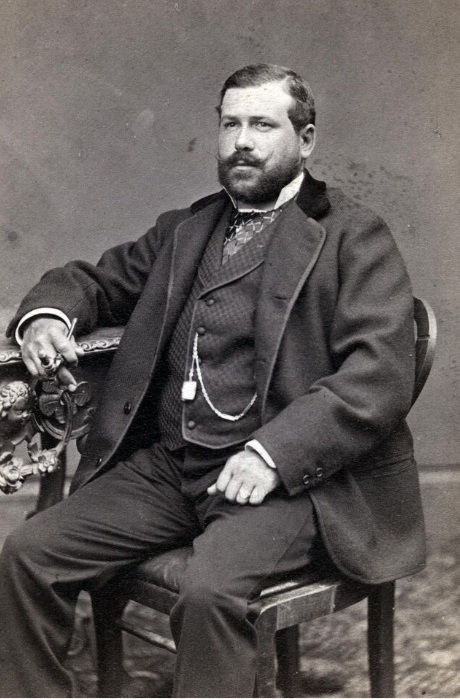
Above: Josef Bratfisch. Photo credit: Anton Baschta (-1927?). Source: Osterreichische Nationalbibliothek (Austrian National Library)
1. Josef Bratfisch
Josef Bratfisch was born in Vienna in 1847, the son of Franz Bratfisch, a master saddler. At the time of the Mayerling tragedy he was 41 years old and worked as a driver for the Leopold Wollner cab firm.
Josef was married to Johanna, the widowed mother of two children whose first husband had been a cab driver. Josef's stepson, Josef Linka, also drove for Wollner. His stepdaughter Antonia, at 17, was the same age as Baroness Mary Vetsera.
As was common in the horse-cab era, Vienna had a two-tier cab system divided between "numbered" street cabs, which displayed license numbers and trolled for fares in the street or waited for them on cab stands, and "unnumbered" cabs which were hired directly from the stable, usually by the hour.
The unnumbered cabs were analogous to hired limousines and served a clientele that had higher incomes and higher pretensions than street cab customers. This clientele included people who had carriages and horses of their own but who preferred to take cabs to theatres, restaurants, house parties and other venues.
Cabs hired by the hour were expected to wait outside until their customers were ready to go home, or go on to their next destination. Standing for hours in the street was hard on horses, especially in bad weather, so these people hired cabs rather than expose their own carriage horses to this kind of punishment.
For people not quite wealthy enough to maintain carriages of their own, the unnumbered cab allowed the pretense, or fantasy, of belonging to the carriage trade.
The elevated status of the unnumbered cab rubbed off on the driver who was called a leibfiaker (personal coachman), a cut above the ordinary fiaker (cab driver) or kutscher (coachman). The distinction was important enough for Josef to have it inscribed on his tombstone.
Josef originally held Vienna street cab license 104 and worked from stands in three Vienna districts, Leopoldstadt, Aspernbrücke, and Ferdinandsbrücke (Friedrich), but by the 1880s he was driving an unnumbered cab which meant that he was trusted by Wollner to dress and behave in a manner that would meet the expectations of class-conscious customers.
And there was something else that set Josef apart from his fellow cab drivers – he was a well-known Viennese nightclub and music hall star.