




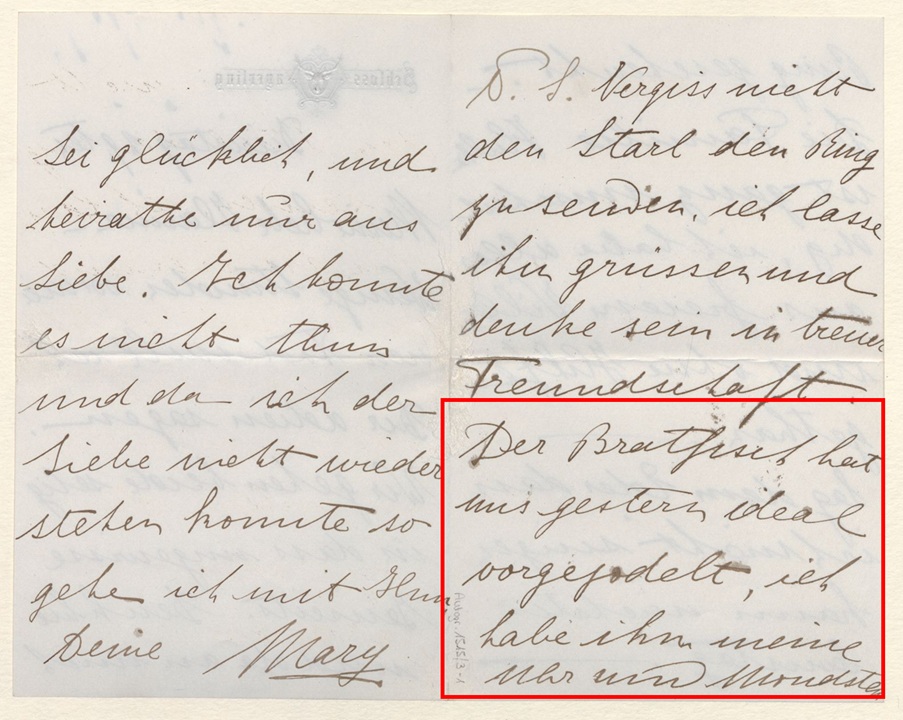
Above: Pages from Mary's letter to her sister Hanna with the reference to Josef's yodeling.
Source: Osterreichische Nationalbibliothek (Austrian National Library)
13. The Last Night (continued)
The postscript to Mary's letter to Hanna refers to Josef: "Bratfisch yodeled perfectly for us yesterday, and I gave him my watch and moonstone ring."
Josef's stepdaughter Antonia saw the watch and ring and described them as "a small gold ladies' watch with diamonds, a pearl-studded sports chain, and a hanging gold ring" (Konhäuser).
For 125 years it was believed that Mary's last letters were lost or destroyed. However, Helene had included transcriptions in the lengthy memorandum she composed to defend herself and Mary from the gossipy accusations that swirled around them after Mary's death (Vetsera).
Helene's memorandum remained the authority for the content of Mary's letters until 2015 when the originals surfaced during an audit of a bank's safe deposit boxes (Jilek).
The original letters confirmed the accuracy of Helene's transcriptions, aside from a few details. One detail was the reference to Josef, which Helene did not publish.
However, another version of one of the letters was printed in the Paris newspaper Le Figaro of February 8, 1889. This version quoted Mary as writing that "Bratfisch whistled wonderfully tonight."
"Unbelievably, the Baroness Vetsera [Helene] had made... [Mary's letters] available to a small circle of friends. No doubt it was from this 'small circle of friends' that copies of the letters reached the Paris Figaro" Le Figaro purported to publish Mary's letter to her mother but instead paraphrased her letter to Hanna, suggesting that the newspaper did not have an actual copy of the letter but relied on somebody's memory of reading it.
In any case, Le Figaro's statement that Josef "whistled wonderfully tonight" (i.e., the night of January 29th) became the accepted version until the original letters revealed that he "yodeled perfectly for us yesterday" (i.e., January 28th, the day or evening of her arrival at Mayerling).
The documents discovered in 2015 include more evidence that Josef entertained Mary and Rudolf at Mayerling: a manuscript four-verse poem entitled "Mein lieber Wienerwald!" ("My Dear Vienna Woods") inscribed (apparently by Hanna) with these words: "Written by Josef Bratfisch" and "Sung by Bratfisch on the evening of the [January] 29" (Jilek), although the 28th seems more likely.