




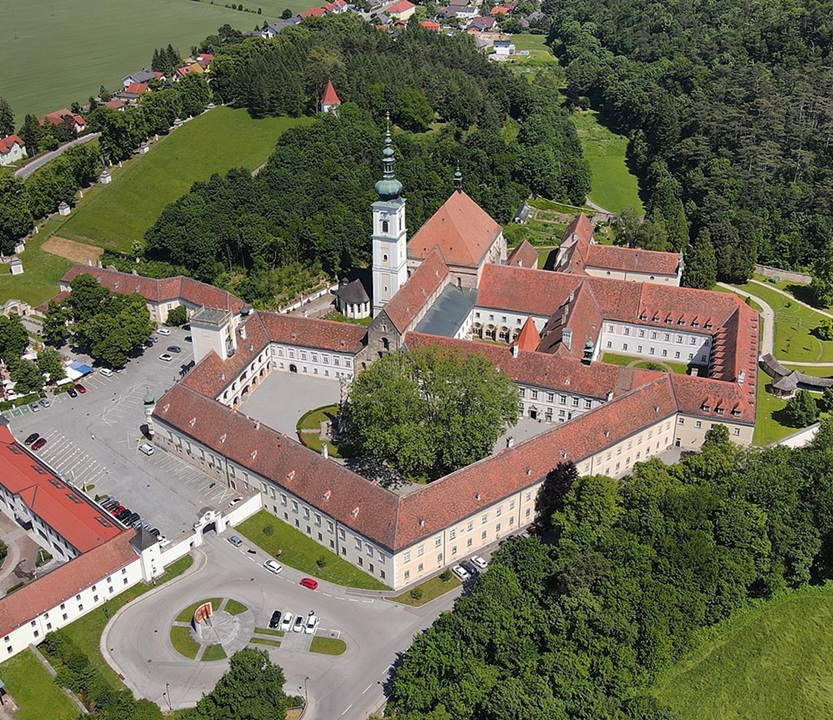
Above: Heiligenkreuz Abbey in 2021 (detail). Photo credit: Copyright C.Stadler/Bwag
Source: Wikipedia: Heiligenkreuz Abbey
16. Mary's Burial (continued)
Soon after Taaffe's briefing Krauss was summoned to a meeting with Count Bombelles who gave him a letter addressed to Abbot Heinrich Grünböck of the Heilignenkreuz Abbey. The letter requested, on behalf of the emperor, that Mary be buried at the Heiligenkreuz cemetery and that the interment take place during the night. Krauss dispatched police commissars Gorup and Habrda to deliver the letter to Grünböck.
The decision to inter Mary at Heiligenkreuz was likely based on the assumption that the burial would attract less attention there than at Alland, which was closer to Mayerling. In her last letter to Helene Mary expressed the wish to be buried with Rudolf at Alland. Oddly, in his letter to Empress Elisabeth, Rudolf asked to be buried with Mary at Heiligenkreuz. Neither of them got their wish.
The request for a night burial was only one grim detail of a grotesque charade that was to be inflicted on Mary. The other details were revealed to Helene by her brother-in-law, Count Georg Stockau, who was married to Helene's sister Eveline.
Mary was to be, in effect, smuggled out of the hunting lodge seated in an open carriage to give the impression that she was alive and to make witnesses assume that she was an anonymous lady visitor to the lodge.
Stockau had been put under severe pressure by Franz Josef's Lord Chamberlain, Prince Constantine Hohenlohe, to agree to this plan and to persuade Helene to accept it as well.