




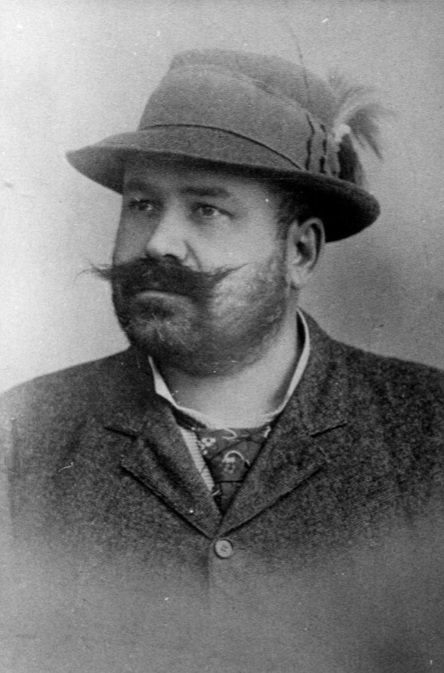
Above: Josef Bratfisch, 1892 (detail). Photo (mistakenly?) attributed to Albert Hilscher (1897-1964) who was born 5 years after Josef died. Source: Osterreichische Nationalbibliothek (Austrian National Library).
17. Interrogation
Josef's stepdaughter Antonia recalled that he did not return home for four days, but on his return he was interrogated several times by Baron von Krauss.
The purpose of the interrogations was not only to find out what Josef knew about the deaths of Rudolf and Mary – it was also to ensure that Josef did not pass on his knowledge to anyone else.
Krauss found Josef to be a reluctant interviewee, unwilling to volunteer anything beyond answers to direct questions, and it was only in response to Krauss's "most insistent behaviour" that Josef "willingly and voluntarily" agreed to the statement compiled from his answers.
Despite this, Josef made a favourable impression on Krauss who saw Josef's reticence as proof that he could be trusted to keep his mouth shut.
Reporting to Count von Taaffe, Krauss wrote: "Based on the impression I gained of Bratfisch, I assume that he will maintain confidentiality towards everyone" (Hummelberger 290).
"Nevertheless, I have, of course, given orders that Bratfisch will be observed for the foreseeable future and have strictly ordered him not to make any reports of his observations to anyone, and especially to newspaper reporters who approach him."
Krauss did, however, confess to one lingering doubt. Josef, he told Taaffe, was a "quartelstrinker" – that is to say, a periodic binge drinker who might only get drunk four times a year but who on such occasions, though an "otherwise discreet man," might "let slip a statement that he would later regret" (Hummelberger 291).
Krauss offered no evidence for his conclusion that Josef was a binge drinker, but it became one of the Mayerling legends. Indeed, "As late as the 1950s, his elderly stepdaughter Antonia tried in vain to combat her father's reputation as an alcoholic" (Friedrich).