




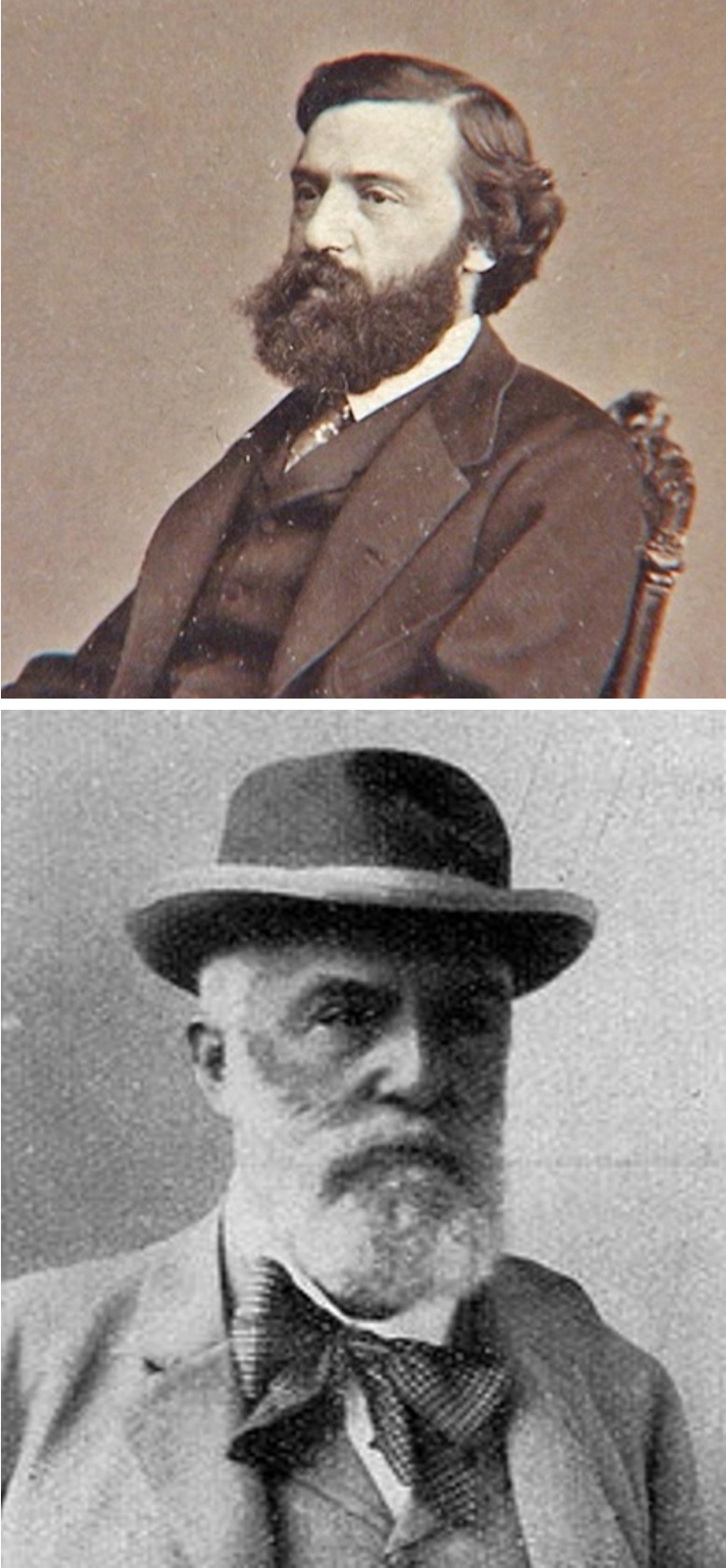
Top: Gustav Pick in the 1880s (detail).
Source: Burgenland.orf.at (regional news webside for Burgenland State, Austria), Kultur: Gustav Pick und das Fiakerlied.
Bottom: Gustav Pick in later years.
Source: Karen Kiradi, Gustav Pick (1832-1921) Schöpfer des Fiakerliedes in Geschichten und Geschichtliches um zen Zentralfriedhof (blog)
Appendix:
I used to be a stable boy for Prince Esterhazy, in his big stable full of grey horses. That was my greatest pleasure. I should have been a groom for his highness, but I enjoyed driving a carriage. The old prince was noble, a gentleman. But I was embarrassed by having to wear livery. It bothered me to sit so stiffly on the carriage box, wearing fur like a bear, and shaving off every whisker as if I were an actor. I wasn't born for that. That's why I became a cabbie.
A cabbie has to be what they call "discreet," he has to listen, charm, keep quiet; he has to be clever and -- nice and dignified. Often gentlemen hire us to go to Number One, a place that Count Lamezan doesn't like, but he'll never know. Often two lovers get in the cab and I realize, that's not proper, but I'm so discreet. If someone asks who the lovers were, I just drive on. The horses help because nobody can catch up with us. And if anyone wants to find out something from me, he fools himself because I can lie.
Cabs often served as rolling bedrooms for couples who couldn't find privacy elsewhere. See Les Femmes Cocher: A Cocher Miscellany.
Every year on Ash Wednesday, we have a Fiakerbal, everybody is thrown together, and yet there is no scandal. Lots of noblemen and lots of coachmen, they sit together nicely, because the whole gathering is just one "elite ball." The young people are dancing, we old people are watching, we just enjoy it. The singer "Laut Schan" is bellowing "Duliäh." The Schrammel brothers are playing too, Bratfisch is singing along, and our ball isn't over until the sun shines in the morning.
The greatest fun for me is riding in a fiaker race. The Viennese people love it. They flock there in droves. There are 20 carriages all lined up together. The coachmen and the horses are completely unruly today. The starter gives the signal, and they take off like lightning. At first everyone is clawing back and forth in one big mob. But I'm already away with my black horses. They'll keep me out of the crowd. If the others mess up, I'll be first. That'll be a joke! I rush along with my hat pulled down. Ten thousand people shout "Vivat!"
Gustav Pick and Wiener Fiakerlied (continued)
Verse 2:
Verse 3:
What "Number One" was is now lost to history, but presumably it was a notorious destination that required discretion on the part of the cabbie. Count Lamezan is Count Eduard Lamezan-Salins who was the Austro-Hungarian Chief Justice at the time. When the Ring Theatre fire occurred in 1881 Lamezan was one of the rescuers who pulled injured people to safety. With Gustav Pick's friend Count Hans Josef Wilczek he co-founded the Vienna Volunteer Rescue Society.
Verse 4:
Verse 4 celebrates the annual Fiakerbal, and mentions Josef Bratfisch, the Schrammels and another performer called Laut (Loud) Schan Jean.
Verse 5: