


Click on the picture to see a larger version.
City pavement made rubber tires a necessity. Pneumatic tires (introduced on Paris horse cabs in 1904) provided more passenger comfort than solid rubber but they were subject to punctures. The best quality solid rubber tires were formed around a steel wire core but they required a special machine to fit them onto wheels. Cheaper tires were made up of curved pieces of solid rubber that could be separately attached to a wheel. An important advantage was that damaged sections could be removed and replaced without having to discard the whole tire. This picture shows a late innovation -- tires made of uniform, solid rubber knobs.
Source: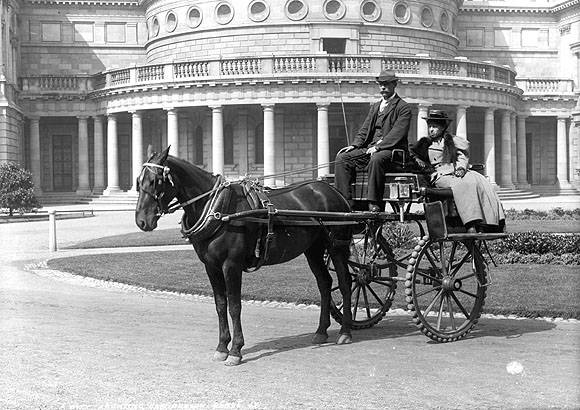
A city jaunting car, Dublin. Photo taken between 1930 and 1950.
Reproduction rights owned by National Library of Ireland (call no. VAL 26896).
Click here to view source.
Bloomsday for Cab Drivers / 17
The Jaunting Car / 4
The jaunting car was also called and "Irish" or "Dublin" car, a "side" car and sometimes an "outside" car (possibly because the passengers' legs hung outside the vehicle). Joyce also refers to them as "hackney" cars, hackney being an old word meaning "for hire". At the same period the legal term for a London cab was "hackney carriage".
As with cab vehicles in other cities, the Dublin jaunting cars were licensed and numbered. Here is one of two appearances that car number 324 makes:
The jaunting cars in Ulysses are rubber-tired, so apart from the clip-clop of the horses' hooves, the chief sound they make is the jingling of harness bells:
Jingling on supple rubbers it jaunted from the bridge to Ormond quay. [11 304 / 12786]
A HACKNEYCAR, NUMBER THREE HUNDRED AND TWENTYFOUR, WITH A GALLANTBUTTOCKED MARE, DRIVEN BY JAMES BARTON, HARMONY AVENUE, DONNYBROOK, TROTS PAST. BLAZES BOYLAN AND LENEHAN SPRAWL SWAYING ON THE SIDESEATS. [15 3726 / 24010]
He eyed and saw afar on Essex bridge a gay hat riding on a jaunting car. It is. Again. Third time. Coincidence.