


Click on the picture to see a larger version.
A photo taken during the Civil War. Although the jaunting car was designed for a maximum of four passengers, overloading was apparently common. A comic postcard entitled "The Capabilities of the 'Oirish Jauntin' Car'" depicts a car loaded with the driver, nine adult passengers, three small boys and a pig. But this was no doubt an exaggeration (see www.joyceimages.com).
Source: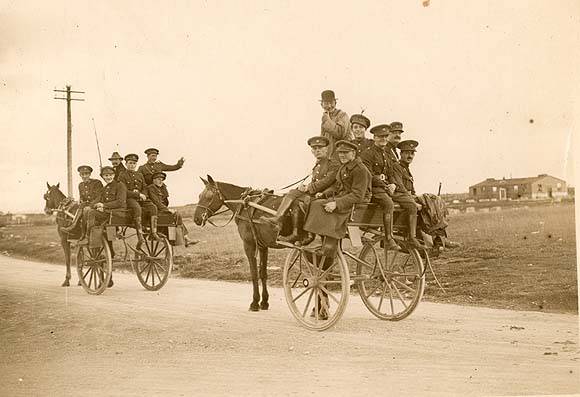
Two Irish hackney cars, formerly used by the British Military, at the Curragh Camp bringing National soldiers from the races. Photograph by W.D. Hogan, September 26, 1922.
Reproduction rights owned by National Library of Ireland (call no. HOG92).
Click here to view source.
Bloomsday for Cab Drivers / 18
The Jaunting Car / 5
In Episode 11 Joyce uses the jingling of the harness bells as a kind of poetic shorthand for the jaunting car itself:
The harness bells on the rubber-tired jaunting car were probably a safety feature designed to alert pedestrians and other drivers.
When the first solid-rubber-tired horse cabs went into service in London about 1880 they ran so silently -- at least compared to the steel tired traffic -- that people sometimes did not hear them approaching. Harness bells were introduced to remedy this problem.
Similarly the first traffic bylaw passed in Winnipeg required that bells be put on carriages and sleighs during the winter months because snow on the streets tended to muffle the familiar sounds produced by vehicles and horses.