• Driver Profiles
Timothy Ross Alward London, Ontario / January 2, 1974 At about 8 p.m. on the evening of January 2, 1974, an 18-year-old woman called the Checker Cab Co. from a phone booth near a John Street apartment block and asked for a cab to take her and a 22-year-old male companion to Union, a village near Port Stanley, Ontario.
Timothy Ross Alward, 20, was dispatched in answer to the telephone call. When the cab reached Union the man directed him to stop in a driveway and then shot him four times, pausing to reload his two-shot derringer pistol. Mr. Alward was hit in the head, back, neck and upper chest. His body was found in the snow outside the cab.
According to witnesses at the John Street apartment the man had showed off a gun prior to the phone call and talked of robbing a taxi driver on the way to Port Stanley, declaring that he would shoot the driver if "hassled". The apartment tenant, a former taxi driver, suggested Checker Cab as the best company to call for this purpose. The woman was allegedly present when these statements were made.
The killer pleaded guilty to non-capital murder and was sentenced to life in prison with no possibility of parole for ten years. The Crown applied unsuccessfully to have parole eligibility postponed to fifteen years. A psychiatrist called by the defence testified that the killer had a treatable personality disorder and that extending the parole eligibility period beyond ten years would make treatment more difficult. In refusing the Crown's application, the judge expressed confidence "that this person will not be paroled at any time in the future unless he is no longer a danger to the public."
The woman was also convicted of Mr. Alward's murder. She was found in possession of Mr. Alward's coin changer and her statement to police indicated that she was aware of the plans to rob a taxi driver. Section 21(2) of the (then) Criminal Code provided the main grounds for her conviction -- namely, that she participated in the planning of the robbery, that she knew the killer was armed, that she "ought to have known" that he would use the gun if necessary, and that Mr. Alward had in fact been shot to death by the killer.
On appeal, the woman claimed that she had not been present when the robbery was discussed and that the details she gave in her statement to police had all been communicated to her by the killer after the murder had taken place. She also claimed that the killer had forced the coin changer on her.
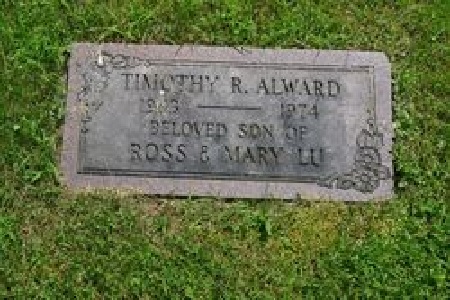
[Next column] Grave of Timothy Ross Alward, Kilmartin Cemetery, Middlesex County, Ontario. Photo by Ron Spurr (Source: FindaGrave.com)
The Ontario Court of Appeal noted that most of the evidence of the woman's complicity (other than her own statement to police) depended on witnesses who were themselves implicated in the crime, either as accomplices or accessories after the fact (the apartment tenant who had suggested calling Checker cab was later convicted on unrelated charges). The court decided that the judge in the original case had not sufficiently instructed the jury as to the need for caution in accepting this kind of testimony. As a result the woman's conviction was overturned and a new trial ordered.
The killer was released on a temporary absence in August, 1981. When he failed to return on September 1, a Canada-wide warrant was issued for him. He was arrested four months later, on January 8, 1982, in Amherstburg.
The killer died in an automobile accident on October 11, 1993.