• Driver Profiles
William Alexander Alward St. John, New Brunswick / February 15, 1970 William Alexander Alward, 41, had driven for Vet's Taxi in St. John for three years. He and his wife Genevieve had three daughters, one married and two others, aged 18 and nine, living at home.
At about 4 o'clock on the morning of February 15 he was dispatched to the Glen Falls restaurant to pick up an order of food and deliver it to a house on Metcalfe Street where a party had been going on for several hours.
At the house, a 22-year-old man hired him to drive to the west side of the city. According to witnesses the man had drunk half a dozen quarts of beer and some wine.
When they got as far as the MacKay Highway the man ordered Mr. Alward to continue driving. However, perhaps suspecting that he was being set up for a robbery, Mr. Alward turned around and drove back toward downtown.
At that point the man shot him three times, then robbed him of $22 and five cents.
Three bullets were recovered from Mr. Alward's body. The fatal bullet entered his right side and lodged in his pelvic area. Another bullet hit him in the left side of his neck.
After the killer left the cab, Mr. Alward was able to drive to the nearest police station. Hearing a noise, a police officer came out ot a back room and found him slumped over the counter. Mr. Alward tried to walk but fell to the floor. Another officer drove him to hospital.
Mr. Alward was able to tell police where he was robbed and officers were immediately dispatched to the area. They soon located the killer and arrested him. He was carrying an eight-shot .22 calibre revolver and Mr. Alward's $22 in bloodstained bills.
The killer was charged with non-capital murder and went to trial in May, 1970.
The jury had the option of convicting him of either non-capital murder or manslaughter. The judge's instructions laid heavy emphasis on the need to consider whether the accused was capable, in his intoxicated condition, to form the intent to murder. The jury evidently had doubts on this point and returned a verdict of manslaughter. The killer was sentenced to five years in prison.
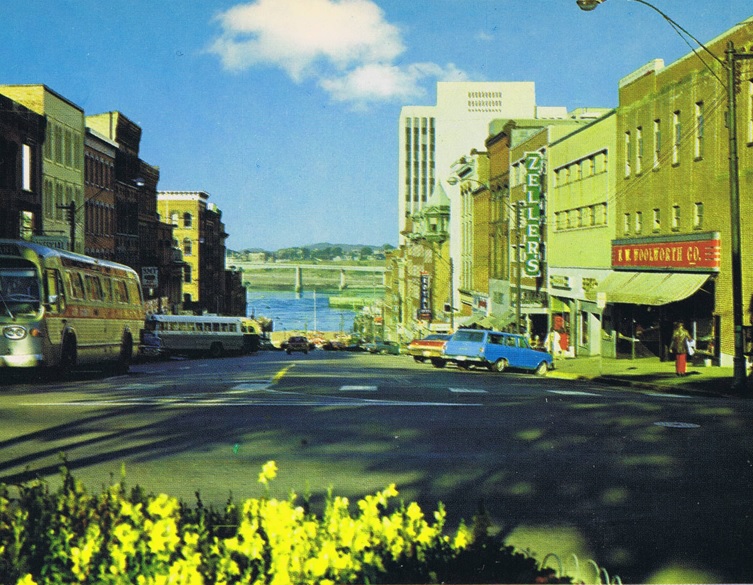
Historic King Street, Saint John, New Brunswick, Canada [detail from postcard, circa 1970]. Photo by E. Otto (Source: Karen Carruthers, The Postcards of Father Maurice)
The Crown appealed the conviction to the New Brunswick Supreme Court on the grounds that the judge did not instruct the jury properly with respect to murder committed in the course of an armed robbery. They also argued that the sentence was inadequate in view of the seriousness of the crime.
The court ruled that the judge in the original trial should have pointed out to the jury that a person who was too drunk to form the intent to murder might nevertheless be capable of forming the intent to commit robbery; and that under the Criminal Code a person who caused a death in the course of an armed robbery could be found guilty of non-capital murder whether or not there was a specific intent to murder.
The court granted the appeal and a second trial took place in November, 1970. The killer was convicted of non-capital murder and sentenced to life in prison.