• Driver Profiles
Elmer Battler Kitchener, Ontario / July 13, 1945 Elmer Burton Battler, 37, was a labourer in a meat packing plant who drove a taxi part-time. He was married with two young children, one of them only seven weeks old.
On the evening of July 13, 1945, a man with a loaded .22 calibre rifle hired him for a trip outside of town to shoot groundhogs. As they drove along the Kitchener-Guelph highway toward Bresleau, about five miles (8 km) west of Kitchener, the man spotted a target in an adjacent field and asked Mr. Battler to stop.
According to his story, as the man got out of the cab his rifle accidentally discharged, hitting Mr. Battler in the side of the head. The bullet passed through his left cheek and into his brain, killing him instantly.
The man drove Mr. Battler's body to a police station and reported his death as an accident. The man was released without bail on condition of appearing at a coroner's inquest. The inquest ruled Mr. Battler's death to be accidental and the man was not charged.
In the following years the killer became an alcoholic and drug abuser and on three occasions was confined to hospital for psychiatric reasons.
Twenty years after Mr. Battler's death, in November, 1965, he confessed to his therapist that he had murdered Mr. Battler with the intention of robbing him. He later told the same story to a co-worker who, at the killer's request, reported his confession to the London police.
The killer was charged with capital murder but the judge accepted a plea of guilty to non-capital murder. This became the basis of appeal on the grounds that a jury was needed in order to return a verdict of guilty to the lesser charge.
The killer was granted a new trial on the charge of non-capital murder and this time he was found guilty. However, the conviction was appealed on the grounds that the trial judge had too severely restricted the scope of testimony by psychiatrists called by the defence.
The burden of their testimony was that the accused was susceptible to making false confessions. He now claimed that he had confessed to the crime in order to gain attention.
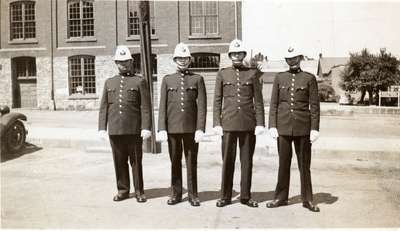
Kitchener police constables, circa 1942. (Source: Kitchener Public Library)
The Ontario Court of Appeal granted the killer a new trial, but also noted that the previous jury had not been allowed to hear certain evidence against him:
"After the death of Battler the appellant was said to have threatened his friend.... with a pistol, and during the ensuing conversation she said: 'You will never get away with this.' He replied: 'I did once.' She then said 'Don't tell me that wasn't an accident, and he answered 'Yes, that was [not an accident], and I can make this look like one too.'"
Nevertheless, the killer was found not guilty in the third trial. The Crown's application for permission to appeal this decision to the Supreme Court of Canada was denied.
This case provides a strange parallel to the Albert Richer murder in 1947 and the W. James Edwards murder in 1948.
In the Richer case, a man confessed to the murder 25 years after the fact and psychiatric testimony about the susceptibility of the accused to making false confessions was a key factor in his acquittal.
In the Edwards case a man confessed to witnessing the murder in 1971, 23 years after it took place. In this case the confession did not jibe with key evidence.