• Driver Profiles
Patrice Beaulieu Dégelis, Québec / November 7, 2001 Patrice Beaulieu was apparently shot to death when he balked at allowing his cab to be used to transport drugs.
Mr. Beaulieu, 19, had been driving for Taxi Dégelis, the company operated by his father and mother, for nearly two years. Before that he had worked for the company as a dispatcher. On September 17, a few weeks before his death, he acquired his own cab and proudly announced the fact on his personal web page.
Mr. Beaulieu was a member of #urgence911, an internet discussion group devoted to emergency services, and hoped to become a firefighter. "Patrice loved the firefighting profession above all," read an obituary posted on the #urgence911 home page. "His first appearances on our list took place in 1999 and he became a regular contributor from the end of 2000. This young man always behaved in a polite and gentlemanly way on the list. We will all treasure the memory of this young man."
At about 11:30 on the night of November 6/7, 2001 the killer and a fellow drug-dealer left a local bar to pick up and distribute shipment of "merchandise". The killer called for a taxi from the phone booth in front of the Georges Deschenes Cultural Centre and the pair was picked up by Mr. Beaulieu.
The 23-year-old killer was a regular customer of Taxi Dégelis and well known to both Mr. Beaulieu and his parents. Mr. Beaulieu's mother, who was dispatching that night, recognized the man's voice. The second drug dealer shared an apartment with the killer.
The family was also aware of the man's reputation. The killer allegedly complained to his supplier that Mr. Beaulieu had been spreading word in the small community about his drug dealing. According to police both the drug dealers had direct links to the Québec chapter of the Hell's Angels.
The taxi stopped at a residence in St.-Jean-de-la-Lande where the two men consumed alcohol and drugs and picked up a teenage girl. The killer then directed the cab to a second address, saying that he wanted to make a delivery. Afterward the killer asked Mr. Beaulieu to stop a third time so that he could get out and urinate.
By now Mr. Beaulieu had evidently become suspicious. When the killer returned to the car Mr. Beaulieu refused to go further without knowing the destination. The killer told Mr. Beaulieu to do his job and not ask any questions.
An argument ensued and the killer struck Mr. Beaulieu four times on the back of the head with his 9 mm pistol, one of the blows breaking the skin. As the second drug dealer got out to intervene (he said his own large size prevented him from restraining the killer from inside the cab) Mr. Beaulieu was shot eight times with hollow-point bullets.
Just before midnight at the taxi dispatch office Mr. Beaulieu's mother heard three rapid clicks of the microphone button -- a prearranged distress signal -- and then screams of terror. When there was no response to radio calls Mr. Beaulieu's sister tried to contact him by cell phone and pager. When that failed they called 911.
At the sound of gunfire the second drug dealer ran for cover. The teenage girl, sitting in the front seat beside Mr. Beaulieu, was splashed with the victim's blood. She too fled.
The taxi was being followed by a third accomplice in a van. The killer caught up with both his fellow passengers, forced them into the van and took them back to his apartment. He threatened to kill them if they talked about the murder.
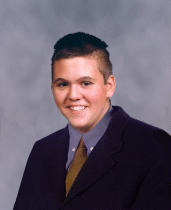
[Next column] Patrice Beaulieu. (Source: Photo posted by Patrice Beaulieu with a brief biographical note on his personal web page; no longer accessible.)
Meanwhile another taxi driver was sent looking for Mr. Beaulieu and found the car parked in front of a house, its lights on and the engine running. Police arrived on the scene about 12:30. The homeowner told of hearing shots fired at about the same time that Mr. Beaulieu sent his distress signal.
At first the Sûreté du Québec had few clues in the case but residents of Dégelis quickly came forward to identify the suspects. The SQ acknowledged that it was largely thanks to assistance from the community that they were able to make the arrests. Nevertheless the investigation took three months, involved more than 20 officers in five cities and required 250 interviews.
The preliminary inquest found too little evidence against the van driver to charge him with being an accessory after the fact. However the killer was tried and convicted of second degree murder. He was sentenced to life imprisonment with no possibility of parole for 12 years. When the verdict was announced the killer's emotionless facade broke down. He burst into tears and seemed barely able to stand up.
At his sentencing the judge in the case remarked on the killer's evident lack of concern for the victim, the cold-blooded manner in which he denied any responsibility for the crime and his shameless attitude toward drug dealing. Nevertheless he refused to deny parole for 15 years, saying he was not convinced that the killer presented a threat to society.
Mr. Beaulieu's parents were not impressed with the sentence. "With the little sensitivity he demonstrated during the trial, if he gets out before the next 50 years, it's certain that he'll kill somebody else," said Mr. Beaulieu's mother.
In 2006 the killer appealed his sentence, claiming that he now had a witness to refute the second drug dealer and the teenage girl, as well as a statement from someone who claimed to have overheard the girl boasting that she herself killed Mr. Beaulieu. The appeal was dismissed.