• Driver Profiles
Wilfrid Dumais Trois-Pistoles, Québec / July 1, 1948 At about 8 p.m. on the evening of July 1, 1948, three young men were returning from the St.-Arsène sawmill with a truckload of wood. As they drove along the back road between Cacouna and St.-Modeste they saw a car parked on the wrong side with one of the front wheels in the ditch. The car had not been there when they passed by the spot on the way to the sawmill about 45 minutes earlier.
Stopping to investigate they found the right front door open. Traces of blood were visible on the front seat and the windshield was shattered. There was a 12-bottle beer case in the back of the car and a jacket on the back seat. A cap lay on the ground near an empty beer bottle.
The men were about to leave when they came across the body of Louis-Philippe Breton, manager of the Banque Canadienne Nationale at Trois-Pistoles, lying about 75 feet in front of the car. Mr. Breton, a slightly-built man of 53, had been beaten almost beyond recognition. His face was covered with blood and his left eye was gouged out, apparently by having a gun barrel rammed into the socket. He was still breathing at the time but soon died from the effects of multiple blows to the base of his skull.
As the men hurried to summon help from a nearby village they discovered the partially concealed body of Trois-Pistoles taxi driver Wilfrid Dumais. The 47-year-old man was face down in the ditch about 75 feet to the rear of the car and had also been savagely beaten. Both victims were well known in Trois-Pistoles. Mr. Breton had five children and Mr. Dumais was the father of two.
A priest arrived to administer last rites before the bodies were removed to Rivière-du-Loup. Local police quickly called in the Sûreté provinciale and the scene was scoured for clues. A farmer found a cartridge from a 20-gauge shotgun and police discovered the hammer from a similar weapon.
Investigators soon learned that a third man had left Trois-Pistoles shortly after 7 p.m. on July 1, riding with the two victims in the front seat of Mr. Dumais' taxi. The suspect was a 26-year-old truck driver from St.-Guy. He was arrested in Rivière-du-Loup the next day and remained in custody as incriminating evidence piled up against him.
Police learned that at about 3 p.m. on the fatal day the man had met with Breton about three promissory notes in the banker's possession. Two of the notes, totalling over $4300, fell due later in July.
During the meeting the suspect persuaded Breton to accompany him to Rivière-du-Loup, 30 miles away, and to bring the promissory notes with him. The suspect's truck had burned two weeks earlier and he had talked about using the insurance money to pay off his debts. The insurance claim may have provided the pretext for the trip, or the suspect may have told the banker that someone in Rivière-du-Loup was willing to redeem the promissory notes on his behalf. Whatever the case the notes were conspicuously missing when Mr. Breton's body was searched although money and other valuables were left untouched.
Shortly before 7 p.m. the suspect had showed up at Wilfrid Dumais's house to hire him for the trip. Mrs. Dumais reported that he wore a cap with a glossy peak similar to the one found at the murder scene. He kept his hand in his right pants pocket and sat with his right leg extended.
Earlier that day a local barber saw the suspect on the street and noticed that he was concealing something under his shirt. That evening when the cab picked up Mr. Breton another witness thought he saw a bottle stuck into the suspect's waistband. When the suspect grabbed it to keep it from falling out the witness was able to see that the object was too long to be a bottle.
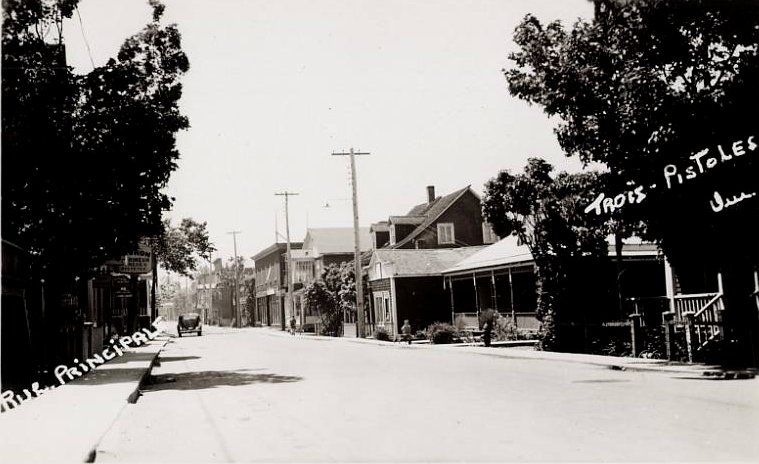
[Next column] Main street of Trois-Pistoles, Québec, circa 1940. (Source: Bibliothèque et Archives Nationales de Québec)
The object that the suspect made so much effort to hide was a shotgun that he had possessed since the previous fall, an old weapon that had at some point been coverted from a muzzle loader to a breech loader. On the night before the murders, according to a female cousin who lived in the same house, he had sawed off the stock and fired a couple of shots to test it. The gun stock, with one of his fingerprints on it, was later found under a railway car where it had been discarded.
Sometime between leaving town and reaching the murder scene the suspect moved from the front to the back seat of the cab. An autopsy revealed that Mr. Dumais was shot from behind as he sat at the wheel, which also accounted for the damage to the windshield.
Three heavy-gauge shotgun pellets were retrieved from Mr. Dumais' back and five more from his neck. However, medical examiner testified that the wounds were not fatal and may not even have caused him to lose consciousness. Both victims were beaten to death with a blunt instrument that had protrusions on it, consistent with being clubbed by a firearm.
The suspect's fingerprints were also found on three of the nine beer bottles found at the scene. None of the bottles carried fingerprints from either victim, although an unopened bottle was retrieved from beneath Mr. Dumais's body.
The beer may have been a prop that the suspect brought along to buttress an alibi. His sister-in-law testified that he showed up at her house later that night in blood-soaked clothes which he made her wash. He claimed that he, Mr. Dumais and Mr. Breton had been flagged down by three strangers and stopped to have some beer. During a political argument one of the strangers suddenly struck down Mr. Breton with a beer bottle. While the suspect ran for his life the strangers killed his two companions.
As a result of the inquest the suspect was found criminally responsible for the two deaths and was bound over for trial the following February. Despite an attempt by the defence to cast doubt on the man's mental competence a jury found him guilty of murder. He was hanged at Bordeaux prison on July 22, 1949.