• Driver Profiles
James Hickey Windsor, Ontario / March24, 1974 James Allan Hickey, 22, drove for Veteran Cab in Windsor, Ontario for less than three weeks before he was murdered on March 24, 1974.
It was a temporary job. He was recently hired to work for a mining company in Thompson, Manitoba, and was scheduled to fly there on April first. The plane ticket was found on his body.
Mr. Hickey lived with his 18-year-old wife Nora Johnson and her parents. The couple had a year-old son and a month-old daughter. They intended to move to Thompson once Mr. Hickey was established there.
Mr. Hickey was on good terms with his in-laws, Mr. and Mrs. Gerald Logan. Gerald Logan said that Mr. Hickey kept very much to himself but was easy to get along with.
"He was a very conservative, very honest fellow who deserved better than he got."
Mrs. Logan cut Mr. Hickey's shoulder-length hair short in preparation for his new job. She remembered how excited he was when he returned from the airport with his ticket.
Mr. Hickey was last heard from about 2:30 a.m. on Sunday, March 24, when he reported dropping off a fare at Isack Drive and Wyandotte Street East.
His abandoned taxi was found about 12:30 p.m. Sunday in the 400-block of Church Street, not far off Wyandotte Street West and about 9 km (5.5 miles) from where he dropped off his last fare.
The driver's seat and back seat were splashed with blood and there was a large pool of blood on the left rear floor. Some of the blood had run down the rocker panel outside the left rear door. The microphone was dangling from its cord.
At about 2:30 p.m. two young boys found Mr. Hickey's body lying face up in a frozen, snow-covered field behind 887 Francois Court, just north of Wyandotte Street East and about 4 km (2.5 miles) west of his last reported location. He had been savagely beaten and his face was covered with blood.
There was a hole in his forehead above the right eye. Death was caused by brain lacerations due to a skull fracture. The autopsy indicated that he might have lain unconscious in the field for several hours before he died, sometime between 4 a.m. and 8 a.m.
At first Windsor police suspected that Mr. Hickey's murder might be drug-related.
"At one time he was involved with narcotics, but cut all his ties about a year or so ago," said Mr. Logan. At that time Mr. Hickey had gone to the RCMP with Mr. Logan and turned in "some stuff."
Mrs. Logan said that Mr. Hickey seemed worried and upset about something before he left for work on Saturday.
Nora Johnson said that for the previous week he appeared to be afraid of something. He had trouble eating and sleeping and his nerves seemed to be on edge. He told Mr. Logan "he thought maybe the RCMP was tailing him to see if he was keeping straight."
However, the drug theory was abandoned when Windsor police arrested a 29-year-old Michigan man at a local motel on April 8 and charged him with possession of a restricted weapon, a .32 calibre pistol.
Further investigation led them to another Michigan man, 43 years old, who had recently moved into an apartment on Wyandotte Street West a little over two blocks from where Mr. Hickey's taxi was abandoned.
When police searched his apartment they found a bloodstained hammer. The stains matched Mr. Hickey's blood type. The man was arrested and charged with Mr. Hickey's murder.
A woman who lived with her boyfriend at the killer's address told police that a few hours after the murder the killer asked the couple to provide him with a false alibi. Apparently he accidently hit his own finger with the hammer while attacking Mr. Hickey and smashed it so badly that the tip had to be removed. An assistant nurse reported seeing him at Grace Hospital about 6:45 a.m. Sunday.
The killer told the couple that he had been at an after-hours gambling party on University Avenue. When he tried to pick up his winnings another gambler smashed his finger. The killer said that he stabbed the man and fled.
He asked the couple to tell police that he had dropped one of the boyfriend's barbells on his finger. He smeared some of his blood on the barbell and on the floor in an effort to substantiate this story.
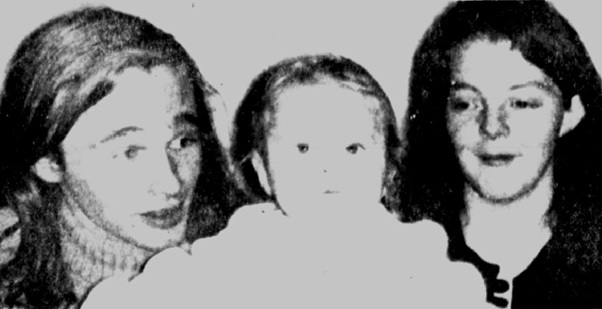
[Next column] James Hickey, Nora Johnson and their son. (Source: Windsor Star, March 25, 1974, p. 3 via Google News Archive)
The next day the killer gave the woman a blood-stained suit and asked her to try to remove the stains. She turned the suit over to police. Testing revealed that the stains on the suit, like those on the hammer, matched Mr. Hickey's blood type.
Later, in court, a man who admitted to hosting "after-hours parties" in his University Avenue residence testified that he did not know the killer and that the killer had not been at the residence on the night of the murder.
As well, a police detective testified that there were no other "after hours" clubs anywhere on University Avenue.
Under questioning by Detective-Sergeant John Laforet after the arrest, the killer admitted to escaping from Michigan's Ionia State Hospital for the Criminally Insane in the fall of 1973. He was serving a sentence of 20 to 50 years.
The killer asked Det.-Sgt. Laforet about the penalty for murder in Canada and when a person would be eligible for parole. Although he did not admit guilt the killer told the detective that "when this charge is brought against me I will plead guilty provided I do this time in Canada."
Both suspects were initially charged with murder but the charge against the first suspect, the 29-year-old, was dismissed at the prelimiinary hearing. A woman told police that she had seen him in Mr. Hickey's taxi with a concealed hammer but this was 24 hours before Mr. Hickey disappeared. There was no other evidence to implicate the suspect.
The killer came to trial in October, 1974 and took the stand in his own defence. He denied owning either the bloodstained hammer or the suit.
When his story about the University Avenue after-hours club was contradicted he changed it and said that the club was in Detroit but he could not say exactly where.
He said that he had an alibi but could not give specifics because of "the law of the cages," the code of silence that convicts imposed on one another.
The killer said that he could not have driven Mr. Hickey's taxi away from the crime scene because he did not know how to drive, this despite a previous conviction for car theft.
He refused to answer prosecution questions about his previous criminal record even after being advised to do so by his own lawyer.
The killer was found guilty of non-capital murder and sentenced to life in prison. In 1978 he was transferred to the U.S. Bureau of Prisons at Lewisburg, Pennsylvania.
In 1981 he was transferred to Leavenworth, Kansas. In 1994 he launched an appeal for habeas corpus relief claiming that his imprisonment was unlawful because he was denied parole hearings between 1981 and 1989.
The U.S. Ninth Circuit appeal court ruled that the claim was without merit. Although he was entitled to a parole hearing every 24 months, the killer had waived his right to a hearing in 1981 and failed to make the necessary requests from then until 1990.
Despite subsequent parole hearings the killer was evidently never granted parole. He died in the Terre Haute, Indiana Federal Correctional Institution in 2006 at the age of 75. The cause of death was lung cancer.
The killer spent practically all his life behind bars. In fact, from the age of seven until his death he was out of prison for a total of only three years.
He murdered Mr. Hickey during one his rare intervals of freedom and less than eight weeks before the murder of another Windsor taxi driver, Jack Tuite.