• Driver Profiles
Jack Bernard Tuite Windsor, Ontario / May 16, 1974 Just after 1 a.m. on Thursday, May 16, 1974 a resident of Lincoln Road saw a taxi crawling slowly down the back lane. It suddenly came to a stop and two people jumped out and ran away.
The taxi was still behind 1543 Lincoln with its lights on when two police constables discovered it at 3:20 a.m. The driver had been shot behind the left ear with a sawed-off .22 calibre rifle.
Jack Bernard Tuite, 59, had driven for Checker Cab for more than 15 years, full-time, part-time and as a supervisor.
This kind of guy never has an enemy, said Tom Banks, vice-president and general manager of Checker Cab. "People always say a tragedy victim was a nice guy, but in this case it's true."
Mr. Tuite was dispatched to pick up a fare on Hanna Street at 12:02 a.m. He had about $30 on him at the time but was not robbed. He was killed less than eight weeks after the murder of another Windsor taxi driver, James Hickey.
Mr. Tuite was a veteran of World War II, having served in Europe with the Canadian Armored Corps.
He didn't deserve it, said his widow, Mildred Tuite. "Overseas for three years and then to come over here for somebody to shoot him."
Since 1952 Mr. Tuite had also been a crossing guard at General Brock Public School, shepherding elementary students across the busy intersection of Brock and Sandwich streets. Principal Derek White said he never missed a day in over twenty years.
"""He always waited for the last kid no matter how long it took. He was on his corner bright and early every day.
He was gruff but unassuming. He really cared about people. The kids respected him."""
"The kids were saying, 'What's wrong with Mr. Tuite? Is he sick?'"
Mr. White said the children were informed that morning about Mr. Tuite's death "at a level they can understand."
Mr. Tuite's death provoked some discussion of protective shields but there was not much enthusiasm among drivers. The general concensus of those interviewed by Windsor Star reporter Jack Reddon was fatalistic: "If you're going to get it, you're going to get it."
One of the drivers was George Kersey who had guns pointed at him three times in two and a half years of driving. He never reported the robberies to the police, saying it wasn't worth while.
Some drivers stayed off work briefly after James Hickey was killed but his death "affected things for only a week. This will be the same, mostly it's the wives who worry," said Jim Tessier, a driver and dispatcher for Veteran Cab.
Checker Cab offered a $1,000 reward for information leading to the arrest of Mr. Tuite's killer.
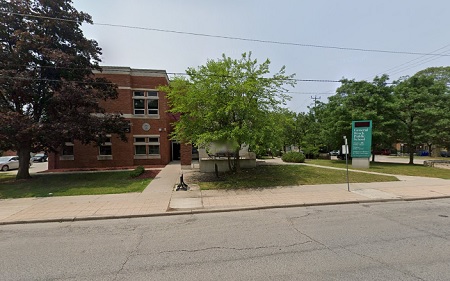
[Next column] General Brock Public School, Windsor, near the corner where Jack Tuite was a crossing guard for 22 years. (Source: Google Street View, July 2019)
Almost a year after Mr. Tuite's death, in March, 1975, Windsor police arrested a 23-year-old man and issued a Canada-wide warrant for a 19-year-old woman. She was arrested early in April.
Both suspects were initially charged with Mr. Tuite's murder. The man was convicted of manslaughter and sentenced to 18 years in prison.
In 1987, after having served 12 years (two-thirds) of his sentence, the killer applied for early parole.
During his imprisonment the killer had been transferred four times to medium-security prison but proved "too disruptive" and had to be returned to maximum security.
He was suspended from a prison drug and alcohol treatment program and refused to attend an anger control program. He was also reported to have abused his job as a window-cleaner and to have bragged that "given the parole board's female membership, he would easily have his way" and get released on early parole.
Nevertheless, with the exception of one member, a case management team recommended that the killer be released. The dissenting member wrote a minority report and urged that the case be referred to the full Parole Board for a decision as to whether or not the man should serve his full term before release.
When the case was referred to the Board, the killer appealed on the grounds that the case management review and the minority report had not been carried out a full six months before his scheduled date of parole. The appeal was lost, but the Board nevertheless decided to grant early parole.
The killer was released on Sept. 23, 1987. Apparently he violated his parole and was soon back in jail. An article on disturbances at B.C.'s Kent Maximum Security Penitentiary in April, 1990, reports that he was beaten up in his cell.