• Driver Profiles
Edgar Maltais Chibougamau, Québec / June 29, 1974 Edgar Maltais, 63, was a well-known citizen of Chibougamau, a remote mining town about 695 kilometres (434 miles) north of Montréal.
In 1971 Mr. Maltais was interviewed at a community protest organized to demand that the provincial government pave a heavily-used gravel highway that connected Chibougamau with the outside world. It was the tenth time residents had blocked the highway. The protesters included the mayor and the parish priest.
Mr. Maltais, who drove in and around Chibougamau 16 hours a day, took the opportunity to offer insights into rural taxi drivng.
"We have a beautiful road, but if you drive a car on it you'll be eating dust for hour after hour.
"We need this road. If we want to go to Lac-Saint-Jean without using it, we have to go by way of Abiibi, a small detour of 950 miles. That's a bit of a stretch!
"In Chibougamau a taxi driver has to replace his car every year. It's impossible to run the same car for two years.
"Even a car wash costs $4, expensive enough, and our cars are always getting dirty because of the gravel. And I'm not even talking about cracked windshields. Some cab drivers actually refuse trips on this highway."
In the early afternoon of Saturday, June 29, 1974 a man came to the Chibougamau taxi stand and asked to be driven to Dolbeau, 259 kilometres (162 miles) to the southeast.
Leandre Chabot was already hired for another trip but he asked the man to wait and shortly afterward Mr. Maltais arrived. Mr. Maltais accepted the Dolbeau trip and collected the $55 fare in advance. That was the last time Mr. Chabot saw his friend alive.
The passenger, a 29-year-old butcher, had arrived in Chibougamau from Dolbeau early that morning. The night before, about midnight, he called a taxi from the Hotel Saint-Louis in Dolbeau where he had been drinking heavily. He asked to be driven to Montréal but when the taxi driver, André Asselin, told him that the fare would be $150, he changed his mind and asked to go to Chibougamau.
The man was a regular customer and Mr. Asselin had driven him several times. He was drunk, but not as drunk as Mr. Asselin had seen him on other occasions. They went to the man's mother's house where he picked up some clothes for the trip to Chibougamau. Mr. Asselin charged him $90 for the night trip.
When they got to Chibougamau Mr. Asselin dropped the man at the Hotel Wacanachi. As he got out of the cab the man made a cryptic and, as it turned out, sinister remark:
"Goodbye, André. You'll be hearing about me tomorrow."
After sleeping for a few hours the man decided to return to Dolbeau and hired Mr. Maltais.
The trip was apparently uneventful until Mr. Maltais and his passenger stopped in Notre-Dame-de-la-Doré, about 50 kilometres from Dolbeau. Here the passenger purchased a .22 calibre rifle and ammunition, telling Mr. Maltais that the weapon was a gift for his father.
A few minutes later, about 20 kilometres from Dolbeau, the man shot Mr. Maltais once in the head and once in the chest and left his body in a roadside ditch.
The killer then drove the taxi to the municipal police station at Dolbeau and confessed to Segeant Bertrand Rancourt:
"I killed a taxi driver. The rifle is in the car. Come on, I'll show him to you. He's on the Villeneuve Road, the other side of the Villeneuve Road."
Sergeant Rancourt knew the killer well and was taken aback. Then he noticed blood on the man's pantleg and shoes.
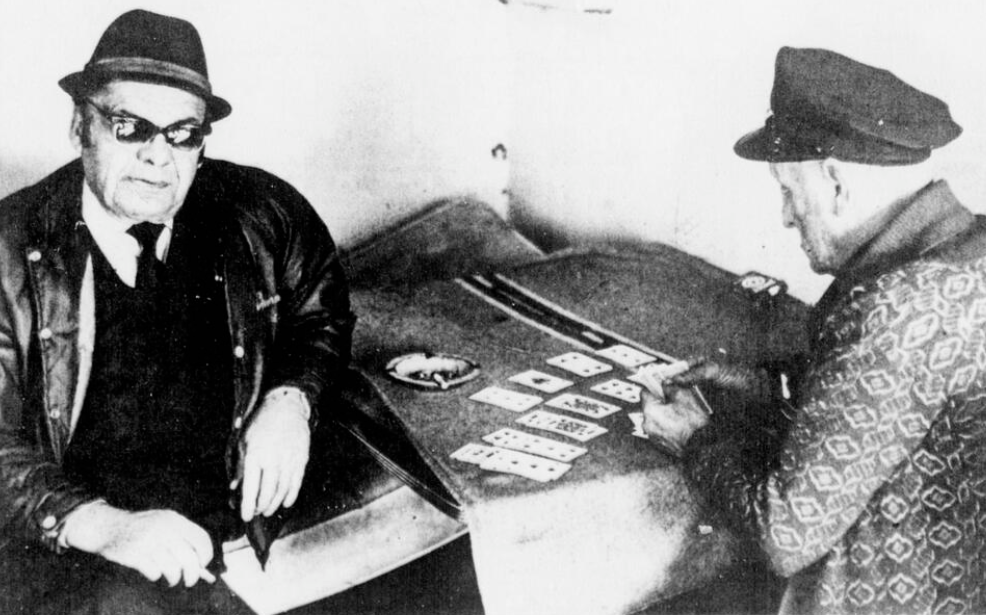
[Next column] Four months before his murder Edgar Maltais plays solitaire between trips in the "shack" on the Chibougamau taxi stand. His friend Leandre Chabot (left) spoke with the killer and saw him drive away with Mr. Maltais. (Source: Le quotidien du Saguenay-Lac-St-Jean, Friday, March 15, 1974, p. 9 via Bibliothèque et Archives nationales du Québec).
"Are you sure he's dead?" asked Sergeant Rancourt.
"Yes, I killed him."
"How did you get here?"
"In the car of the guy I killed."
Sergeant Rancourt accompanied the killer to the scene of the murder and found Mr. Maltais.
The police and prosecution theory was that killer persuaded Mr. Maltais to stop and get out of the taxi on the pretext of testing the rifle. The killer, however, claimed that he had blacked out and could remember nothing between purchasing the rifle and seeing Mr. Maltais lying dead in the ditch.
A coroner's inquest was held in Dolbeau's town hall on July 17, 1974 in such stifling heat that court was adjourned three times so that the 300 spectators, witnesses and officials could get some fresh air.
The coroner's jury found the killer criminally responsible for the death of Mr. Maltais and the next day he was formally charged with murder.
The trial took place in June, 1975 in Roberval, Québec. The same court was also scheduled to hear another case involving a taxi driver victim. The killer of Napoléon Tremblay was appealing his 1972 murder conviction.
The Maltais trial became a battle of psychiatrists, two of whom were called by the Crown and two by the defence. Their conflict was over whether or not the alcoholic killer could suffer a blackout that obliterated the murder but which left him a detailed memory of what occurred before and after.
In the end the jury found the killer guilty of involuntary manslaughter and he was sentenced to 11 years in prison. He was subsequently granted parole but a few months later he was convicted of an indecent assault on a woman. He was sent back to prison to complete his original sentence plus six months.
In April, 2001, nearly 27 years after the murder of Mr. Maltais the killer, now 56, was arrested by the Dolbeau police on suspicion of having committed an armed sexual assault. Later the same day he hanged himself in his prison cell.
At the time of his arrest the killer gave the police a false birth date which prevented them from learning about his previous criminal record. It was a relative of Mr. Maltais who came forward and revealed the truth.
"I hope the day isn't far off when I can travel on a highway that's been properly asphalted," Mr. Maltais told the reporter who interviewed him in 1971. "I've got two houses and a taxi. I'll be here for the rest of my days."