• Driver Profiles
Napoléon Tremblay Chicoutimi, Québec / May 31, 1971 Chicoutimi taxi driver Napoléon Tremblay, 56, was the father of six children. One of them, his son Carol, drove for the same company.
At about 9 p.m. on the evening of May 31, 1971 Gilles Chaput, the manager of taxi station 4230, received a call from Hôtel Chicoutimi. He dispatched Mr. Tremblay to the hotel.
Five minutes later Mr. Tremblay radioed that he was going out of town to Alma, about 60 km (35 miles) west of Chicoutimi. These were the last words that Carol Tremblay heard his father speak.
At the hotel one of Mr. Tremblay's fellow drivers, Gérard Fortin, saw him pick up a passenger who had a suitcase and a blue airline flight bag. Mr. Fortin's first thought was that Mr. Tremblay had luckily drawn a trip to the airport.
Shortly before 10 p.m. a taxi stopped in the parking lot outside Hôtel Hébert in Hébertville, about 20 km (12 miles) south of Alma. The driver immediately went to the hotel bar and asked bartender Réal Rossignol to phone for another taxi to take him to Roberval, about 50 km (30 miles) west of Hébertville.
The man seemed to go out of his way to make himself conspicuous. He wore such an ill-fitting chestnut wig that he attracted the attention of half a dozen witnesses. He also introduced himself by name to Mr. Rossignol and reminded him that he once travelled to Chibougamau with Mr. Rossignol's brother to look for work.
Driver Gratien Hudon answered Mr. Rossignol's call. He and his passenger briefly haggled over the fare (Mr. Hudon asked for ten dollars but settled for nine).
The passenger paid Mr. Hudon in advance with four two-dollar bills and four quarters. Gilles Chaput later told police that Mr. Tremblay kept a supply of one- and two-dollar bills in his left pants pocket to make change with.
During the trip Mr. Hudon's passenger chatted about people he knew in Roberval, showing that he was familiar with the area. He also told Mr. Hudon about travelling to Chibougamau with Mr. Rossignol's brother. They arrived at Hôtel Windsor in Roberval about 10:45 p.m.
Ironically given his flamboyant behaviour the passenger's parting words to Mr. Hudon were "Ni vu ni connu" ("Unseen, unknown") It was a familiar catchphrase Mr. Hudon had heard from other customers so he took no special notice.
Meanwhile police officer Roger Jean, on a routine patrol, discovered the taxi in the Hôtel Hébert parking lot and became suspicious. The headlights were on and when he looked closer he saw that the doors were unlocked and the key was in the ignition. When he went searching for the driver he learned about the mysterious man in the wig who left in a taxi for Roberval.
A call to Chicoutimi revealed that the abandoned taxi's driver was Mr. Tremblay and that he had disappeared hours earlier on a trip to Alma.
Officer Jean now became alarmed. The route from Chicoutimi to Alma went west to Saint-Bruno and then turned north. Hébertville was south of Saint-Bruno, in the opposite direction. He notified his headquarters in Alma.
At about 3 a.m. on June 1 officer Raymond Lessard of the Sûreté du Québec arrested Mr. Hudon's passenger at the Windsor. He had the blue flight bag with him and the wig was in his jacket pocket.
At first the man told officer Lessard to leave the flight bag behind because it didn't belong to him. However the Windsor desk clerk said that the man was carrying the bag when he entered the hotel and booked a room.
Then, after his arrest, the man asked a police officer to retrieve his eyeglasses from the bag and signed a receipt for them.
When the bag was opened it was found to contain, among other things, a sawed-off twelve-gauge shotgun, 15 shotgun shells, lock-pickng tools, two false mustaches and a tube of glue.
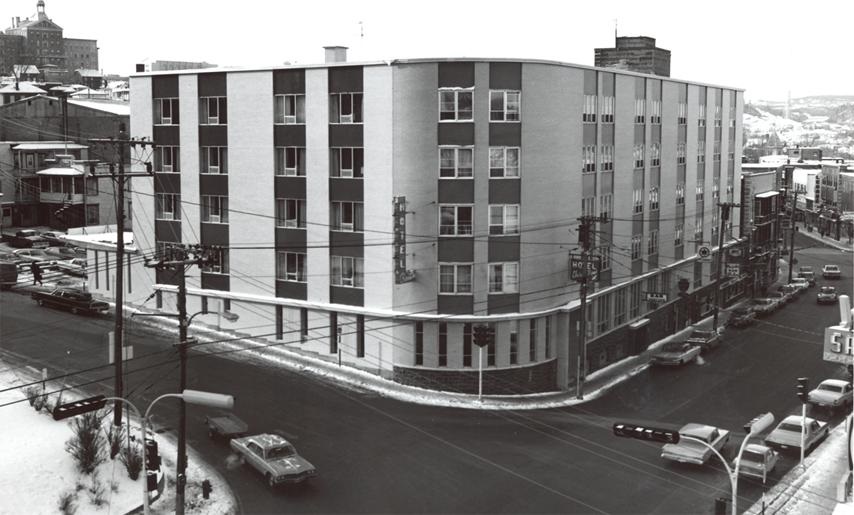
[Next column] The newly-renovated Hôtel Chicoutimi in 1969. The original hotel, built in 1899, was destroyed by fire and rebuilt in 1912. (Source: J.E. Perron construction company, Chicoutimi: historic project photos)
The 31-year-old man had been convicted of theft from a post office in 1967 and sentenced to five years in jail. In December, 1970, he was released from the Institut Leclerc, a medium-security prison attached to Saint-Vincent-de-Paul penitentiary.
He had flown to Chicoutimi from Montréal, hence the flight bag. Thanks to the lax airline security of the time he was able to board the plane with a revolver tucked in his belt.
By now officers from the Chicoutimi SQ were searching the stretch of road between Saint-Bruno and Larouche, about 20 km (12 miles) to the east, paying special attention to areas that might conceal a body.
They found Mr. Tremblay at about 3:30 a.m., after searching for about an hour. He was lying in the ditch about 6 km (4 miles) from Saint-Bruno. That afternoon, near Hébertville, searchers found Mr. Tremblay's coin changer and a .38 calibre revolver with five spent cartridges in the cylinder.
Not long after his arrest the man confessed to a police officer that he had killed Mr. Tremblay. He then dictated substantially the same confession to Sergeant Nelson Poulin. However, despite having dictated the statement voluntarily, he refused to sign it.
In the statement he said that a few miles from Saint-Bruno he told Mr. Tremblay that he did not have enough money to pay the fare and offered to cover the shortfall with a cheque.
Mr. Tremblay allegedly refused to accept the offer, stopped the car and removed the killer's suitcase and flight bag. When he could not convince Mr. Tremblay to accept his cheque, the killer "lost control" and shot him to death.
Nevertheless he kept enough self-control to steal Mr. Tremblay's money ($57 according to Gilles Chaput) and hide his body in the ditch.
An autopsy revealed that Mr. Tremblay was hit at least four and possibly five times. Two of the shots would have been fatal.
The killer's trial was held in April, 1972. Over the objections of the defence his statement was admitted in evidence. The jury deliberated for one hour and fifteen minutes before returning a guilty verdict. The sentence was life in prison.
Five years later, in June 1977, the Québec court of appeal overturned the killer's conviction and ordered a new trial.
The court ruled that the suspicious items in the blue flight bag, such as the sawed off shotgun, the lock picking tools and the false mustaches, had nothing directly to do with Mr. Tremblay's murder.
However, by itemizing them in court the Crown might have stigmatized the killer as a criminal in the jury's minds and thereby unduly influenced their guilty verdict.