• Driver Profiles
John McKechnie Vancouver, British Columbia / May 19, 1992 John McKechnie started driving a taxi in Vancouver in 1973, when he was 19 years old. "He came into the office at 19 with a class four license and said ‘I want to drive cab,'" recalled long-time friend Pat Fearon.
Mr. McKechnie spent the next 15 years driving for Black Top Cabs. "He was one of the guys that would go out and help anyone," said dispatcher Ron Christensen.
"I remember him on one graveyard [shift] volunteering to go from the Bayshore [Inn] to 57th and 9th [about nine km or six miles] to give another car a jump. The guy was always around. Any time somebody needed something he would go and help them."
Mr. McKechnie regularly attended the Central Presbyterian Church on Thurlow Street and sang in the choir. His devout demeanor often caused people to mistake him for a minister.
This impression was probably reinforced by his height (he was six foot four). "All through school, everybody called him the Gentle Giant," said his brother Mark.
Mr. McKechnie loved driving in Vancouver which he referred to as "my town," but things changed over time.
"It used to be a lot of fun driving cab. I started in the early 70s and [have] driven off and on for years," said fellow driver Bob Jones at Mr. McKechnie's funeral. "It's just too damn dangerous now. This sort of thing is going on all the time, drivers being beaten up and drivers in trouble. It's not uncommon to have two, three cars in trouble at the same time."
In 1975 someone fired a shot at Mr. McKechnie's cab from an apartment building. The bullet went through the roof just above his head. This sobering experience caused him to move briefly to Princeton, B.C. where he met his wife Moria but he was soon back driving a cab in Vancouver.
When the couple were married in 1990 Moria McKechnie persuaded John to give up taxi driving and look for another job. He was not hard to persuade. The increasing danger of night driving made him ready to move on.
Mr. McKechnie landed a job with Hertz Rent-a-Car, but he was laid off after nine months. Bills began to pile up and the McKechnies reluctantly agreed that John needed to go back to taxi driving as a stopgap until another opportunity arose. He hired on with Advance Cabs which operated a fleet of 52 cars.
"He didn't like the way things were turning," said family friend Robert Olsen. "Vancouver was turning into a pretty rough town.
"He didn't like it and he wanted to get out of it, and he got out of it. And money problems put him back into it."
Shortly before 11:45 p.m. on Tuesday, May 19, 1992, Mr. McKechnie was dispatched to a group of apartment blocks adjacent to the Blue Horizon Hotel in the 2100 block of Prince Edward Street. It was Mr. McKechnie's fourth trip of the shift on his fourth night of working for Advance.
"We heard something come over the radio to the effect of 'What's your problem' and then a moaning sound," said Jan Prins, Advance Cab's operations manager. "And that is all we heard."
Mr. McKechnie was shot three times in the head, neck and torso with a 9mm automatic pistol. Gunpowder traces in one of his eyes suggested that he saw his killer pull the trigger at least once. A witness investigating the sound of gunshots saw two people running away from the scene towards one of the apartment buildings.
Despite his absence from cab driving, Mr. McKechnie remained well known and well respected in the industry. His death sparked grief and anger among other drivers.
"It's driven the drivers into a state of panic and rage," said Jan Prins. At Advance some drivers wept when they discovered McKechnie had been murdered. Others kicked the walls in fury and frustration, said Mr. Prins.
Five of Vancouver's largest taxi fleets jointly announced that their operations would be restricted to emergency calls only during Mr. McKechnie's funeral on May 29.
On the day of the funeral an estimated 600 cabs marshalled near B.C. Place and drove a mile (1.7 km) to Central Presbyterian Church. It was the longest funeral procession in Vancouver's memory, stretching for ten blocks and taking 25 minutes to pass through one intersection.
A trust fund was set up for Moria McKechnie with individual donations matched by taxi companies, and the companies posted a $10,000 reward for information leading to the conviction of Mr. McKechnie's killer. The reward was later boosted to $50,000.
Predictably, Mr. McKechnie's murder revived the on-again, off-again debate about safety options, particularly the installation of shields.
At the funeral Bob Jones expressed the hope that safety shields would be legislated and "make it a safer situation for everyone."
"Ironically, it takes a tragedy to get people to move," he said.
Constable Gord Elias, speaking for the Vancouver Police, also supported the idea of installing "some kind of screen between the back seat and the front seat."
Harry Toor of Yellow Cab thought that it was only a matter of time before partitions started being adopted, although he worried that they might "cut out the one-to-one relationship between the driver and the passenger."
Black Top driver Len Janus did not like shields but echoed Harry Toor, saying that they would probably be introduced in the future.
"We've got a gang problem, a drug problem and we're a [sea]port. So far it hasn't been necessary. [But] I think it's inevitable."
However, spokespersons for the industry remained opposed to shields. Barry Hinks of the Vancouver Taxi Owners Association, who was heading a "crisis meeting" to discuss Mr. McKechnie's murder, said "They are going to kill you anyway and shoot through the window."
Black Top Cabs operations manager Jackie Jones said "even a shield wouldn't stop a gun." She thought a visual alarm would be better than a shield.
Al Benson, head of the B.C. Taxi Association, said shields "could create more problems" by isolating the driver. He thought a driver's best defence was "street smarts."
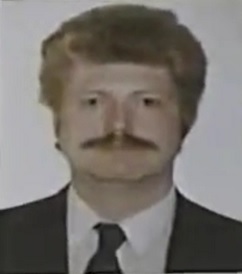
[Next column] John McKechnie. (Source: UTV, May 20, 1992. News coverage of the murder of taxi driver John McKechnie)
To encourage this, driver training included a video that showed new drivers "things to look for: Angry passengers, drunks and drug addicts."
New drivers were told that they could refuse passengers who swore at or threatened them, and that they didn't have to stop in dark alleys or isolated areas.
Such training was useful as far as it went, but it carried the unspoken and no doubt unintended suggestion that attacks on drivers were the result of the drivers failing to apply their training and street smarts.
The industry position on shields was shared by several drivers who felt that their own ability to anticipate and avoid dangerous situations was their best protection. To them the inconvenience created by shields far outweighed their supposed safety benefits.
Steen Rasmussen, a 10-year veteran Advance driver who had twice been threatened with knives, opposed shields because they would be a barrier to conversations with fares.
David Coakwell, another Black Top driver, also said screens were not the answer.
"I've never liked them. It puts you in a cage and you can't enjoy your customer. And this is not a bad city for driving. If it came to [screens], I'd probably get out [of the business]," he said.
Other Vancouver drivers echoed Mr. Rasmussen and Mr. Coakwell:
It was not until eight months after Mr. McKechnie's murder that police were able to announce the arrest of a suspect. On January 16, 1993, Vancouver newspapers reported that authorities in New Orleans had taken a 21-year-old former U.S. Marine into custody. He was being held pending extradition to Canada.
The man was stationed at Whidbey Island, Washington at the time of Mr. McKechnie's murder and frequented Vancouver's nightclub scene.
During their investigation police learned that the killer arrived at one of the apartments soon after the shooting and confessed to having shot someone. With the help of female friends living in the apartment he had disguised himself as a woman and was smuggled away from the murder scene.
Moria McKechnie thanked the police for not giving up on the investigation. "I went to John's grave at Christmas and I was very angry that I had to visit John in a graveyard because of some jerk with a gun," she said.
The killer offered various versions of Mr. McKechnie's murder. He told one woman that he and his friend, a U.S. sailor, planned to rob Mr. McKechnie for rent money. When the cab driver said that he had no cash the killer yelled at the sailor to shoot him. The sailor failed to do this, so the killer grabbed the gun from him and shot Mr. McKechnie.
Other versions portrayed the murder as an accident, with the shooting resulting from panic. Finally, when he came to trial, the killer denied all responsibility and blamed the murder on the sailor.
In October, 1994, the killer was found guilty of murder and sentenced to life in prison with no possibility of parole for 15 years.
The defence appealed the conviction on the grounds that the killer had not been properly informed of his rights by the Vancouver police officers when they picked up in New Orleans. The killer had been given a "Miranda warning" by a U.S. Federal Marshall on his arrest, but the appeal argued that this warning did not comply with the Canadian Charter of Rights and Freedoms.
The British Columbia Court of Appeal dismissed the appeal in December, 1996, but this judgement was itself appealed to the Supreme Court of Canada. In October, 1998 the Supreme Court overturned the judgement and ordered a new trial.
In July, 1999, the killer was again found guilty of murder and again sentenced to life in prison with no possibility of parole for 15 years. This judgement was the subject of another appeal because the second trial was held before a judge and not before a judge and jury.
In April, 2002, the British Columbia Court of Appeal dismissed this appeal. The defence then appealed the 1999 conviction on the grounds that the sentence was inappropriate. The British Columbia Court of Appeal dismissed this appeal in May, 2003.
After the 1999 conviction Moria McKechnie and Mr. McKechnie's brothers said that they were bothered by the killer's decision to appeal his conviction for a second time and by his lack of remorse.
"They say he's a model prisoner," said Moria McKechnie. "I think he's just a good actor. In his mind, he has done no wrong."