• Driver Profiles
Ernest Midwinter Calgary, Alberta / August 16, 1930 Ernest Midwinter, 26, drove for Bennett Taxi in Calgary. Shortly after 11 p.m. on August 16, 1930 the owner, Percy H. Bennett, received a call asking for a taxi at the Shamrock Hotel, "an obscure hostelry in Calgary's packing-house district."
Originally a harness shop, the Shamrock was converted to a hotel in 1914 by the Burns company to accommodate seasonal workers in its meat packing plant. Shamrock was a Burns brand name. The hotel survived until 2017 and in its final years was a popular music venue featuring local bands.
Mr. Bennett sent Ernest Midwinter to the hotel. Four men were waiting for him. Mr. Midwinter telephoned the office to let Mr. Bennett know that he was going out of town to Okotoks, which in 1930 was about 20 miles (32 km) south of Calgary.
Two of the four men were career criminals who in less than a year would be executed for Mr. Midwinter's murder. The other two, one of them 18 years old, had no criminal records but were willingly complicit in a plot to steal a car.
Not having seen a suitable parked car, and having failed to persuade a motorist to give them a lift, they decided to hijack a taxi. Bennett Taxi was picked at random out of the phone directory.
Ten or twelve miles out of town Mr. Midwinter was asked to pull over to let one of the passengers out, presumably to relieve himself. At that moment the man in the front passenger seat shouted "Stick 'em up!" and as Mr. Midwinter started to get out of the car he was shot in the right side.
The two killers later claimed that the shooting was unintentional, but it was clear from their treatment of Mr. Midwinter that they had no compunction about murdering him. While the man who first exited the car jumped into the driver's seat to keep the engine running, they dragged Mr. Midwinter about 12 yards (metres) into a field of wheat and tied him hand and foot with a coil of wire that one of them brought along for the purpose.
Having ensured that Mr. Midwinter was unlikely to be spotted from a passing car, they left him for dead and sped off in the stolen taxi.
Despite his wound and loss of blood, and despite being unable to free himself, Mr. Midwinter rolled all the way back to the highway, passing under two wire fences and through a shallow ditch before he managed to get to the roadside.
Eventually a motorist, Tiffin Hetherington, saw his body lying by the road. Mr. Hetherington initially feared a trap and approached cautiously. When he saw Mr. Midwinter's condition he flagged down a second motorist who attended to the victim while Mr. Hetherington went for help. Mr. Midwinter was taken back to Calgary by ambulance but died 36 hours later.
Detective George Harvey of the Alberta Provincial Police took charge of the investigation, but the prospects for solving the murder looked bleak. Neither Mr. Midwinter nor a witness at the Shamrock Hotel were able to describe anything distinctive about the four men. The few footprints at the scene were largely erased by Mr. Midwinter's desperate efforts to roll back to the road.
Also, it took a long time for the police to track down the missing taxi. The bandits got lost on their way to Okotoks and left the car on an out-of-the -way country road. By the time the police were notified so many curiosity seekers had climbed in and out of the car that any evidence it might have contained was obliterated. All the police found was a spent .32 calibre cartridge, indicating that Mr. Midwinter had been shot with an automatic pistol.
The murder scene did yield one critical clue. This was a home-made sap or billy club. It was covered with pigskin and so distinctively decorated that it was likely to draw attention to the owner. At first the police suppressed information about the billy and this tactic actually succeeded in lulllng one of the killers into a false sense of security when he sifted the early news reports.
Later, the police offered a reward for information about the billy and advertised extensively in newspapers and with posters. This produced a major lead in the form of Glen McMaster, an Edmonton taxi driver.
Mr. McMaster came forward to claim the reward, having read about it in the Edmonton Journal. He said that he had made the billy the previous winter as a defensive weapon in case he was attacked by robbers. Later he decided it would not be very useful and when he moved from one lodging to another he left it behind.
While he was moving, shortly before the Midwinter murder, an old taxi driver friend showed up with a pair of companions. The friend was broke and had no place to stay and since there was still a few days' rent paid in advance on his old room, Mr. McMaster invited his friend to stay there. One of the companions, who Mr. McMaster knew only as Slim, took possesson of the billy.
During their visit the three men tried to induce Mr. McMaster to take part in stealing a car and other crimes. He declined and tried to persuade his friend not to get involved. But his friend "had visions of easy money."
Mr. McMaster had now given the police the identity of one suspect, and the hope of tracking down a second, Slim, through the first suspect's other friends. Pursuing this trail police learned that Mr. McMaster's friend had worked for a Calgary taxi owner named Sid.
Sid had met Slim, who also went by the name of Mickey. Sid knew Slim was a crook and stayed away from him, but he was able to provide police with a key piece of information. Slim confessed to having done a three-year stretch in the Saskatchewan Penitentiary, and on his release had been ordered to stay out of town by the Saskatoon police. Inquiries in Saskatoon and at the penitentiary produced Slim's real identity and a set of fingerprints.
By now it seemed likely that Mr. Midwinter's murderers had fled to the United States. The Henry System classification numbers for Slim's fingerprints were sent to the Federal Bureau of Investigation. Within a week the FBI informed the Alberta Provincial Police that Slim, under yet another alias, had been arrested for stealing a car in Chicago and was now serving a three-year term in Leavenworth.
Detective Harvey travelled to Kansas and interviewed Slim, who refused to co-operate. Regardless, he was extradited back to Canada two months later.
Meanwhile, the police on both sides of the border were trying to track down Mr. McMaster's elusive friend. Far from being a hardened con, the man had no criminal record and had attempted suicide twice. It seemed likely that once captured he would tell the whole story of the murder, and this proved to be correct.
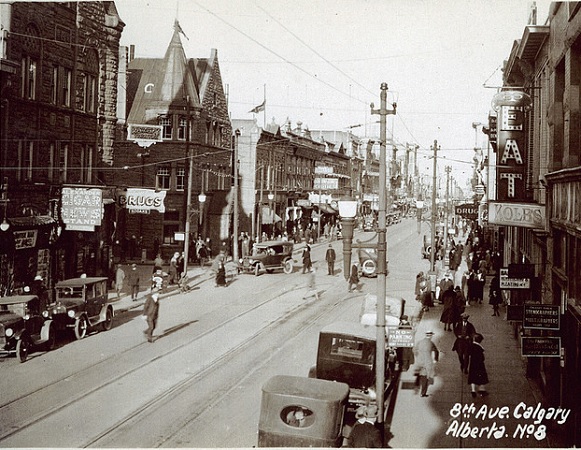
[Next column] "8th Avenue Calgary Alberta," detail from postcard published by McDiarmid Photo Laboratories, Calgary, circa 1930. (Source: University of Alberta, Peel's Prairie Provinces, Postcard 5389)
Police got wind of a club bag that he had left in the care of a Calgary taxi- or truck-driver named "Bob". It took police two weeks to locate the right Bob, but when they did the club bag turned out to be a goldmine. It contained his personal papers, some excellent snapshots of himself and letters and cards that firmly established his long-term link with Slim.
Aided by the snapshots, police now watched for him in Chicago, where he once lived, and put his father's house under surveillance in Spokane. However it was the King County sheriff's department that spotted the fugitive peddling wicker baskets with two young companions in the village of Carnation, Washington. Two deputies were sent to arrest the trio but not before Detective Harvey was invited down from Alberta to take part.
As expected, the fugitive surrendered without resisting and immediately confessed to his role Mr. Midwinter's murder. He drove the taxi away from the murder scene.
After losing their way in the taxi, the fugitives hid during the day and walked for two nights until they reached High River. There they stole an Oldsmobile sedan and made their way to Montana, first stopping at MacLeod and Lethbridge.
They tried to get rid of the Oldsmobile by selling it to a used car dealer in Billings, first fitting it with stolen Montana license plates. They were stymied when they were unable to produce ownership papers. They further aroused the dealer's suspicions when he noticed that the car was equipped with three new Dominion Royal tires, a Canadian brand.
In the end they abandoned the Oldsmobile by the roadside. It was misidentified as another Oldsmobile stolen in North Dakota, so the Alberta Provincial Police were never notified of a potentially useful clue.
The four men hopped a freight to Denver where they rifled a store till and then travelled east to Chicago where they split up. While in Denver they impressed themselves on the memory of a hotel owner by paying for their rooms with nickels and dimes, by being "very untidy," by attempting to steal a towel and by making themselves obnoxious in other ways.
Mr. McMaster's friend identified the shooter as another ex-convict. Finding this third fugitive turned out to be easy. After fleeing as far as Chicago he had drifted back to Medicine Hat, Alberta where he was arrested as a vagrant. Police found him sitting in a cell in Lethbrdge Gaol. He, like Slim, refused to co-operate.
Mr. McMaster's friend was allowed to plead guilty to manslaughter in exchange for acting as the Crown's chief witness against his two confederates. He was sentenced to life in prison.
His testimony did not stand alone. It was buttressed by a parade of other witnesses and a wealth of circumstantial evidence. The jury deliberated for only an hour and forty minutes before returning a guilty verdict. Their appeals denied, the two men were hanged on June 10, 1931.
Despite the arrest, trial and execution of Mr. Midwinter's two killers, police never gave up on finding the fourth fugitive, the young man whom the others referred to as "The Kid."
Mr. McMaster's friend said that the Kid spent his summers travelling as a hobo and spent the winter working in a coal mine. The Kid also said that a close relative had been killed in a mining accident. Inquiries at Drumheller, the major coal mining centre in Alberta, were fruitless.
Then, after the trial, a man came forward with a significant nugget of information. This man was a rancher in southern Alberta, but he was also an ex-con who knew both Slim and the shooter from prison. On their flight to Montana he had put the four men up overnight and he kept quiet about this until now.
During a conversation with the rancher the Kid remarked that he knew a horse trader in his hometown of Truro, Nova Scotia. This took the search in a new direction.
The Kid travelled under an assumed name but the Alberta Provincial Police had a good description of him. This, combined with the other details gave the Nova Scotia Provincial Police all the clues they needed to track him down. The close relative who was killed in a mining accident turned out to be his father.
The Kid was arrested at his home in Westville, Nova Scotia, and transported to Alberta. He was charged with robbery, not murder. During his tearful testimony he told how Slim beat Mr. Midwinter over the head with the billy as the other man shot him. Mr. McMaster's friend testified that he dissuaded Slim from his intention of killing the Kid in order to prevent him from squealing to the police.
On September 29, 1931, after deliberating for four hours, the jury found the Kid not guilty and he was released.