• Driver Profiles
Trevor O'Dell Edmonton, Alberta / April 7, 1995 Sometime between 2:00 and 2:30 p.m. on Friday, April 7, 1995 Co-op taxi driver Trevor O'Dell picked up two teenagers, one 15 and the other 16, at Edmonton's North Town Mall.
Mr. O'Dell, 62, was affectionately known as "Pops" to younger drivers and was "like a father to everyone". Born in Spalding, Saskatchewan, Mr. O'Dell was raised in Saskatoon. He moved to Edmonton in 1980 where he began driving a cab. He was no longer in contact with his adult daughter, believed to be living in eastern Canada, but he had several cousins and a godson living in Saskatchewan.
Unknown to Mr. O'Dell his 16-year-old passenger had hatched a robbery plot and enlisted the aid of the 15-year-old who had brought along his father's .45 semi-automatic pistol.
Mr. O'Dell turned on his meter when he picked the boys up but immediately turned it off again, raising the suspicion that he came under threat soon after the trip began. Mr. O'Dell's cab was equipped with a computerized silent alarm but he did not trigger it. The system had been down on March 31 due to computer problems but according to Co-op general manager Rita Curtiss all the alarms were working on April 7. "He didn't have the time to get to it. That's the only thing we can figure."
Mr. O'Dell drove west along 137th Avenue to 135th Street and then made a left turn, presumably following orders (the 15-year-old lived a short distance down 135th). As he slowed for the turn both juveniles prepared to jump from the moving cab. Mr. O'Dell managed to radio for help and the Co-op dispatcher immediately alerted other drivers to look for him. But by then Mr. O'Dell was already dead. Before bailing out of the cab the 15-year-old shot him in the back of the head.
Meanwhile, 58-year-old Alexia Lema was approaching 135th Street from the east on a service road running parallel to 137th Avenue. Mrs. Lema, the mother of ten adult children and grandmother of 23, was returning home from grocery shopping. She was at the stop sign when Mr. O'Dell's cab, accelerating down 135th Street, ploughed into the driver's side of her car and somersaulted end over end. Mrs. Lema died instantly of massive head injuries.
As word of the collision spread through the neighbourhood Mrs. Lema's husband Emile walked to the scene and immediately recognized his wife's car. Police prevented him from approaching the wreckage and a neighbour escorted him home. Dazed with shock Emile Lema could only say "She's gone. She's gone."
Witnesses described the two fugitives to police but a bloodhound was unable to pick up their scent. On the assumption that the killer and his accomplice had sustained injuries when they jumped from the car police canvassed local emergency wards but without success.
Police circulated descriptions of the suspects and appealed to the public for help. Over the weekend they received several tips and were able to arrest the 16-year-old at his school about 1 p.m. Monday. At about 5 p.m. the same day police surrounded a house across the park from where Alexia Lema and her husband had lived since 1958. The occupants were telephoned and ordered to leave the house one at a time. The 15-year-old was arrested along with his parents and brother. The other family members were released after questioning.
Police searched the house and found two handguns in locked boxes. One of the handguns was seized as the murder weapon.
Two white crosses were quickly erected near the scene of the collision. In the following days the crosses were covered with flowers and cards from friends and neighbours. Black and purple ribbons fluttered from a roadside hedge which was still littered with headlight glass and a twisted strip of chrome.
On Saturday, the day after the tragedy, about 40 cabs slowly circled Edmonton's city hall for an hour in tribute to Mr. O'Dell and to call attention to the killings. On the following Monday about 100 drivers attended a meeting of the Edmonton Taxicab Commission. Representatives of the Edmonton Taxi Drivers' Association called for a series of mandatory safety measures, including shields, silent alarms, satellite tracking systems and a five-day safety training course for drivers. The Association proposed that the measures be financed through the federal government's infrastructure grant program or through provincial lottery funds.
As in other cases involving juvenile killers the deaths renewed calls to harshen penalties in Canada's Young Offenders Act. Alberta's premier and attorney-general were quoted as saying that juveniles with a record of violent crime should have to face the death penalty in cases of murder. The debate was intensified by a recent Montréeal case in which a 14-year-old and 15-year-old were charged in the beating deaths of a minister and his wife.
Classmates of the 16-year-old who planned the robbery described him as a tough-talking loner with few friends and a drug problem. But a neighbour of the 15-year-old killer was shocked at his arrest. "He played with our dog, he played with my 11-year-old ... babysat for me," she said. "I don't understand, really, what happened."
On Wednesday, April 12, more than 700 mourners packed St. Angela Merici parish church for Alexia Lema's memorial service. The eulogy prompted tears and laughter as the family shared its memories. "I could sense the love and outpouring of good will," said her brother-in-law Peter Lema. "It was more of a celebration than a funeral."
On Monday, April 17, about 350 people attended Trevor O'Dell's memorial service at the Chapel of Chimes. About 200 taxis were parked in streets around the chapel. Most were Co-op cabs but others represented companies from as far away as Calgary.
Former driver Phil Baker, confined to a wheelchair, told how Mr. O'Dell came to his aid ten years earlier when a knife attack by a passenger left him unconscious in hospital.
"Trevor started a collection for me," said Baker, "and he stood by my wife and helped her through the whole ordeal."
"He helped me through a really rough time in my life," said Patty Fuller, another former taxi driver. "I would always leave with a big smile on my face after having coffee with Trevor. He could always make me laugh no matter how bad things were going."
The following Wednesday another memorial service was held for Mr. O'Dell at St. Paul's Cathedral in Saskatoon. About 100 people attended. Mr. O'Dell's cousin Donnee Baxter said he had a huge extended family wherever he went. "I'm not angry, just sad because it was so senseless," said Baxter. Earlier Mr. O'Dell's cousins had released a prepared statement expressing sympathy to Alexia Lema's family and addressing the families of the two accused:
"We recognize the terrible hurt you surely must feel to know your sons may have committed such a senseless act," Donnee Baxter, the family representative and Mr. O'Dell's first cousin said. "This surely will bring a lifetime of remorse and sorrow."
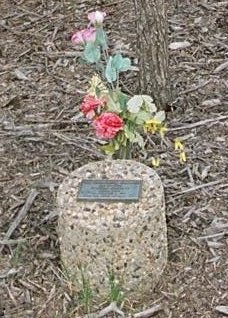
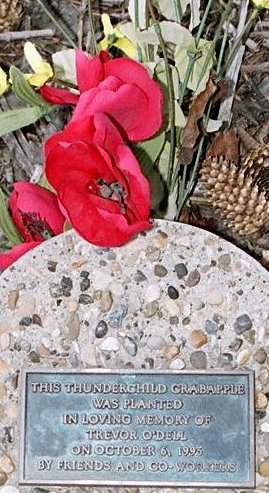
[Next column] The plaque reads "This thunderchild crabapple was planted in loving memory of Trevor O'Dell on October 6, 1995 by friends and co-workers." Another tree with a similar memorial to Alexia Lema is located nearby. Both are in small park across the street from where they died. (Source: Norman Beattie)
In October, 1995, two crabapple trees were planted in a small park near the site of the collision in memory Mr. O'Dell and Mrs. Lema. Taxi drivers and friends of the two victims donated money to plant the trees and erect commemorative plaques.
In December, 1995, the Alberta Crimes Compensation Board denied Emile Lema's request for money to cover the cost of his wife's funeral, ruling that she was not the direct victim of a crime. After a public outcry the decision was reversed in January, 1996. Lema said he planned to use the money to set up a trust fund for his grandchildren.
The two suspects were jointly charged with first-degree murder in the death of Trevor O'Dell and with second-degree murder in the death of Alexia Lema. The Crown applied to have the pair tried as adults but on October 2 Provincial Court Judge Sydney Wood rejected the application.
"In the 39 years that I have been in the business of law, I can't recall anything more difficult than what I have been through in the last week or so," he said. He spent nearly an hour detailing the reasons for his decision before denying the Crown's application to try the killers in adult court.
Wood's decision provoked an angry reaction in the courtroom. "Which cab driver is going to be next," shouted two drivers. The judge ignored them and quietly left the courtroom.
Emile Lema response was very different. "It's OK. It must have been a very, very, tough decision for the judge and hopefully he made the right one," he said. "I don't want revenge. These are just two little boys." But one of his daughters expressed disappointment at the ruling because the penalty available under the Young Offender's Act "doesn't seem to fit with the magnitude of the crime."
Wood's reason for denying the Crown's application rested mainly on his concern that juveniles sent to adult prisons were exposed to habitual criminals who would jeopardize any chance for their rehabilitation. The Crown appealed and in July, 1996 the Alberta Court of Appeal overturned Wood's decision.
The appeal court agreed with much of what Wood had said, but noted that the two accused would be adults by the time they were tried and sentenced and therefore not as susceptible to the influence of adult criminals. In any case, the seriousness of the crime warranted a trial under the Criminal Code, which ensured that parole restrictions would last for life rather than for the five-year limit allowed for by the Young Offenders Act.
In October, 1996, a year and a half after the deaths, the 16-year-old accomplice was given a life sentence for second degree murder with eligibility for parole after six years. The 15-year-old killer was sentenced to life for second degree murder with no parole for seven years. He was also given a three-year concurrent sentence for manslaughter in the death of Alexia Lema.
The 16-year-old accomplice was jailed in the Edmonton Young Offender Centre until his 18th birthday. He was then imprisoned at Fort Saskatchewan. In August, 1999 he appeared in court demanding to be sent to a federal penitentiary and was subsequently transferred to the Bowden Institution.
Five years after the killings the accomplice began training as a plumbing apprentice with two other inmates. There was tension between him and one of the other apprentices, an older inmate jailed for murder.
In January, 2000, when they were left unsupervised in the prison plumbing shop the older inmate attacked him with a pipe and left him near death. The accomplice survived with multiple skull fractures, the loss of one eye and only 20 percent vision in the other. Steel plates had to be implanted in his head and he also required major dental surgery.
In May, 2000 the accomplice was freed on early parole. In 2005 he was awarded CDN$728,000 in damages when Judge Doreen Sulyma found the plumbing instructor and the instructor's supervisor guilty of negligence in leaving the two inmates alone.
Sulyma noted that during his imprisonment the accomplice had "shown a tendency to fight and had shown negative attitudes to discipline and authority. After his arrival at Bowden, his attitude continued to be cocky and this was noted by staff generally. He was particularly cocky, mouthy and disrespectful" to the older inmate who eventually attacked him. She did not, however, find that his behaviour made him contributorily liable for the attack.
Sulyma noted expert testimony that pointed out the endemic tension between young inmates and older "lifers" in prison. Graham Stewart, executive director of the John Howard Society, expressed concern about putting young prisoners in federal institutions.
"Putting a young person in the adult system is really the worst possible environment," he said. "Young people are young, they are not as mature, and they do not have the same judgment as others."