• Driver Profiles
Ahmad Sabbagh Calgary, Alberta / October 2, 1976 Ahmad Sabbagh, 23, was born in Syria but his parents, a sister and three brothers all lived in Tripoli, Libya. Mr. Sabbagh came to Canada in 1975 and had been driving for Yellow Cab for three months. The cab he drove was owned by Gaby Saliba, formerly of Israel.
Shortly before 4 o'clock on the morning of Saturday, October 2, 1976, Mr. Sabbagh was dispatched to an address on Whitestone Way in northwest Calgary. About 15 minutes later he radioed that he was going to the airport. That was the last that the dispatcher heard from him.
When he arrived at the address two young men, aged 19 and 16, got into the cab. Unbeknownst to Mr. Sabbagh, his passengers were armed with a .22 calibre Browning semi-automatic pistol and a knife. The pistol was stolen from a motor home on Whitestone Way about two weeks earlier.
The youths planned to finance a trip to Swift Current, Saskatchewan by robbing a taxi driver. The Whitestone Way address was the home of the younger man's uncle and aunt where the two boarded in a basement bedroom.
Mr. Sabbagh had driven for only half a kilometre (1/3 mile) when the two pulled out the gun and knife and ordered him to drive to a new destination. They said that if he obeyed nothing would happen to him.
Instead of complying, Mr. Sabbagh hit the accelerator, ran a stop sign and attempted a high-speed right turn at 52nd Street and McKnight Boulevard. The car went out of control and careened into a ditch.
When the three men emerged unhurt from the cab, the 16-year-old had the gun. He ordered Mr. Sabbagh to hand over his wallet, but as the driver did so he allegedly struck the gunman's arm hard enough to cause the gun to fall to the ground. When the 16-year-old scrambled to pick the gun up he "accidentally" pulled the trigger and shot Mr. Sabbagh in the back of the head.
He then stood over Mr. Sabbagh and fired ten more bullets into the right side of his face and neck. At the killer's trial Alberta chief coroner Dr. John Butt testified that Mr. Sabbagh's brain was torn and his skull was fractured in "just about every place" from the bullet wounds.
The murder did not stop the youths from taking Mr. Sabbagh's wallet, which contained $46 in bills and two dollars in change. Minutes after the shooting a car approached and the pair fled across a field and made their way back to the Whitestone address.
The car contained three men who were leaving Calgary for a hunting trip near Sundre, about 100 km (60 miles) northwest. They stopped to investigate the taxi in the ditch and quickly called police when they discovered Mr. Sabbagh's body. The body was still warm when Dr. Butt began examining it at 7 a.m.
Half an hour after the two youths got home a police officer knocked on the door to ask if anyone in the house had called for a taxi. The killer's uncle, apparently unaware of what had happened, told the officer that no one had called a taxi and that the other people in the house were asleep.
The police officer went away but detectives soon returned to ask more questions. They learned who the youths were and that they had left Calgary right after the police officer's visit, probably for the home of the younger man's parents in Swift Current. The two were arrested in Swift Current the next day.
The pair gave police detailed confessions although each tried to incriminate the other. The 16-year-old led police to the murder weapon, wrapped in a sleeping bag and hidden in a child's bedroom at the Whitestone Way house. He also led them to the York Hotel where Mr. Sabbagh's wallet was hidden under the cover of a floor drain. Police found several rounds of .22 calibre ammunition with the wallet.
Mr. Sabbagh's murder was the first taxi driver homicide in Calgary since Ernest Midwinter was killed 45 years earlier and it had been a dozen years or more since a Calgary driver was seriously injured in an attack.
Nevertheless, the murder raised concerns about cab driver safety and discussion of safety measures, including the installation of shields. The Calgary Taxi Commission was quick to throw cold water on the need for such measures.
Taxi Commission general manager Floyd Shaw said that shields "interfere with talking to passengers which is the reason why many drivers enjoy the job.
"They say 'I take job because I like people and if I can't talk to them I don't want to sit in a cab for 12 hours every day," Mr. Shaw said.
According to Mr. Shaw, drivers saw being close to their passengers as so important that they were quite willing to take the risk of being injured or killed by thugs.
"Most of the drivers I've talked to, veteran drivers with two, three years or more, have expressed the attitude, 'It's unfortunate, but dammit, we take job and we know the risks are there.'"
Calgary Police inspector Don Nelson, a taxi commission member, said that police respond immediately if they know a cab driver is in trouble, but he also said that there was nothing more police could do to offer protection. He said secret trouble signals had not proven to be effective.
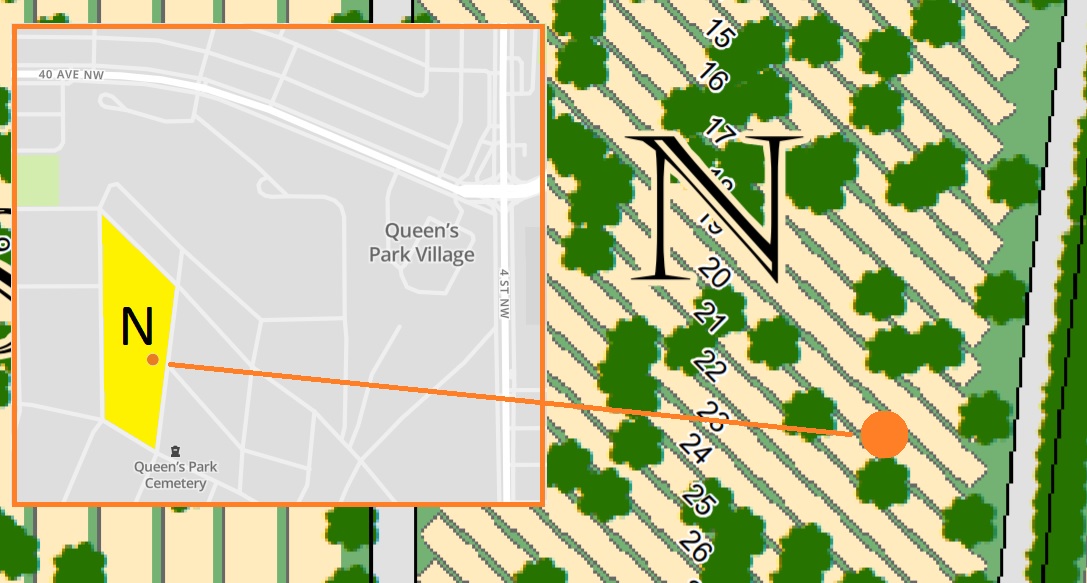
[Next column] The location of Ahmad Sabbagh's grave in Queen's Park Cemetery, Calgary (Lot 70, Block 20, Section N). Sources: Open Calgary: Cemetery Burial Records Map and Queen's Park Cemetery Map.
Both Mr. Shaw and Inspector Nelson noted that Calgary drivers had more permission to turn down fares than drivers in other cities, but Inspector Nelson conceded that this provided only "some small protection" because "burglars don't wear masks."
The two youths were convicted of murder in March, 1977 and were sentenced to life in prison. Alberta Supreme Court justice Hugh John MacDonald recommended that neither of them be eligible for parole until they had served at least ten years.
In December, 1982, the older youth, now 25, was serving his sentence in Stony Mountain Penitentiary north of Winnipeg. He and another inmate escaped by scaling the prison wall with the aid of a home-made rope. Both were arrested without incident a week later in Saskatoon.
The 16-year-old killer served 12 years in three different penitentiaries before being paroled.
"I was lucky. I found a job as a cook within the first month after I was released, at one of the best hotels in Saskatoon. I met a good employer. I told him my story and he accepted me."
He also got married and apparently benefitted from a stable relationship as well as a steady job. After a friend and fellow lifer committed murder and suicide, he applied to join the Correctional Service of Canada as an "in-reach" worker.
One reason for his decision was "maybe I could have prevented my friend from taking his life and his loved one's life.... The other reason was maybe I thought I hadn't paid back enough yet for what I had done."
The killer's role as an in-reach worker involved counseling other lifers, offering a role model as someone who had adapted to life outside prison, finding employers willing to hire parolees, keeping in touch with these parolees, lending an ear when they vented their fears and frustrations, and helping to organize events that allowed prisoners out into the community.
He also made presentations to schools and youth groups. "I try to leave them with a message, which is: I didn't have a very good home life, but I'm not the only one in that situation. One of my problems as a youth was not being able to talk about things. I kept everything in."
"I tell the kids if you're in a situation like that you have to find someone you can talk to or trust. What happened with me is that I kept it in and I let it all out on this individual [Ahmad Sabbagh]. And he paid with his life."
The killer's words contradict the frequent assertion by police and the media that taxi driver homicides are "robberies gone wrong." Even when robbery is the pretext, motives for mayhem simmer close to the surface and, wittingly or not, may dictate the agenda right from the start.
The killer was still on the job as late as 2009 despite the difficulties of influencing inmates damaged from childhood and institutionalized for a decade or more, finding jobs for parolees who had few skills and little education, experiencing hostility (initially, at least) from prison staff and dealing with on again, off again government funding for in-reach programs. He died in 2018 at the age of 68.
From the perspective of rehabilitation his life during and after prison represents a remarkable success story, although it clearly depended on his own determination and luck rather than on institutional programming.
At the same time, no amount of rehabilitation can diminish the terrible price paid by the killer's victims: a young man robbed of his life and a family robbed of a brother and son.