




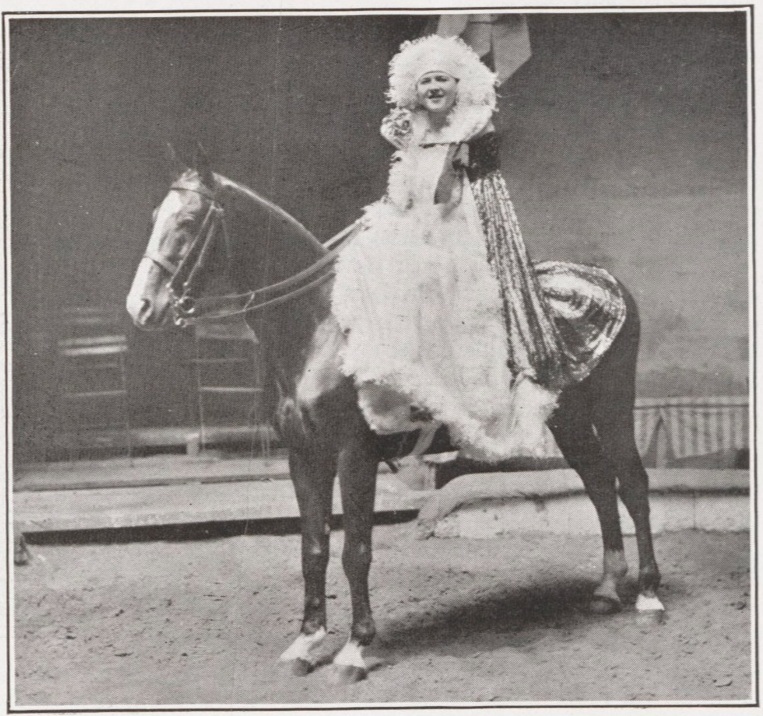
Above: Rachel Dorange at the Cirque Molier, 1927.
Source: Henri Thétard, "Au Cirque Molier," Le Sport Universel Illustré, July 15, 1927, pp. 502-503. (Bibliothèque nationale de France via Gallica)

Above: Clowns at the Cirque Molier, 1927: Mlle de Marcigny and M. Bompard.
Source: Same source.
4. The Amazon
The French term "amazone," referring to the fearsome women warriors of Greek mythology, may have been applied as a joke when women on horseback were a rarity and therefore suspect. By the 1920s, though, the term was a legitimate and accepted term for a horsewoman, especially one involved in dressage or competitions.
To ride "en amazone" meant to ride sidesaddle. Traditionally sidesaddle was the only decent and proper way for a woman to ride a horse, but by the 1920s it was both acceptable and common for women to ride "à califourchon" or astride.
Rachel said her career as an amazone began during her modeling days when she went for a walk in the Bois de Boulogne. Here she was struck with admiration and envy at the horsemanship displayed by the gentry riding along the bridle paths. The very next day she enrolled as a student with France's foremost professor of equestrianism, Armand Charpentier (1868-1948). Or so she claimed.
"She made such progress that she soon abandoned her modeling career and made her debut as an equestrian at the Club de l'Étrier...."
The Club de l'Étrier and Armand Charpentier were names to conjure with, but once again the evidence of Rachel's association with them rests on her own testimony. The Club de l'Étrier, founded in 1905 and located in the heart of the Bois de Boulogne, was "one of the most exclusive and aristocratic" clubs in Paris. Applicants for membership had to be approved by election.
In a 1925 article in Le Sport Universel Illustré Rachel is identified as a "new student" not of Charpentier but of Ernest Molier (1844-1933). Independently wealthy, Molier abandoned his law studies to take up horsemanship and became an accomplished dressage rider at the age of 25. In the 1880s he opened a small one-ring circus at his home with seating for about 400 invited guests.
Molier and his wife Blanche Allarty (a celebrated rider, acrobat, gymnast and trainer) set up a riding school which attracted young women of good family, but they also took in "courtesans, dancers, actresses, and other women on the margins and gave them an intensive introduction to horsewomanship that included riding astride, vaulting, and acrobatics on the horses' backs."
The circus operated for more than 50 years until Molier's death in 1933. In addition to nightly performances, the circus staged an annual three-day extravaganza at which Molier's students and some of his aristocratic friends could show off their skills in dressage. Although horsemanship was the centrepiece of the circus the programs included a variety of other acts. In 1905 the circus featured Mata Hari (real name Margaretha Geertruida MacLeod) who "improvised a Javanese dance while lewdly undressing, to great delight of the wealthy attendees." Mata Hari was accused of spying for Germany during World War I and was executed by a French firing squad in 1917.
Although Rachel continued to perform at the Cirque Molier she made little mention of it. This is strange, because Molier and his circus enjoyed considerable prestige in Paris and one would think that Rachel would have been proud of her connection with them. A German newspaper correspondent, describing the delights of Paris in 1931, wrote that the annual Molier circus performances were the climax of the Paris "season" and "anyone who remains in Paris after this final event... no longer has the unconditional right to call themselves a decent person, just as it is part of the documentation of Parisianism to be invited to the Molier Circus."
"An hour before the start, the guests are already queuing up at the gates. Ladies in evening gowns of unheard-of preciousness. Gentlemen in tailcoats, the richest people in Paris, the aristocracy, ministers and politicians, and marshals of France. The arena is accessed via a courtyard, where horses stretch their curious heads out of the stables on the right and left. Order is maintained by gentlemen in red coats, which for these gentlemen are not costumes but their usual attire. Only the ladies are allowed to sit on the chairs. There is no room for the gentlemen; they can sit somewhere in the back corners or, if they are lucky, on the padded edge around the arena."
Whether under the tutelage of Molier or Charpentier, Rachel was accurate in saying that she made excellent progress. The 1925 article noted that she was "graceful and bold" and would certainly be the star of her class at the upcoming Cirque Molier show, while her skills would no doubt "disturb the dreams of many famous horsewomen."