





Above: The Empire Music Hall, circa 1930. Originally constructed in 1913, the theatre was completely rebuilt in 1924 and operated as the Empire Music Hall from 1924 to 1936 after which it became the Empire Cinema.
Source:Wikipedia, Théâtre de l'Empire
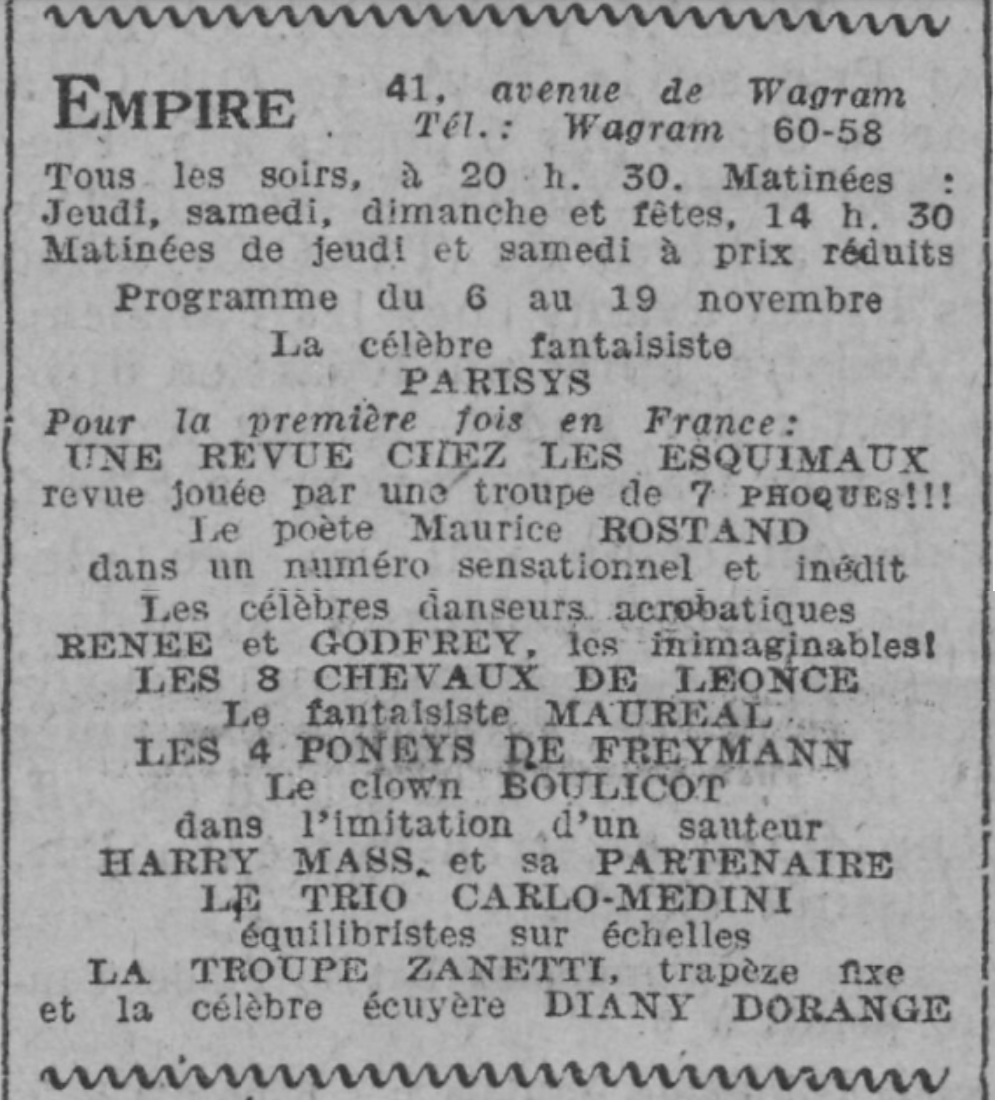
Above: The Empire program for November 6 to 19, 1925. Rachel (as Diany Dorange) is at the bottom of a bill topped by the popular actress and singer Marcelle Parisys and a revue "from the land of the Eskimos" performed by a troupe of seven trained seals.
Source: Comoedia, November 12, 1925, p. 6 via Gallica.
5. The Empire Music Hall
"... it was at the Empire music hall, around 1925, that she became famous and her engagement was extended for an entire year.... All of Paris came to applaud her and at the end of her number the stage was transformed into a veritable flower garden... [of] enormous and costly bouquets."
It is not surprising that Rachel would make a point of mentioning her Empire performances. The Empire was almost brand new, having opened in 1924, and at the time it was probably the most popular music hall in Paris. It was one of a dozen competing music halls that regularly advertised their bills of fare in the show business newspaper Comoedia. And there was plenty of other competition. The back page of each Comoedia issue was crammed with ads for entertainment venues. For example, the issue of May 17, 1925 listed 41 live theatres and 36 movie theatres in addition to the music halls.
Nothwithstanding Rachel's claim to have been given a year's contract, the Empire's ads in Comoedia reveal that her run lasted only from April 10 to May 21, 1925, and again from November 6 to 19, the equivalent of two months. She appeared under the stage name Diany Dorange with her horse Le Huppé ("Classy").
Far from being the toast of Paris, she always appeared at or near the bottom of each Empire bill. The problem was not that she lacked talent but that her specialty – taking a horse through the complex, stylized manoeuvres of formal dressage – did not fit well with a music hall audience who wanted excitement, belly laughs and a tug at the heartstrings.
As a result, Rachel was consistently outranked by clowns, musical acts, acrobats, magicians and performing animals, and even by other equestrians who were able to package their acts in spectacle.
Rachel and Le Huppé also occasionally performed at other venues, such as the Cirque d'Hiver. Her reviews, such as they were, tended to be tepid or condescending and based less on her performance than on her failure to meet music hall expectations:
"Mlle Diany Dorange... is in no way a circus performer, neither in appearance nor profession, though she possesses the seductive charm of a pretty young woman who enjoys morning rides in the Bois du Boulogne. She repeats this in the evening at the [Empire] music hall; it is neither unpleasant nor boring for the audience." (La Presse).
"Mlle Diany Dorange, a haute école equestrian with a delicate face and elegant figure, who rides gracefully sidesaddle, lets herself be guided more or less by her horse, which suits her quite well." (Comoedia).
On the other hand, Rachel could shine when her performance was packaged in drama, spectacle and perhaps a touch of naughtiness.
In July, 1931 she and two male riders took part in the 50th anniversary edition of the Cirque Molier dressed as courtiers from the time of Louis XV and with Rachel portraying the victim of a kidnapping. The performance included a crowd-pleasing swordfight on horseback and earned favourable if brief notices in Le Figaro. Comoedia, Le Petit Bleu de Paris and L'Ordre.
"What amuses me is that everyone thinks I'm a modern woman. I'm not modern at all. I would never, for example, dare to go swimming in public at Deauville. Yet I felt quite at ease when, at the Cirque Molier... the rider who caught up with me in the race would remove my bodice, along with the flower I had pinned to my shoulder, and reveal me in my swimsuit. On horseback, no outfit intimidates me."
The most enthusiastic review appeared in Le Petit Bleu de Paris, perhaps demonstrating that spectacle lies not so much in what people see as in what they think they see:
"There was once again enthusiastic applause... above all, for an equestrian pantomime: 'A Kidnapping in the Reign of Louis XV', in which Messrs Marcel Courtois, Persin, and Mlle Rachel Dorange shone. It was a moment of artistic joy that could be offered to us nowhere else but at Molière's [sic]. A duel on horseback between a gentleman and a brigand, ending with a chase of Mlle Dorange across the arena, and culminating in the capture of the beautiful horsewoman, who had been nearly stripped bare in the fight. Skill, grace, and beauty truly triumphed in this act."
In later years Rachel claimed to have accumulated a "colossal fortune" from her music hall and circus performances but this must have been a fantasy. Even the Empire run, her biggest stage success, evokes the hand-to-mouth existence experienced by legions of struggling Vaudevillians of whom only a tiny fraction ever achieved lasting stardom.
But Rachel's career as a long-distance "amazon" would be a different story: it brought her the international fame and celebrity that she had dreamed of achieving on the stage.
Still, the question of her income remains unanswered. Her 1928 journey to Bucharest and back seems to have been underwritten partly by the newspaper Le Petit Journal and partly by the organizations and government agencies that hosted her in the countries she passed through. On the other hand, she seems to have self-financed her 1927 ride to Berlin.
She does not seem to have earned any cash from these or her other long-distance feats. There were no lucrative product endorsements. Her image appeared in newsreels and in newspaper and magazine articles but not in advertisements.
Nor is there any record of her having a steady job, other than cab driving from 1941 on. Despite this she managed to support herself and at least one horse for nearly 40 years.
The likeliest answer is that Rachel was sustained by some other source of income. Perhaps there was an inheritance which if not "colossal" at least provided her with an adequate living and enough left over to pay for oats and stabling.
The definitive answer, as with much of her personal life, remained locked away in a private vault. One reporter who was impertinent enough to ask for it was quickly shut down (Page 20):
"I am curious about what Mlle D'Orange does for a living.... Mlle D'Orange taps the table with impressive force.
"'This is my secret. I have money and I live off of it.'"