




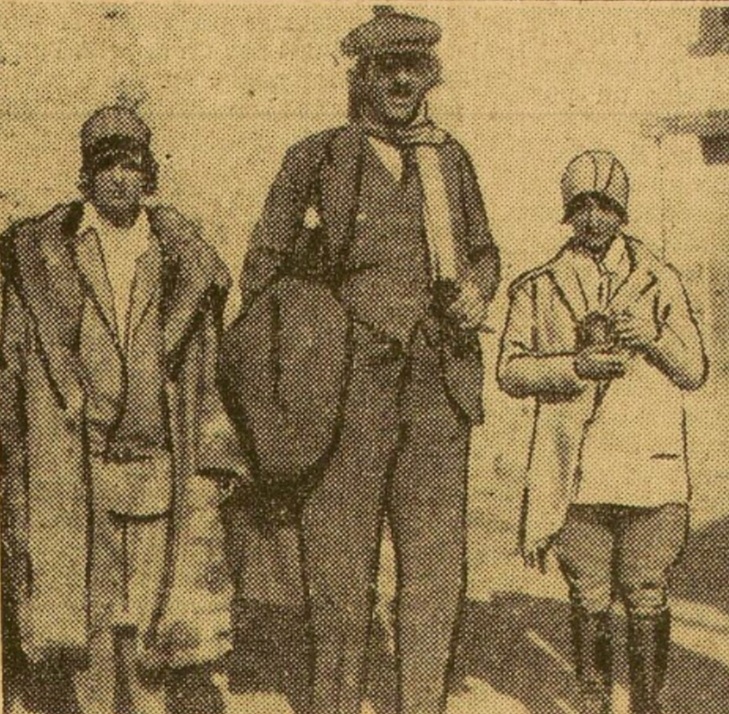
Above: Viscountess d'Alauzier, Armand Massard and Martha Gaiatry with her turtle (detail).
Source: La Liberté, February 28, 1928, p. 1 (Bibliothèque national de France, via Gallica). Photo illustrating an article by Armand Massard reporting on the fifth stage of the Paris-Cannes race.
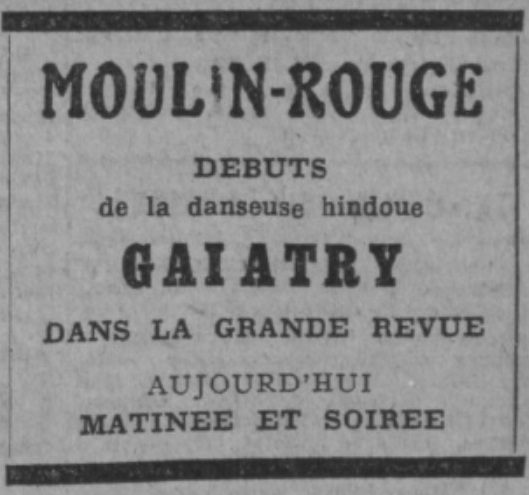
Above: Ad announcing the debut of Martha Gaiatry at the Moulin Rouge.
Source: Comoedia, February 4, 1928, p. 3 (Bibliothèque national de France, via Gallica).
8. Paris-Cannes, 1928 (continued)
A flock of Cannes businesses and other donors, sensing the publicity value of the race, offered a miscellany of prizes for the winner and runner-up. The City of Cannes, the Cannes Municipal Casino, two Cannes newspapers and the Cannes Festival Committee together stumped up a total of 15,000 francs in cash (the eqivalent of U.S. $588 at the time) while other donors contributed a bronze horse statuette, a riding crop, a bridle, a travel bag, a silver cup, several engraved medals and plaques and a bicycle.
Martha's exotic presence dominated press coverage all through the race and even after her victory. She was hailed as an example not only of what women could achieve but as a symbol of the innate qualities that ordinary women possess:
The victory of the little Hindu girl is like a mirror reflecting the more discreet courage of countless women. (Optima)
The women's newspaper Eve devoted a whole front page to Martha's portrait (page 11) accompanied by a fulsome article extolling her victory:
Here she is, the charming Hindu dancer, the exquisite ballerina, born, it seems, to live reclining on costly cushions, who, smiling a mysterious smile, has set off on the road to conquer the Mediterranean sun.
But other press coverage was far from complimentary. Early on skeptics began casting doubt on the authenticity of Martha's supposed heritage as well as on the Vicount's credibility. It was suggested that Martha was recruited from one or another notorious neighbourhood in Paris and that her Hindu origin was fabricated in the same way that a lot of supposed Egyptian carpets were manufactured in Montmartre.
The skepticism increased following the race. It was said that Martha had performed for the crown prince of Kapurthala who spoke to her in Hindustani. Martha's bewildered reaction was explained away by a story that she hit her head in a fall from her horse and completely forgot her native language. The Visount later amended this explanation by saying that Martha's native language was not Hindustani but another Indian language called "Toulougou."
The amended explanation was contradicted by witnesses who claimed that one of the crown prince's guests mocked Martha's failure to understand Hindustani by saying "That took the wind out of your sails!" and she retorted, in good round Parisian street slang, "Mind your own onions, idiot!"
Martha was supposedly seen darkening her face with ochre. The "Sanskrit" hieroglyphics with which Martha signed her name on checkpoints registers was said to be, on closer examination, a Paris phone number.
The Viscount was accused of doing a lot more than simply following Martha to Cannes by car. Nobody saw or photographed Martha between checkpoints and skeptics theorized that she and the Viscount switched places, he riding the horse while she rode in the car. It was even suggested that they both rode in a carriage pulled by the horse.
There was a lot of suspicion but no solid evidence. In any case the controversy had no impact on Martha's popularity. She performed as a celebrity model at a fashion show and resumed her turns at the Moulin-Rouge where the audience could see at first hand that she had ridden all the way from Paris to Cannes without suffering any chafing from her saddle.
Within a few months, though, Martha disappeared from the newspapers, replaced by other novelties. The last we see of her is in July, 1928, performing with three other actors in a series of sketches at the Casino de Paris.
Earlier the Viscount had announced another attention-grabbing project for Martha entitled "The Flight to Egypt" in which Martha would ride a donkey 760 kilometers from Bethlehem to Cairo. The purpose was to reenact the journey that Mary, Joseph and the baby Jesus took to escape the wrath of King Herod, but nothing came of the project. Skeptics joked that the Viscount would miraculously part the waters of the Suez Canal to let Martha cross over it.
And where was Rachel Dorange when the five amazons set off on the race to Cannes? Apparently she was in Monte Carlo, rubbing shoulders with the rich and famous. On February 19 she was numbered among the prominent guests at Monte Carlo's luxurious Hotel Hermitage.