




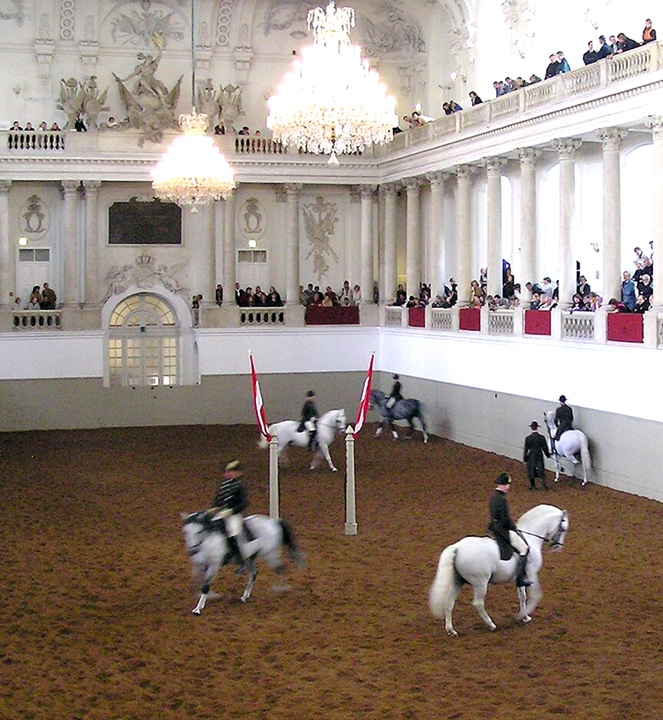
Above: Spanish Riding School, Winter Riding School arena, Vienna, Austria, October 14, 2003 (detail).
Source: Wikimedia Commons. Photo credit: sparre.

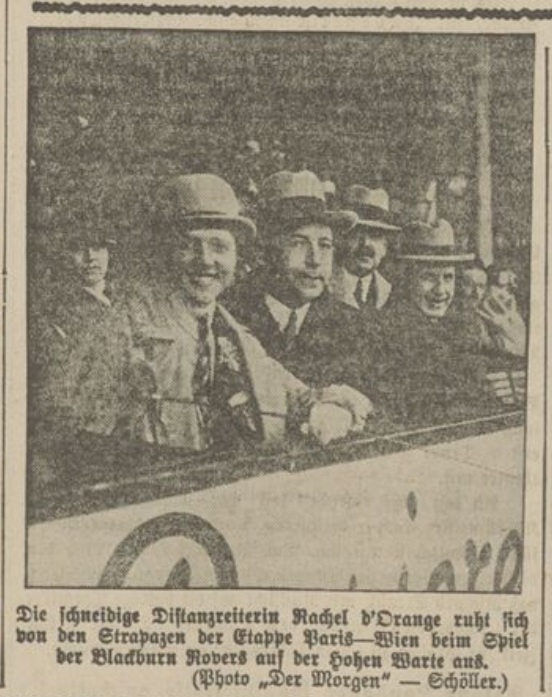
Above: "The dashing long-distance rider Rachel d'Orange takes a break from the rigors of the Paris-Vienna stage at the Blackburn Rovers game at Hohe Warte [Stadium]. (Photo: "Der Morgen" – Schöller.)
Source: Der Morgen: Wiener Montagblatt, May 14, 1928, p. 3, Austrian National Library (via ANNO).
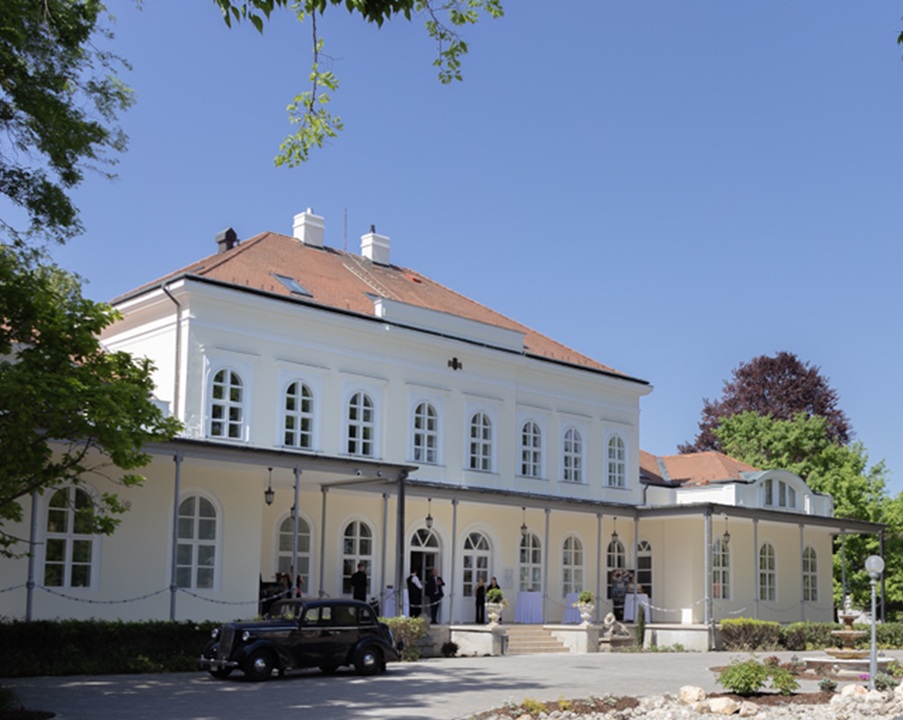
Above: Födváry Castle in Öttevény, Hungary (detail), where Rachel spent the night of May 22-23, 1928. Built in 1870, the refurbished castle celebrated its grand opening as a convention centre and venue for corporate and social events on May 1, 2024.
Source: Chateau Födváry gallery photo 25/185.
9. Bucharest, 1928 (continued)
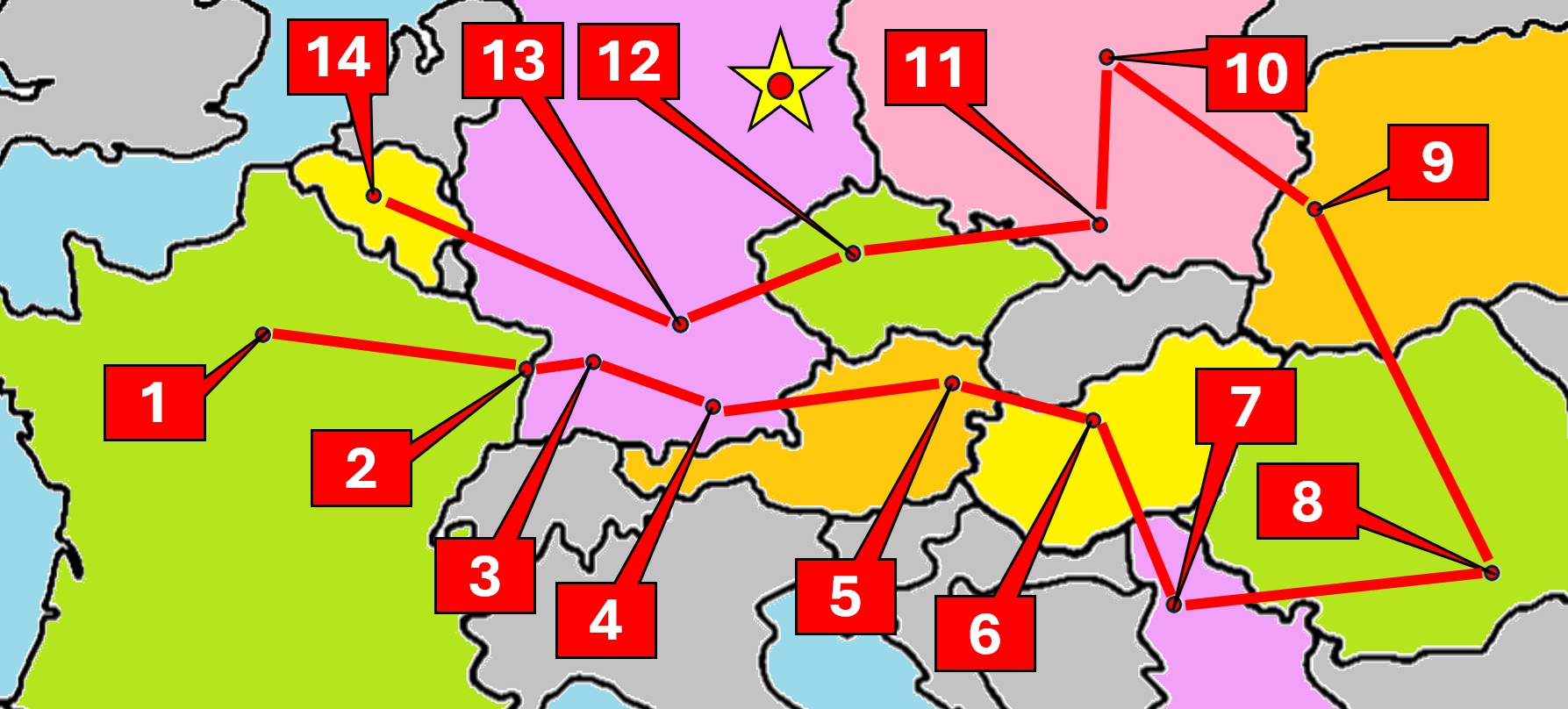
Vienna to Budapest (Map 5-6)
Rachel left Vienna on Friday, May 18 after a six-day visit. She evidently had a good time:
"Rachel Dorange spoke enthusiastically about Vienna and only regretted that she had not had much opportunity to dance in the two nightclubs she had visited every evening, as, contrary to all reports, she had brought nothing but riding clothes with her. In the mornings, the tireless sportswoman visited the Spanish Riding School or rode in the Prater. One afternoon, she attended the English soccer match at the Hohe Warte stadium."
The Prater is Vienna's famous amusement park, featuring its giant 20-storey ferris wheel that was constructed in 1897. The soccer match was between an Austrian team and England's visiting Blackburn Rovers (left).
The reference to Rachel's lack of evening clothes is bizarre. Her wardrobe was a source of endless fascination to reporters all along the way and they not only mentioned it but frequently itemized the contents of her saddlebags. Rachel herself showed off her luggage to the reporter who interviewed her in Munich:
"'Come on, I'll show you.' She leads me into the bedroom, where four leather saddlebags are lying on the floor.... One contains her toiletries, another her little horse's.... The third bag contains maps, books, passports, photographs, and travel provisions, and the fourth, finally, the lady's wardrobe. Wardrobe? 'Yes, don't be surprised, a saddlebag as a substitute for a wardrobe. Not too much. After all: another raw silk blouse to go with the riding outfit, a number of delicate items of lingerie, and this!' And she takes out of the bedroom wardrobe an evening gown made of black lace with gold embroidery, a silk slip to go with it, and a pair of black suede evening shoes."
So what happened to the gown and shoes? Perhaps Rachel looked over the crop of prospective dance partners and decided to decline, using her supposed lack of evening clothes as a graceful excuse.
Rachel was evidently comfortable with traveling alone in France and even in Germany and Austria although she did not understand German. However she had some misgivings about travelling east beyond Austria. Did she have any fear?
"Fear? No, but a somewhat uncomfortable feeling that the further east you go, the fewer people you find who speak French. In Austria it will still be okay, but in Hungary the difficulties begin, even if the famous Hungarian hospitality promises a good continuous escort on horseback. In the Balkan countries, on the other hand, it becomes more eerie. 'If only people could read,' she says, because she carries with her passes in all languages from all embassies, requesting the greatest possible assistance."
When Rachel left Vienna on May 18 she was escorted by the same group of local men and women who had greeted her at Purkersdorf on May 12. They accompanied her as far as Schwechat, 18 kilometers southeast of Vienna. Rachel expected to reach Budapest by Monday, May 21 but this turned out to be optimistic.
"On Monday [May 21] Budapest awaits the arrival of the French guest, who has already been sent an automobile that will accompany the rider on her entire journey through Hungarian territory. In fact, a larger reception is planned there than the young lady received in Vienna, as the entire equestrian association will be lined up on horseback outside the city limits to welcome her."
The automobile that was to follow Rachel through Hungary was provided by Aristide Blank (1880-1960), a powerful Romanian financier, economist and newspaper publisher who Rachel had met in Paris.
Rachel crossed the Hungarian border at Hegyeshalom, about 78 kilometers from Vienna, but by now Le Huppé developed a sore hoof as well as sores on his back that had to be attended to. They stayed in Hegyeshalom as guests of Count and Countess Bolza for four days, until Tuesday, May 22.
On Tuesday afternoon about 1:30 pm they set off for Öttevény, 36 kilometers away. Rachel intended to rest here for a couple of hours but a heavy thunderstorm forced her to stay overnight as a guest of Countess Valéria Födváry.
The countess was an activist who promoted several practical projects aimed at improving economic and social conditions in the surrounding communities and in particular aimed at improving women's employment opportunities and economic participation. She helped to establish daycare centres and children's classes, raised money to equip a hospital children's ward, promoted local cottage industries, encouraged farmers to plant vegetable crops (a rarity in this part of Hungary at the time), organized weekly markets where local people could buy and sell produce, and raised Rhode Island Red chickens as a demonstration project.
Rachel left ├ûttevény on Wednesday, May 23 with the intention of reaching Ács, 47 kilometers to the east, but she and Le Huppé only traveled about 15 kilometers when their journey was enlivened by an incident on the outskirts of Gyor (a town that Austrians called Raab).