




Amazon: Rachel Dorange, Last Femme Cocher in Paris / 22
Amazon: Rachel Dorange, Last Femme Cocher in Paris   / 22 /  

Above: Three pictures of the Hotel Sauer, Alibunar, 1930. In April, 1941, Alibunar was the scene of a savage street battle between invading German forces and Yugoslav defenders. Following the battle an estimated 200 Yugoslav prisoners of war and civilians were executed, including about 30 Yugoslav army officers who surrendered after taking refuge in the hotel.
Source: Kupindo.com, "an online horizontal marketplace" (images); Richard Deveau-Maxwell, "Massacre at Albunar, 11th April 1941," Archive Portal of the Archives of Vojvodina.

Above: Hotel Dacia, Lugoj (detail), where Rachel was given a "small banquet" and where she and Colonel Păun probably stopped overnight. The hotel is one of the oldest buidings in Lugoj, dating back to 1835.
Source: Hotel Dacia, Lugoj, photo "Hotel-Dacia-Lg-03" (5 of 7).

Above: Orăştie, Str[ada] Gheorge Chouşbuc (postcard, early 1900's). Rachel stopped briefly in Orăştie where she was greeted by the mayor and ladies with bouquets of flowers. The postcard bears the Hungarian and German names for both the town (Szászváros and Broos) and the street (Malom Ulta and Mühlen Gasse) meaning "Mill street" and "Mill Alley." The figures at right appear to be drawn at about 2/3 human size, a common ploy at the time to make buildings look more imposing.
Source: RomaniaStamps.

Above: Casa Naţională din Sălişte (postcard, circa 1924). The building is still fulfilling its role as the Săliştea town hall and still looks very much the same. Another copy of this postcard offered for sale on the web includes a message dated "10/VI 924".
Source: ebay. Vendor: The Biggest Little Postcard Shop.

Above: Sibiu city hall (Stadtisches Rathaus); postcard published 1918. The back of the card gives the German and Hungarian names for the town (Hermannstadt and Nagyszeben) but not Sibiu.
Source: ebay. Vendor: Bendav Postcards.

Above: Făgăraş: Union Square (Piata Unirli). Postcard with message dated August 18, 1928.
Source: eBalkan Phila.

8. Bucharest, 1928 (continued)

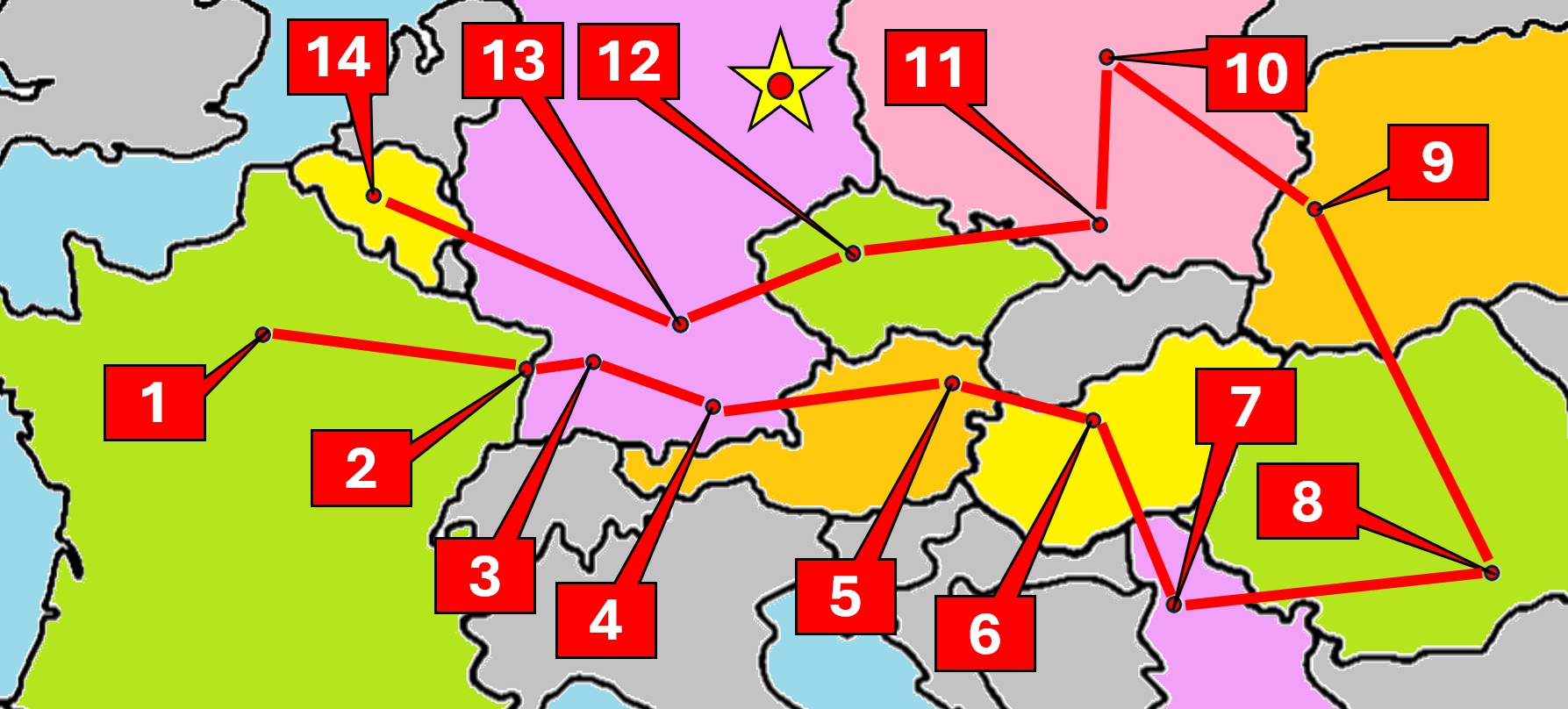
Belgrade to Bucharest (Map 7-8)

1. Belgrade. Rachel and Colonel Păun left Belgrade at 3 p.m. on Thursday, June 14, accompanied by a Yugoslav staff officer and "the Belgrade ambassador Torun."

2. Alibunar. (57 km) – Did Rachel and Colonel Păun stop over in Alibunar? It seems highly likely, since it is highly unlikely that they travelled overnight.

Rachel set a target of 60 kilometers a day during her long distance rides, so the 57 kilometers from Belgrade to Alibunar would approximate a day's journey. This would presumably be accomplished by a combination of trotting (average speed 13 kilometers an hour) and walking (average speed 7 kilometers an hour).

If we (arbitrarily) assume that 2/3 of the journey from Belgrade was covered by trotting and 1/3 by walking, the ride from Belgrade to Alibunar would take a little less than six hours (an overall average speed of a little less than 10 kilometers an hour). This would bring them to Alibunar about 9 p.m., or later if they stopped for lunch.

Covering the 48 kilometers to Moraviţa by ten o'clock the next morning would, at the same speed, take them a little less than five hours, requiring them to leave Alibunar at about 5 a.m.

Where would they have stayed? Alibunar had at least one hotel (left).

3. Moraviţa. (48 km) – At 10 a.m., Rachel and Colonel Păun arrived at Moraviţa, the border crossing point between Yugoslvia and Romania. The Colonel sent this telegram to L'Indépendance Romaine: "Arrived this Friday, June 15th at 10:00 AM from Belgrade. Entered Romania with Miss Dorange, who is undertaking the Paris-Bucharest ride. We crossed the border at the King Michael I border post. Very nice reception in Moravitza, the first Romanian town encountered on the road. Spending the night in Deta and will be in Temisoara tomorrow."

4. Deta. (19 km) – At the rate of about 10 kilometers an hour it would have taken about two hours to get to Deta from Moraviţa. Depending on how long they spent at the reception, they would have arrived in Deta some time in the afternoon. They spent the night of June 15-16 here.

5. Timişoara. (60 km) – This was the next town listed after Deta on Colonel Păun's itinerary and since it was a normal day's journey from Deta the intention was evidently to stop over in Timişoara. However, the informant who reported on Rachel's stay in Lugoj (next) said that her cavalry escort rested for the night at "Topolovec" (i.e., Topolovăţu Mare). This suggests that Rachel pushed on for another 33 kilometers past Timişoara before stopping.

6. Lugoj. (67 km) – Topolovăţu Mare is only 27 kilometers from Lugoj which explains why Rachel was able to show up in Lugoj at 8:30 a.m. on Sunday, June 17. Although Colonel Păun's itinerary had been published in several newspapers, neither the Lugoj city administration nor the public were aware that Rachel was coming. As a result, there was no ceremonial welcome when she trotted into town with her cavalry escort.

But the local officials quickly rallied. Rachel was taken to brunch at the Royal Café and later there was a "small banquet" at the Dacia Hotel, where Rachel and Colonel Păun presumably spent the night. The cavalrymen got to stay at a nearby army tent camp.

Rachel, Coronel Păun and a cavalry escort made up of a captain and four lieutenants left Lugoj from the tent camp at three o'clock on Monday morning, June 18. Rachel seems to have taken the bumps in stride. "Miss Dorange is only 26 years old, has a very nice appearance, has beautiful white teeth, which she often lets you see, is very kind and polite to everyone. When she left, it had just started to rain, so it will not be the most pleasant journey to the next rest stop, Facsad...." Facsad, the Hungarian name for Făget, is 33 kilometers from Lugoj.

7. Deva. (105 km) – Colonel Păun sent another telegram to L'Indépendance Romaine on their arrival in Deva on Tuesday, June 19: "Arrived Deva 6:30 a.m. Tomorrow, Wednesday evening will be in Săliştea and Thursday morning in Sibiu." He and Rachel had covered nearly all the 105 kilometers from Lugoj on Monday and they must have spent the night somewhere within striking distance of Deva (e.g., two or three hours away) in order to get there at 6:30 a.m.

Rachel and the Colonel stayed in Deva for only half an hour before pushing on toward Săliştea. They stopped at Orăştie (Hungarian: Szászváros) about 24 kilometers east of Deva where "She was greeted by the mayor of our city and a large audience, especially ladies who offered her flowers."

8. Săliştea. (100 km) – Rachel and the Colonel supposetly arrived in Orăştie at 5 p.m. but this must be a mistake (it should not have taken ten hours to cover only 24 kilometers). More likely they passed through Orăştie in the morning and got to Săliştea on Wednesday evening as planned. The evening arrival indicates that they spent the night there.

9. Sibiu. (29 km) – As Colonel Păun predicted in the telegram that he sent to L'Indépendance Romaine from Deva on June 19, he and Rachel arrived in at the Weppendorf custom house in Sibiu at 10 o'clock on the morning of Thursday, June 21.

"The leaders of the Sibiu authorities, and the officers of the Sibiu garrison and their wives, arrived at the customs house to receive Miss D'Orange... and welcomed the charming amazon with the greatest possible warmth."

The mayor of Sibiu had the city decorated with French flags in Rachel's honour. This could have been a sore point although nobody made an issue of it. During World War I Sibiu (Hungarian: Nagyszeben; German: Hermannstadt) belonged to the Austria-Hungary and France was the enemy. Sibiu was absorbed by Romania in 1918 after the breakup of the Austro-Hungarian empire but the majority of Sibiu's population was ethnically German.

However, "There is no question about it, politeness is never a crime. And no one envies a beautiful lady the tricolors that the wind waves in honor of Miss D Orange, the long-distance rider. No one objects. In Sibiu, the mayor's measures are only smiled at by the gentlemen of the city hall, who say that perhaps there is a little exaggeration in this kindness."

A report to Le Petit Journal described Rachel's "triumphal progress" through Romania where "in every town and village she passed through, she was acclaimed by the population and showered with flowers." The report also described how Rachel was greeted "before the gates of Sibiu" by three generals, the mayor and members of the city council and numerous society ladies on horseback or in cars as she was being escorted into town by "several hundred" cavalry in a "long and brilliant procession" while "the entire population, gathered in the streets, acclaimed the heroic rider."

The only problem with the report is that it was datelined Bucharest on June 20, the day before Rachel got to Sibiu.

10. Avrig. (31 km) – It is hard to imagine Rachel and the Colonel escaping from their welcome in Sibiu in less than an hour, but if they left Sibiu at 11 a.m. they could, at an average of 10 kilometers an hour, have covered the 81 kilometers to Făgăraş in time to participate in a city tour at 8 p.m. This would have necessitated the briefest possible stop in Avrig, but we have no information about how much time they spent there.

11. Făgăraş. (50 km) – Rachel and Colonel Păun arrived at Făgăraş on Friday, June 22, accompanied by an escort of second lieutenants from the special war school in Sibiu. Each escort accompanied Rachel for one stage of the journey and was replaced by different escort at the next stage.

"She was enthusiastically received at the Teclani barrier by the officers of the III Squadron Călăraşi, the civil and military authorities and a large audience. At 8 p.m. she visited the city and at 9 p.m. she attended a banquet offered in her honour at the Weber terrace."

The călăraşi were "irrigular" or "territorial" cavalry as opposed to the elite, regular cavalry regiments nicknamed "Reds" from their red uniforms. The călăraşi wore blue uniforms.

It was a busy day. On the way from Sibiu she had stopped at the stud farm in Sămbăta de Jos, 15 kilometers west of Făgăraş, "and visited the journalists' dormatory." The state-owned stud farm, moved to Sămbăta de Jos from Hungary in 1920, is now one of the world's most important breeding centres for Lipizzaner horses.

"Today [Saturday, June 23] at 6 a.m. she left for Braşov where she will arrive today at 6 p.m." Rachel actually arrived in Braşov, only 23 kilometers from Făgăraş, the same morning.


(Notes for this page)
Amazon: Rachel Dorange, Last Femme Cocher in Paris   / 22 /