



|
Amazon: Rachel Dorange, Last Femme Cocher in Paris / 21 /  
| |
![]() ![]() Above: "Like Mlle Dorange / From Bucharest to Paris on horseback / Romanian Captain Balacesco." Source: Le Petit Journal, December 18, 1928, p. 1 (Bibliothèque nationale de France, via Gallica). ![]() Above: Horses at the École Militaire, Paris. Source: France, Ministère de la Culture, Journées européennes du patrimoine: La section équestre de lÉcole militaire de Paris. (France, Ministry of Culture, European Heritage Days: The equestrian section of the Military Academy of Paris), September 20 and 21, 2025. Photo credit: GSC IDF/Pôle PEM (Groupement de Soutien de la Base de Défense Île-de-France / Pôle Paris École Militaire). |
8. Bucharest, 1928 (continued)
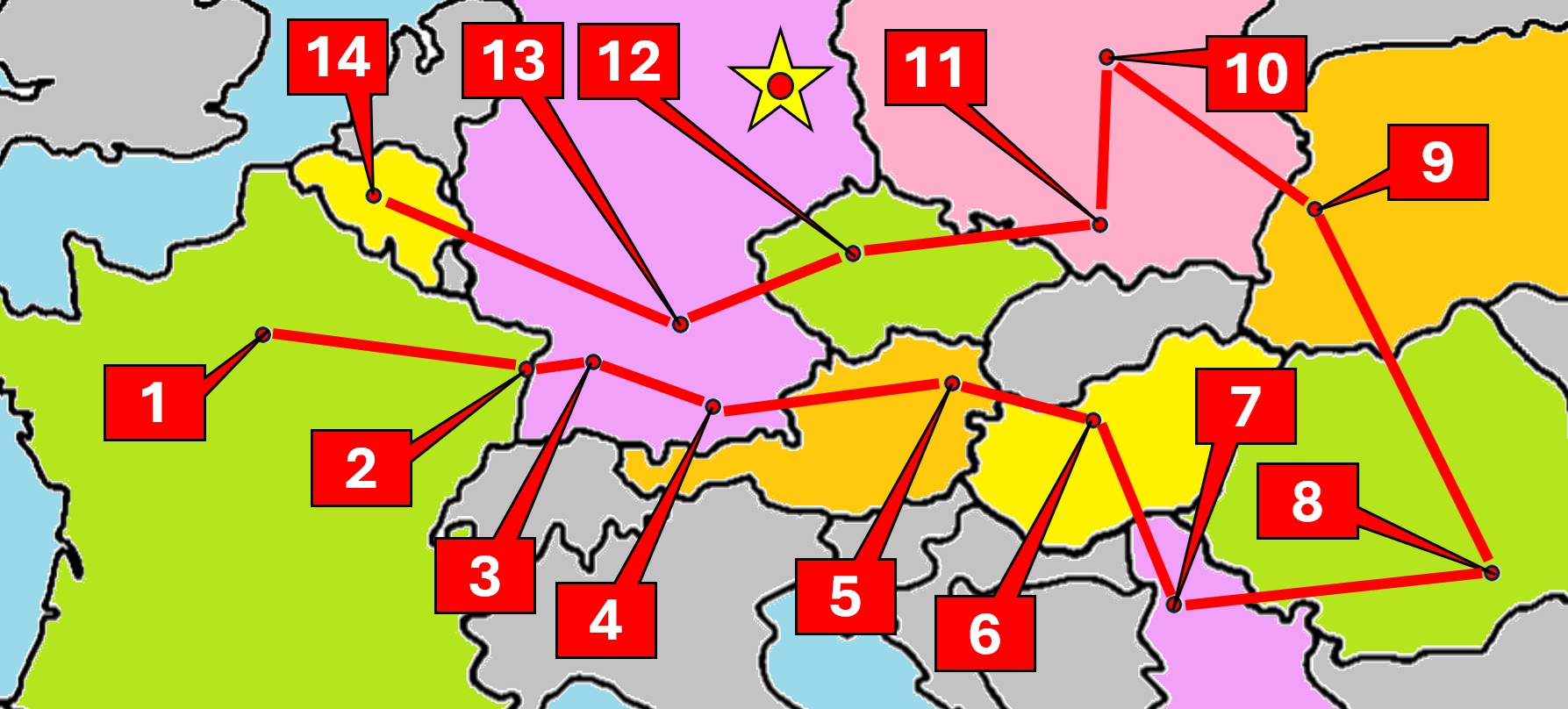
Belgrade to Bucharest (Map 7-8)
While in Belgrade Rachel acquired one more addition to her entourage. This was Colonel Ion Păun, a 60-year-old retired Romanian army officer. In the summer of 1912 Colonel Păun had ridden horseback from Bucharest to Paris in 60 days. He rode a mare named Nonius and was accompanied by the mare's two-year-old foal who carried a small share of the baggage.
Like Rachel, Colonel Păun was more interested in seeing the country than in breaking a speed record. His carefully planned route took him through some of the most picturesque parts of Transylvania, Hungary, Tyrol, Switzerland and finally France.
When he learned that Rachel was making a similar journey to the one he had made almost sixteen years earlier, he mounted his horse and rode to meet her in Belgrade and then accompanied her all the way back to Bucharest.
Colonel Păun turned out to be a mixed blessing. In fact, among the hazards that Rachel had to deal with were some of the men that she met along the way. This is what she told a reporter from Nieuwe Rotterdamsche Courant when she passed through Strasbourg on her way back home:
"The journalist: 'May I ask you one impertinent question, mademoiselle? How many admirers have fallen in love with your youthful beauty?'
"Miss Dorange: 'Go ahead and mock me! But to tell you the truth, a student followed me all the way from Tübingen to Munich. In Munich, a group of artists wouldnΓÇÖt leave me alone; in Vienna, it was sportsmen; and in Budapest, young aristocrats courted me a little. I wonΓÇÖt even tell you about the countless journalists and the attachés from all the French legations IΓÇÖve met!
'But the most enterprising of them all was an old colonel from Romania. He followed me for 900 kilometers, wearing out a four-year-old horse in the process, which he then replaced with a mare. The mare didnΓÇÖt last, and a mule was the next in line. This animal threw him off, but the colonel persevered, with a bleeding knee. I thought IΓÇÖd never shake him off. Good old colonel, you were tough.
'I must admit, however, that I liked the young lieutenants better; they were good riders and good at flirting, and thatΓÇÖs how a hundred kilometers were covered before you even realized it.'"
Years later, in a 1945 interview, Paule Corday put a key question to Rachel point blank: "What do you think of men?"
"That theyΓÇÖre generally not very smart. You have to flatter them, and that annoys me. They can sense it.... They donΓÇÖt really understand me." From Belgrade to Bucharest, Rachel was escorted by gendarmes, "as the authorities feared an attack by robbers, which is not uncommon in these regions. Thus the young Frenchwoman, flanked by two respectable officers, rode through the plains of the Danube as if she were a dangerous criminal."
Rachel and her escort left Belgrade at 3 p.m. on June 14 and arrived in Bucharest twelve days later on June 26. Thanks to one of Colonel Păun's dispatches to L'Indépendance Roumaine we have a fairly detailed itinerary of the Belgrade-Bucharest leg of Rachel's journey and a glimpse into her day-to-day progress.
The map on page 22 is based on Colonel Păun's itinerary and shows the roundabout path that was dictated by road conditions, accommodation en route and other factors. The mileage of all 18 stages totals 814 kilometers while nowadays a direct flight from Belgrade to Bucharest covers only 458 kilometers and takes about an hour and a half.
The longest distances between stopovers, 100 kilometers (Deva) and 105 kilometers (Săliştea) were not beyond Rachel's ability to cover in a day's journey, and the rest of the distances were well within it. The 17 stopovers between Belgrade and Bucharest were presumably chosen because they offered adequate accommodation.
Given all this, one statement in Rachel's Nieuwe Rotterdamsche Courant interview seems a bit curious:
"Miss Dorange had, of course, met real gypsies, with their delightful music and their ancestral customs. Those were good times, and it was wonderful to sleep under the open sky. Hearts were light, and Le Huppé easily found a lush meadow! Yes, that trip was wonderful."
So where and when did Rachel sleep under the open sky? Or was this an embellishment?
According to Rachel, the terrain only became difficult when she entered Eastern Europe, where "the lack of clear signposts made itself felt, especially in the Hungarian Puszta with its endless paths." The Puszta is a vast treeless plain in eastern Hungary with breathtaking scenery but not many aids to navigation in 1928.
Rachel experienced bad weather on her Paris-Bucharest voyage, including both rain and snow, but nothing like that faced by Captain Achille Bălăcescu who undertook a Bucharest-Paris trip, also in 1928. The Captain recalled that "in Yugoslavia, it rained continuously, the roads are very bad, and usually they were like swamps where my horse would get bogged down up to the knees."
Rachel was already back in Paris for ten days when, on October 15, the Captain and his horse Timella set off from Bucharest. As he later admitted he did not do himself or Timella any favours by starting out so late in the year, nor by choosing a route through the Alps. When he got to the Simplon Pass he found it blocked by snow three metres deep.
Luckily mail service through the pass was shut down for ten days and he found some postal workers with time on their hands who helped him shovel a path through the drifts. Timella was shod with cleated shoes for traction on ice, but even so they were slowed to only five kilometers a day. In Italy, where roads had been good, the pair had managed 100 kilometers a day or more.
When the Captain and Timella made their ceremonial entrance into Paris through Porte Bercy at 10:45 a.m. on December 17, Rachel and Le Huppé were waiting to greet them, along with reporters and a selection of officials representing France and Romania.
After the interviews and photographs and congratulations, Rachel rode along with the Captain as he took Timella to a stall in the stables at the École Militaire (Military Academy).
|
|
Amazon: Rachel Dorange, Last Femme Cocher in Paris / 21 /  
| |