




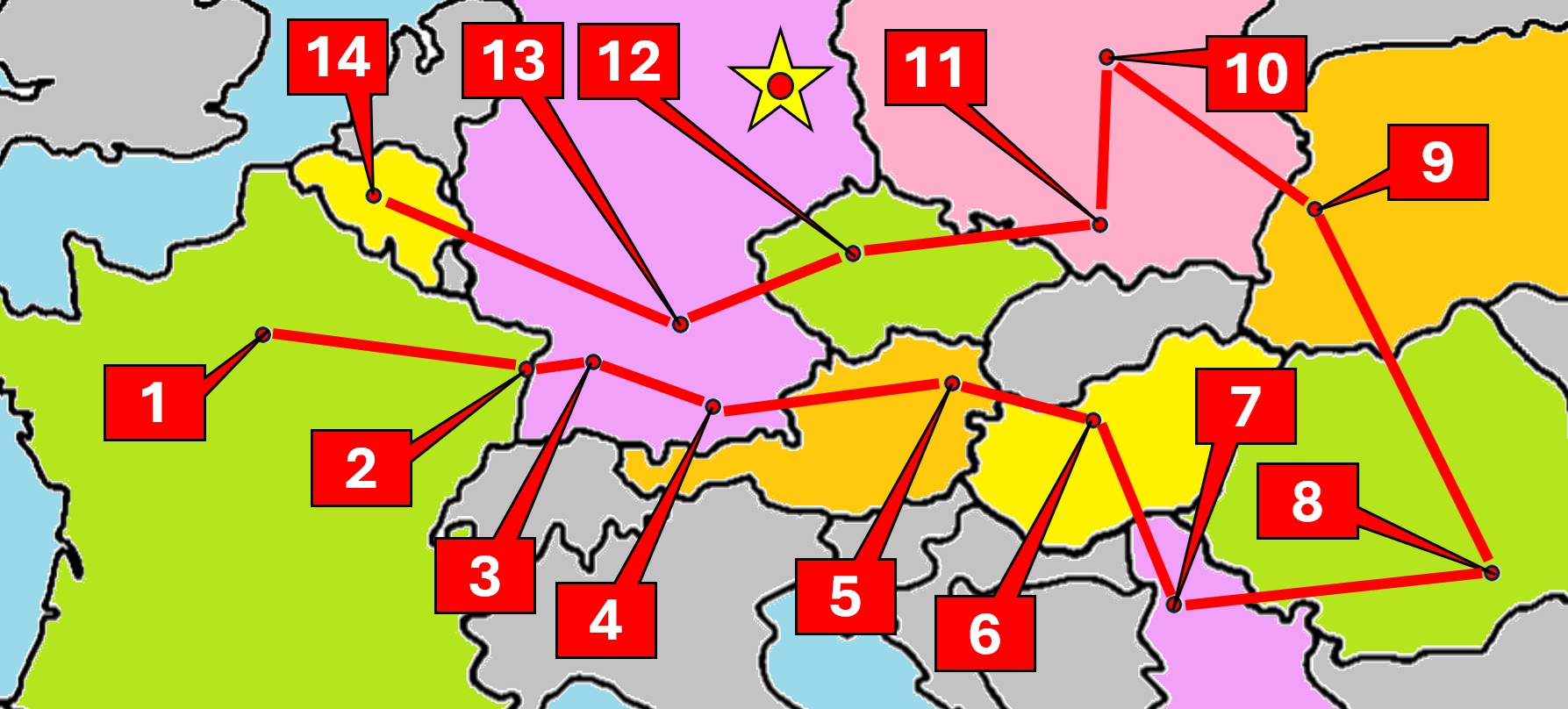
Above: Rachel with one of the many bouquets she was presented with on her way to Warsaw..
Source: Express Kaliski, August 17, 1928, p. 3 (via CRISPA, University of Warsaw).

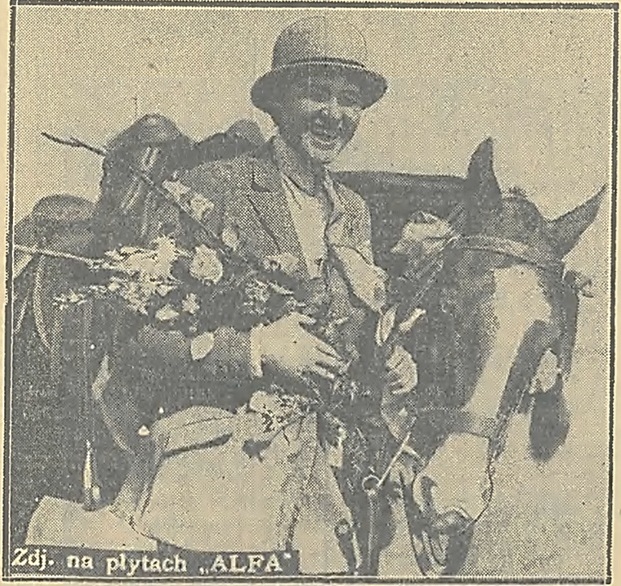
Above: The Polish movie star Maria Malicka (1900-1992) who rode horseback from Warsaw to meet Rachel in Wawer.
Source: "Maria Malicka (actress)," Wikipedia.

Above: Equestrian portrait of Maria Zandbangowa, by Wojciech Kossak (1913). She is the Miss Wodzińska who presented Rachel with flowers on the way to Warsaw and made a "very nice" speech in French.
Source: "Maria Zandbang" (Wikipedia).
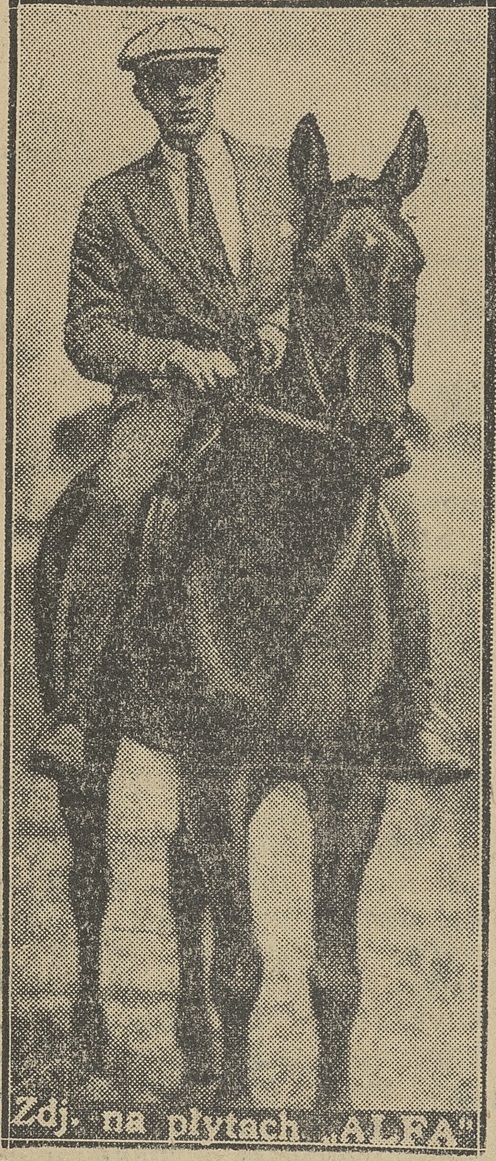
Above: "A Knightly Companion to a Beautiful Horsewoman. From Zamo┼¢─ç to Warsaw, a brave French horsewoman, Ms. Dorange, is accompanied by a local gentleman, Mr. Micha┼é Lipczyński of Krynica."
Source: Express Kaliski, August 17, 1928, p. 3 (via CRISPA, University of Warsaw).
9. Bucharest, 1928 (continued)
Lviv to Warsaw (Map 9-10)
Rachel is next reported as arriving in Zamość on Monday, August 13, 130 kilometers from Lviv. This implies that there was an overnight stop somewhere on the way from Lviv. Here Rachel encounted Michał Lipczyński, "a young landowner" from the village of Krynice who accompanied her all the way to Warsaw.
Rachel may have stayed Monday night in Krynice, about 18 kilometers southeast of Zamość where the Lipczyński family owned an estate and a manor house. Rachel was frequently a guest at the private homes of well-to-do hosts along her route. As she told a reporter on her arrival in Warsaw, "everything I've seen in Poland is beautiful, and the hospitality in the manors is extraordinary."
Rachel's next destination was Lublin, 73 kilometers from Zamość where she made a "long stop" (probably staying there on the night of Tuesday-Wednesday, August 14-15). "On the road from Lviv, the horsewoman was warmly greeted by several officers from Lublin regiments."
Rachel's (and Michał Lipczyński's) last stop before Warsaw was at the village of Stara Wieś where they spent the night of Thursday-Friday August 16-17 as the guests of the Count Zamoyski and his family. The Zamoyskis were not at home so Rachel actually stayed with Mr. and Mrs. Lesins, the administrators of the Zamoyski estate.
Stara Wieś is about 110 kilometers north of Lublin. Assuming that she spent the night of August 14-15 in Lublin, she must have spent August 15-16 somewhere between between Lublin and Stara Wieś.
Rachel had intended to leave Stara Wieś at 6 a.m., but they were delayed by a rain storm and were not able to set out until 8 a.m. At the nearby town of Garwolin they were joined by Captain Kwieciński of the Mounted Rifle Regiment, who escorted them to Warsaw.
Near Kołbiel, about eight kilometers further on, they ran into a party of road repair workers who stopped them and presented Rachel with her first bouquet of the day.
A little further still, about five kilometers from Wiązowna, Le Huppé threw a shoe but a blacksmith in the town quickly replaced it and the party was able to set off from Wiczowna at about 9:30 a.m., but not before the six-year-old daughter of the local police chief presented Rachel with another bouquet.
By now 15 people on horseback and about a dozen more in cars and taxis were waiting to meet Rachel in Wawer, a suburb about 17 kilometers outside of Warsaw. There were seven women on horseback including a star of stage and screen, Marja Malicka.
Several dozen athletes from Anin, a suburb on the northwest side of Warsaw, had also gathered in Wawer to greet Rachel. When she arrived, Senior Police Commander Jan Dobrowolski presented her with another bouquet of flowers.
The procession set off from Wawer at at 10:45 a.m., but they only went two kilometers before they were stopped again, this time by "Miss Wodzińska, a well-known sportswoman" who presented Rachel with another bouquet and "made a very nice speech in French." This in fact was Maria (Wodzińska) Zandbang, an equestrian superstar who in 1926 set a sidesaddle show jumping record that was unsurpassed into the 21st century.
As the procession reached Wólka Mlądzka, a village just outside Warsaw, it was stopped by another party of workers who presented Rachel with yet another bouquet, the fifth she received before setting foot in Warsaw.
"The cavalry column, led by Mademoiselle Dorange, entered the capital around 11 a.m. After crossing the Poniatowski Bridge and Viaduct, 3rd May Avenue, and Ujazdowskie Avenue, the rider dismounted in front of Mr. Konopnicki's Tattersall on Szucha Avenue.
"Miss Dorange had her horse groomed and only then thought of herself." (Kurjer Zachodni Iskra)
"The choice of location was apt, for the tattersal, nestled among gardens, has plenty of fresh air and is not stuffy, which is important after a long journey. (Jeździec i Hodowca)
Back in April, 1928 when she was in Ulm, Germany (Page 14) Rachel described her desperate search for a stable to house Le Huppé. This problem was now evidently solved by having someone make suitable arrangements for her in advance. On August 8, nine days before she reached Warsaw, Jeździec i Hodowca announced that
"Mlle d'Orange, will arrive in Warsaw between August 13 and 15. Mr. Konopnicki, owner of the well-known Tattersall at 11/13 Aleja Szucha (Szucha Avenue), has taken charge of hosting this brave athlete and is is accepting applications from athletes who wish to ride out to welcome Miss. d'Orange to Warsaw."
Rachel spent five days in Warsaw and left the city at 10 a.m. on Wednesday, August 22 on her way to Krakow, 295 kilometers away, which she expected to reach in seven days. She was "bid farewell by a large group of spectators." (Lech; Gazeta Poranna)
However, Rachel's stay in Warsaw was not all sunshine and roses as she revealed to reporters when she arrived in Prague, Czechoslovakia on September 10. According to Pragai Magyar Hirlap:
"In Warsaw, she almost gave up her plan to return to Paris on horseback because she was discouraged by the treatment she received in the East, namely in Romania. She had almost boarded the Warsaw-Prague express train, but at the last moment she changed her mind because she could not bear to part with her horse, and so she mounted her saddle again to make her way home on horseback.
"Almost" boarding the express train sounds a bit melodramatic, but whether or not this was an embellishment it is clear that Rachel was seriously upset. The frosty treatment that she received in Romania on the heels of the rumour that she was a Jew made her decide to return home to Paris on horseback, so it is strange that she would reverse that decision in Warsaw without some more immediate cause.
Kurjer Czerwony offered a clue under the headline "Regrettable Indifference":
"Gazeta Warszawska reports that neither the French community nor representatives of the French consulate welcomed Miss Dorange in Warsaw yesterday:
"'It is regrettable to note that only Mr. and Mrs. Konopnicki, along with a group of people of good will, welcomed Miss Dorange, while all sports associations, including the Society for the Encouragement of Horse Breeding in Poland, displayed a surprising indifference. Representatives of the sports world explain that Miss Dorange does not belong to any sports association – an argument of this kind does not stand up to criticism Wieczór Warszawski was equally indignant and more explicit:
"The brave French horsewoman, Miss Dorange, who, on her way to Warsaw, rode 4,300 kilometers on horseback, mentioned discreetly yesterday that her her reception in Poland was somewhat pale in comparison to the welcome she received in Hungary and Romania.
"Above all, the charming Frenchwoman was surprised that no equestrian sports association had come to greet her. And one must note here that indeed, had it not been for the initiative taken by the owner of the tattersall, Mr. Konopnicki, who gathered his clients and, together with them, set out to meet Miss Dorange, no one would have welcomed her. The bitterness of the brave French Amazon is therefore perfectly understandable.
"The primary responsibility for taking charge of Miss Dorange's reception belonged, quite simply, to The Society for the Encouragement of Horse Breeding in Poland, which is well-endowed with funds, yet no one there could be found who would consider this pleasant and honorable duty...
"What a propaganda asset it would be to skillfully exploit the visit of the valiant French amazone to Poland! How many young ladies and young men would be inspired to take up equestrian sports, if they were given the opportunity to come into contact with the Frenchwoman who has achieved such a magnificent sporting feat.
"This advantage was completely squandered by the Society.There was no one there who would have thought that the Society's duty was to support the French amazon. Simply put – a scandal."