




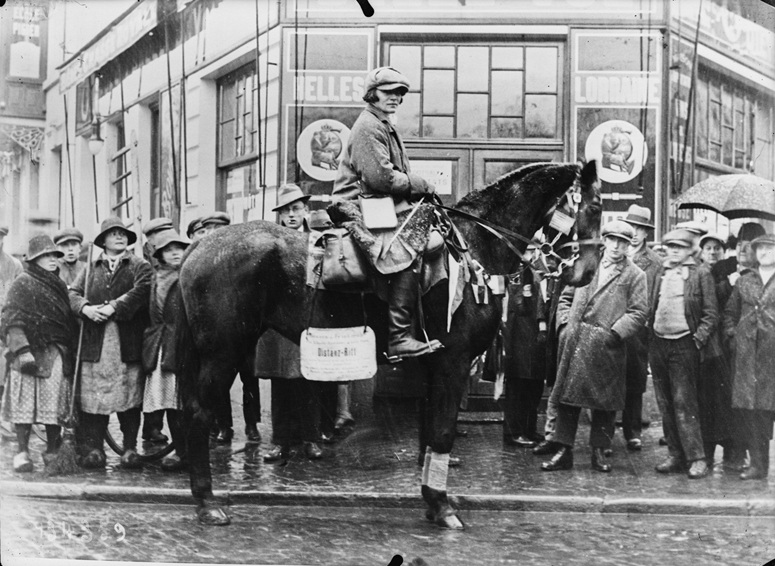
Above: "Sylvia Kuchler-Jeska, artist, arriving from Lithuania on her horse." The scene is Liège, Belgium. The woman at left appears to be wearing wooden shoes.
Source: Biblothèque nationale de France (via Gallica). Photo credit: Agence Roi press photograph.
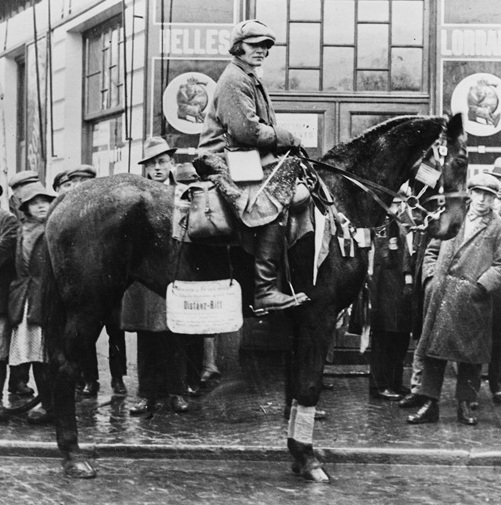
Above: Same photo. The sign hanging from the saddle explains that Sylvia is on a "Distanz-Ritt" – a distance or endurance ride.
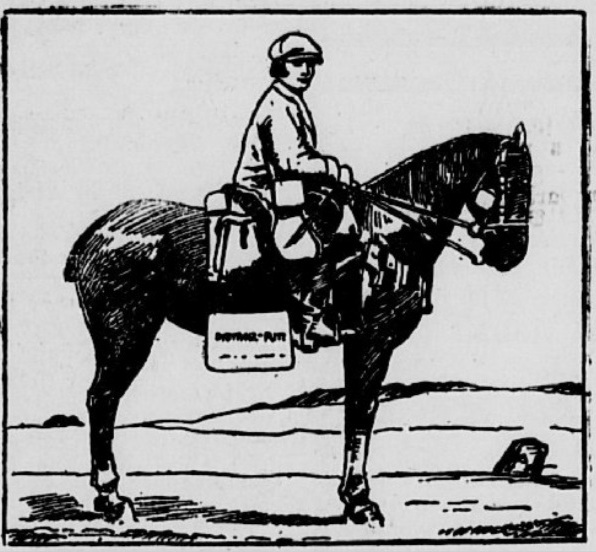
Above: Sketch of Sylvia Kuchler-Jeska and Friedenspalme derived from the photo above.
Source: Billstedter Zeitung, December 13, 1928, p. 5 (via Deutsches Zeitungsportal).
10. Paris-Cannes, 1929 (continued)
Another intriguing question arises: did Sylvia's business relationship with Massard go back well before his Christmas Eve article in L'Ami du Peuple?
Once again we have no solid evidence but the sudden burst of publicity about Sylvia can hardly have been spontaneous. Rather, it looks like it was professionally managed.
The earliest publicity gambit seems to have been the posed photo of Sylvia and Friedenspalme in front of a gaggle of spectators in Liège, Belgium (left top). We know that she was in Liège in December because she visited the office of the newspaper La Wallonia (and maybe other newspapers in the city as well).
The photo must have predated the sketch version (left bottom) published in Billstedter Zeitung on December 13 since the sketch was derived from the photo.
The photo and/or the sketch was distributed to newspapers, likely by a wire service and likely soon after the photo was taken. Individual newspapers decided when or if they would publish either of them, but as the Sylvia publicity campaign went into high gear the incentive to publish increased.
The photo was printed in Les Dernières Nouvelles on December 19 and in Der Landbote on December 29. The sketch version was published in Billstedter Zeitung on December 13 and in Weissritz-Zeitung on December 24.
The caption accompanying the photo or sketch was much the same in all four cases: she had come from the Lithuanian border, had just arrived in Liège, intended travel to Paris, Le Havre and London, and would return to Germany riding in a carriage drawn by her horse. Les Dernières Nouvelles added that on her way to Liège she was forced to sleep out in the open because she could not find a stable for Friedenspalme.
A press release followed the photo a couple of weeks later and was printed by at least nine different newspapers between December 28 and December 30.
The release noted Sylvia's difficulties with French customs which she hoped to resolve before the Paris-Cannes race and revealed that she was now officially registered for the race as entrant number 12.
And oh yes – Sylvia's cumulative long distance mileage now totaled 4,000 kilometers since December 25, 1927.
The press release went on to explain that Friedenspalme was the pure-blooded product of the royal stud farm that had once belonged to the King of Prussia, but only three of the nine papers chose to print this paragraph.
The German embassy evidently coughed up the money to pay Friedenspalme's deposit and Sylvia took the train back to Petite-Chapelle to effect her release. This did not go smoothly. Awaiting Sylvia outside the customs post, the horse was spooked by a train whistle. She snapped her tether and took off galloping across country. It took a while to recapture her.
Although not quite the amazon that she was claimed to be, Sylvia had enough skill and experience to complete the 260 kilometer journey from the French border to Paris on her own.
She retrieved Friedenspalme on Wednesday, December 26 and reached Paris four days later. She did this armed only with a list of towns to chart her route:
We can only guess at where she spent her nights.
Sylvia's arrival in Paris on Sunday, December 30 was announced by another press release in which it was claimed that she was welcomed by Rachel Dorange. This was a lie, because although the welcome was planned with the best of intentions it turned out to be a fiasco.
On Sunday morning Massard and other members of the Paris-Cannes race committee, along with Rachel, gathered to greet Sylvia at the Porte de la Chapelle, the site of an old city gate on the north side of Paris. When she failed to show up by noon a car was sent back along her expected route but she could not be found. So everybody went home.
One would have thought that Massard would have recruited a few local equestrians to meet Sylvia as she approached Paris and provide her with an escort into the city. This would have created a bit of spectacle as well as ensuring that Sylvia found her way to the meeting place.
Instead, Sylvia was left entirely to her own devices. When the road to Paris forked she followed the wrong branch and entered the city by way of Porte de la Villette, a couple of kilometers east of Porte de la Chapelle.
Sylvia managed to contact Jean Hallaure who directed her to a circus on the Left Bank which had stabling for circus horses. Friedenspalme was placed in a stall under the care of circus stable hands and Sylvia checked into a nearby hotel.
It was at this circus where she was found by a reporter and interviewed:
"On this New Year's afternoon, the circus is packed to the rafters. A thousand children are jumping for joy at the clowns' antics. And whilst the show goes on, in a corner of the stables, far from the sparkling chandeliers and the ovations, Madame Sylvia von Kuchler-Jeska tends to her horse....
"Petite, dressed in a sort of khaki jumpsuit cinched at the waist, wearing heavy fawn-coloured boots and a man's cap, Madame von Kuchler, whose features display extraordinary expressiveness, is proud to introduce her horse to us. The brilliant rider understands a little French; I understand a little German. Bit by bit, we'll be able to have a chat....
"'Friedenspalme isn't a fancy horse,' she told me, 'she's an old friend; she's nearly twelve – the age of reason for horses – and since you understand [French] sir, would you please make sure she has been properly fed this morning. It is my constant concern; she must not be deprived of her daily ration.'
"A stable boy assures me: 'Friedenspalme will want for nothing.'
"And when I ask the rider why she undertook such a long journey, she explains:
"'Why did I come? Why have we travelled the roads of Europe for days on end? First and foremost for the sport, of course, but wasn't it only fitting that a German rider should come and return the visit that Mlle Dorange paid us some time ago?
"'And then, there is another reason. This one is more personal to me.'
"And my companion's voice suddenly grew deeper. A touch of melancholy crept into it:
"'It's hard, but I'm not lacking in courage, and neither is Friedenspalme. We've been through some tough times together. To make it to the end, we've had to live frugally, sometimes even meagrely.
"'And what do you intend to do now?
"'I had planned to take part in the Paris-Cannes rally... but I think I'll give it a miss. We're going to rest for a few days in Paris and then hit the road again. We'll be heading to England, where some friends are waiting for us. We'll stay there for a few weeks. Then it will be time to return.
"'We'll take the same route back to our homeland and see whether the German public has understood the determined effort that Friedenspalme and I have made, without seeking any ill-gotten gain, without seeking any sensational publicity.'"