




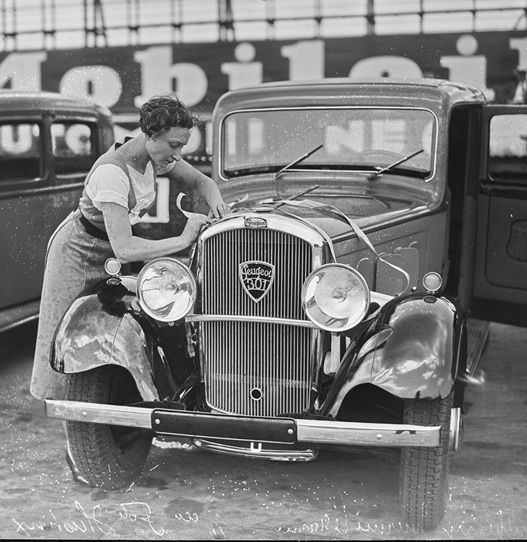
Above: Fernande Hustinx at the Sixth Women's Automobile Day in Montlhéry, July 9, 1933 (detail). She was the winner of the Sixth Women's Automobile Championship, driving a Peugeot. Montlhéry is 30 kilometers south of Paris;
Source: Biblothèque nationale de France (via Gallica). Photo credit: Agence Roi press photograph.
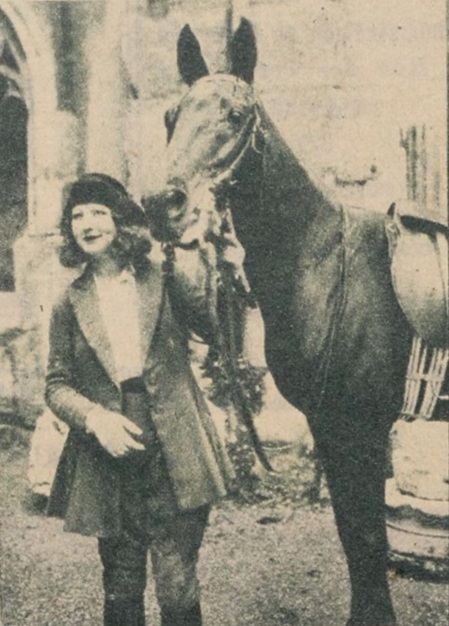
Above: Huguette Villers, from an article about her in Eve magazine after her 400 kilometer ride from Aix-les-Bains to Juan-les-Pins.
Source: Eve, October 5, 1930, p. 2. Bibliothèque nationale de France (via Gallica).
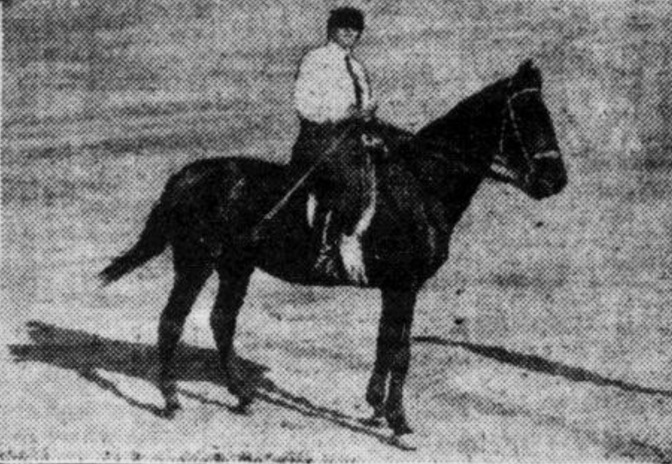
Above: The photo of Sylvia Kuchler-Jeska published with Armand Massard's article.
Source: Ami du People, December 24, 1928, p. 1. Bibliothèque nationale de France (via Gallica).
10. Paris-Cannes, 1929 (continued)
A few days before the 1929 race was to get underway, Armand Massard was interviewed about the event:
"Last year's Paris-Cannes women's horse trek was such a success that it was only to be expected that it would be repeated this year....
"Given such a success, the event's promoter and last year's organizing committee chairman, Mr. Armand Massard, felt compelled to repeat the event. This year, he has placed it under the patronage of the Syndicat de la Presse Sportive et Touristique (Sports and Tourism Press Association). The race will therefore take place on January 5.
"The organizers have provided for an individual mileage allowance and prizes of 5,000 francs, 3,000 francs, and 2,000 francs, as well as trophies, works of art, etc."
The cash prizes were the equivalent of only 200, 120 and 80 U.S. dollars but at the time these were substantial sums. In 1928 the average wage in France for men was about 5 francs an hour, or about 20 U.S. cents. The legal work week was 48 hours (usually eight hours a day over a six-day week).
Therefore, 1,000 francs would be more than a month's pay for the average French workman. Since women were paid considerably less than men, the value of the prizes would be correspondingly greater for the contenders.
In addition to the cash and other prizes the organizers, as Rachel mentioned in her interview with Die Stunde, arranged for free train transportation to take the competitors' horses back home whether they completed the race or dropped out along the way.
Massard claimed that the five contestants for the 1928 race were winnowed down from a large number of applicants "from whom a strict selection had to be made. Some had no horse, others presented horses in such poor condition that they were not allowed to attempt the challenge. In short, only five qualified for the start." He failed to mention that the selection process accepted Martha Gaiatry chiefly on the basis of her dance performances at the Moulin Rouge.
Massard admitted that the 1928 race "was, in a sense, improvised. No one believed it would succeed" including Massard and Hallaure themselves. As Massard confessed in his memoirs "the day of departure arrived, and to our surprise, all the entrants were present" (page 10).
Thanks no doubt to the involvement of the Syndicat de la Presse Sportive et Touristique the 1929 race was much better planned than the 1928 race had been. Nevertheless it was not immune to Massard's and Hallaure's penchant for injecting a bit of circus into the proceedings.
While extolling the professional skill and experience of the equestrian competitors, Massard also promised that "the comic touch will be provided by a young woman who tried in vain to register but will nevertheless be allowed to start – on the back of a camel."
The fact that so many exceptional women were willing to sign on to Massard's eccentric little enterprise speaks to the lack of opportunity for women to exploit their talents and earn an independent living from them.
Nevertheless, despite the quality of the field that the 1929 Paris-Cannes race drew, Massard's public relations instincts told him that he needed something more – he needed one more competitor who, like Rachel Dorange and Mary Féraud, had superlative long-distance credentials, even if those credentials had to be fabricated.
This brings us to Madame Sylvia von Kuchler-Jeska. The first news we have of her is a short wire-service bulletin in the Hamburg newspaper Billstedter Zeitung:
"A fearless German amazon. Miss Sylvia von Kuchler-Jeske [sic] is undertaking an extremely gruelling ride across Europe on her thoroughbred 'Friedenspalme'; starting from the Lithuanian border, she rode through Germany to Liège, where she has just arrived, and will then ride on to Paris, Le Havre and London, her final destination. From there, she intends to return with her friend in a landau, to which her riding horse will be harnessed."
Friedenspalme, meaning "palm of peace," was a mare. The bulletin neglected to mention that Sylvia's trek from Lithuania to Belgium required her to cross Poland as well as Germany but it was illustrated with a black and white sketch of her on horseback. The sketch was copied from an actual photograph (page 36) and was presumably provided by the wire service to newspapers that were unable to reproduce half-tone images. The same sketch and caption also appeared in Weisseritz-Zeitung on December 24.
As with Rachel, the Sylvia portrayed in the newspapers is a mixture of fact and fiction that is hard to sort out. One thing we can be sure of, though, is that her 1,600 kilometer horseback journey across Poland and Germany was a picturesque fantasy. There is no mention of her in Polish or German newspapers until she materializes in Liège, Belgium, and suddenly garners a deluge of publicity.
In a later interview Sylvia said that she was a widow from Berlin who lost both her husband and a brother in World War I, leaving her with a fifteen-year-old daughter and the need to find some way of earning a living. Formerly a theatre actor in Berlin, she went to the United States hoping for a film career but after four years, when her dream failed to pan out, she returned to Berlin to find that her public had forgotten her.
Since she knew how to ride a horse Sylvia decided to emulate Rachel Dorange, Mary Féraud and other famous long distance amazons in the hope that the attention would bring her offers of suitable employment. Specifically, as she told her interviewer, she hoped to run into a film producer who needed an actress with equestrian skills for a series of movies.
We do not know exactly when Sylvia crossed paths with Armand Massard, or which of them concocted her equestrian back story. As with Martha Gaiatry we have no solid evidence but a lot of suspicion.
The published version of events, plausible enough in itself, was that Sylvia heard about the 1929 Paris-Cannes race and decided to compete for the prize money. On December 17 she arrived the French border crossing at Petite-Chapelle, 260 kilometers north of Paris, but the customs officials refused to admit Friedenspalme into France unless Sylvia paid a deposit of 1,000 francs.
Unable to pay the deposit, Sylvia left Friedenspalme at the border and travelled to Paris by train to seek help from the race organizers. That is when Armand Massard took her under his wing.
On December 24 a photo of Sylvia on horseback appeared on the front page of L'Ami du Peuple du Soir. The photo (left) pointed readers to an article on page 5 "by our collaborator, Armand Massard." In the article Massard detailed Sylvia's tale of woe and his own efforts on her behalf.
Massard wrote that Sylvia, still wearing her riding togs (including boots and spurs) entered a meeting of the Paris-Cannes race organizing committee and "in rather laborious French" explained how, inspired by Rachel Dorange and others, she had set out from Kybartai, Lithuania on September 25 and spent three months on the road before reaching the French border.
There, she told the committee members with "tears streaming down her deeply tanned face," the French customs officials, "showing no mercy" had demanded 1,000 francs from her.
Massard said that he contacted the German embassy on Sylvia's behalf but the embassy was about to close for the Christmas holidays and the staff had little interest in rescuing a stranded German national.
However, "we managed to emphasize that our intervention already went far beyond our role, and our arguments undoubtedly swayed our interlocutor, who eventually agreed to receive 'the cavalier Sylvia' before closing its doors."
Massard promised that "my valued colleague... Jean Hallaure, who was able to speak with her at greater length in German, will recount to our readers some of the curious misadventures of the heroine of the Kybartai-Paris trek, through Lithuania, Germany, Belgium and France."
And of course Poland. Hallaure's entertaining work of fiction, unfortunately, seems not to have reached fruition.
The final paragraph of Massard's article has an interest of its own. Apparently he was stung by criticism from skeptics (or as he called them, pessimists) who wondered why the Paris-Cannes race had to be run during the most miserable weather of the year. Now, like a rabbit out of a hat, Sylvia had arrived from Lithuania in December to soothe their misgivings about running a race in winter.
"Is such an example, some twelve days before the Paris-Cannes race gets underway, not enough to offer some reassurance, even – and especially – to the pessimists alarmed by the harshness of the season and the route?"