




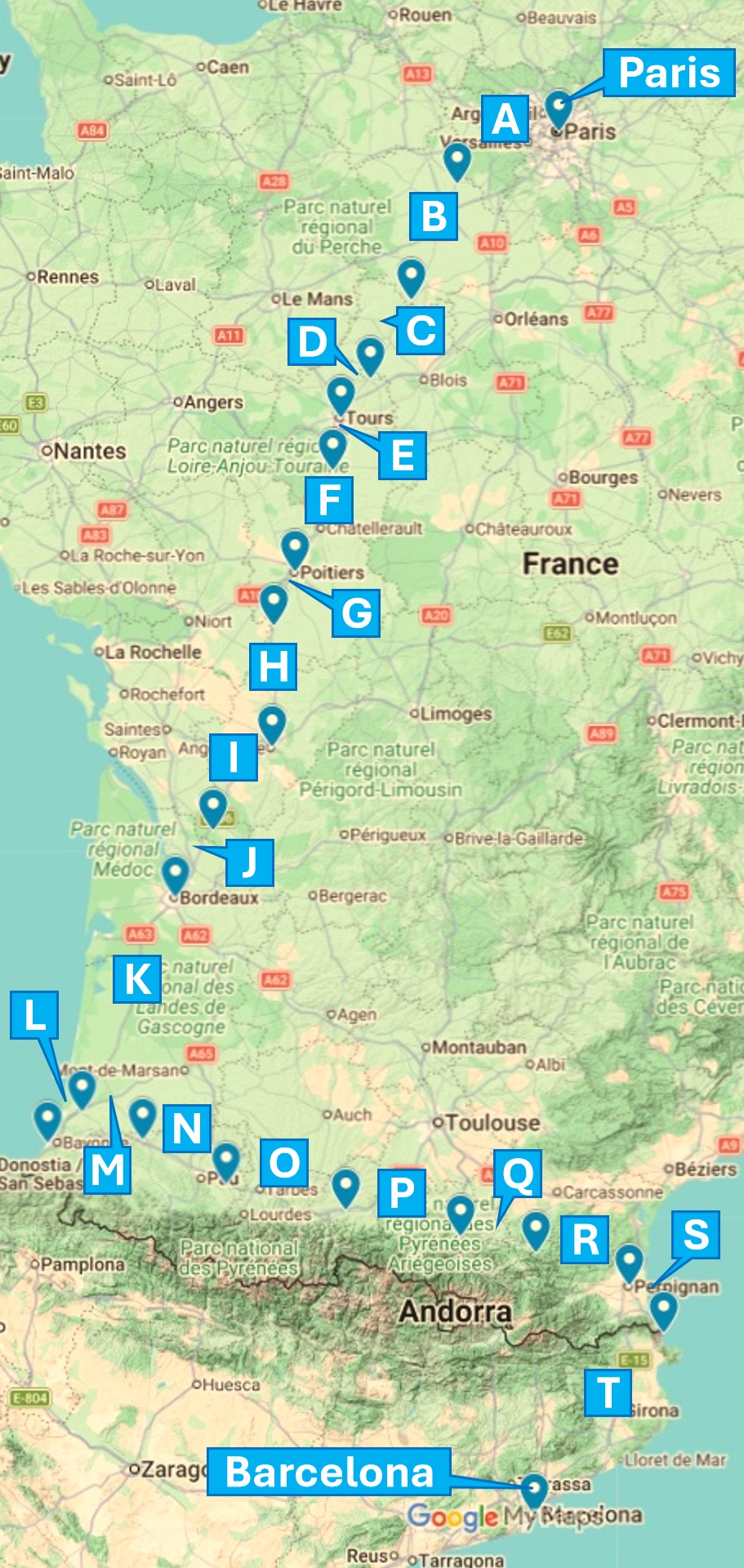
Above: Rachel Dorange's 22-day ride from Paris to Barcelona.
Source: Map created with Google My Maps.
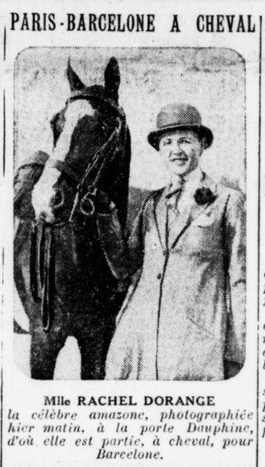
Above: "Rachel Dorange, the famous horsewoman, photographed yesterday morning at Porte Dauphine, from where she set off on horseback for Barcelona." See (A), right.
Source: Le Quotidien, September 3, 1929, p. 1. National Library of France (via Gallica).
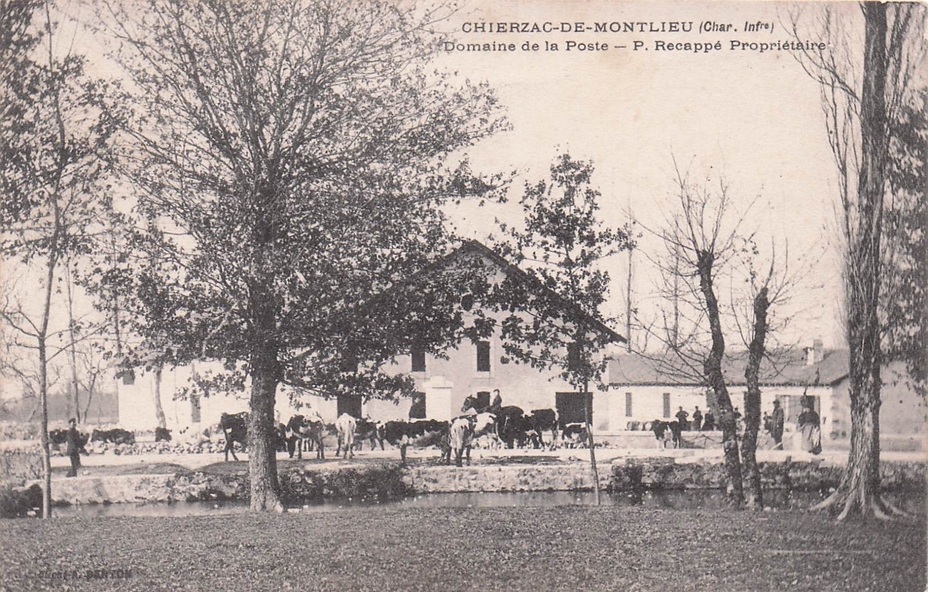
Above: Domaine de la Poste, P. Recappé Propriétaire (postcard, circa 1910 judging by the women's dresses). Rachel stayed at Domaine de la Post overnight on September 10-11, 1929. See (I), right.
Source: Delcampe.net (online marketplace for collectibles).

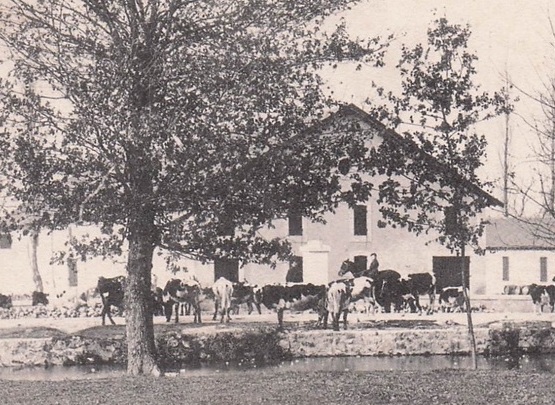
Above: Same photo.
11. Barcelona, 1929 (continued)
(A) / Monday, September 2
"Mlle Dorange left Paris yesterday. Dressed in pearl gray and wearing a bowler hat of the same shade, Mlle. Dorange, a famous horsewoman, set out yesterday morning from Porte Dauphine to attempt the Paris-Barcelona trek. Accompanied through the Bois de Boulogne by many friends, the rider set off alone toward Rambouillet, the destination of her first stage." (Le Matin)
Actually, Rachel went 22 kilometers beyond Ramouillet to Maintenon.
(B) / Tuesday, September 3
At Cloyes-sur-la-Loire, about 150 kilometers south of Paris, Le Huppé began to limp. Rachel was forced to leave him at Cloyes and travel to Tours by car to purchase another horse (below).
Rachel's ability to purchase a second horse and (presumably) pay for Le Huppé's veterinary care and his transportation back to Paris suggests once again that Rachel had a source of income sufficient to sustain her chosen life style.
(C) / Wednesday, September 4
"Tours, Sept. 4. The famous horsewoman Rachel Dorange, who had left Paris on Monday morning to attempt a ride to Barcelona, was forced to stop in Cloyes (Eure-et-Loir) because her horse, 'Le Huppé', grew tired and began to limp. The rider, who has repeatedly demonstrated her intrepidity by completing various treks, notably the Paris-Bucharest round trip, made a heroic decision. She drove to Tours and bought a new horse at a riding school. This horse, which she named 'Va-au-Bout,' ['Go on to the End'] will be sent to Cloyes, where Miss Rachel Dorange will continue her ride. She plans to pass through Tours on Friday morning." (Le Petit Journal)
(D) / Thursday, September 5
"On September 5, Mlle Dorange was in Tours, where, thanks to newspaper coverage, she was given a grand welcome." (Journal de Ruffec)
(E) / Friday, September 6
"Tours, September 6. Mlle Rachel Dorange... passed through Tours this morning at 9:30 a.m., escorted by several riders who had come out to meet her on the road from Paris." (Le Petit Parisien)
From Excelsior:
"Tours, September 6. Mlle Rachel Dorange... passed through Tours today.
"She went to a riding school where, two days ago, she had purchased the horse that is replacing her faithful Le Huppé. She set off again at 4 p.m. toward Sainte-Catherine-de-Fierbois... where she intends to spend the night.
"She hopes to be in Poitiers tomorrow evening, at the end of the day." Presumably Rachel passed through Tours on the way out of town after spending the night there.
Rachel actually went a bit beyond Sainte-Catherine-de-Fierbois and spent the night at Sainte-Maure-de-la Touraine.
(F) / Saturday, September 7
"Mlle Rachel Dorange, ... coming from Sainte-Catherine-de-Fimbois, arrived this morning in Chàtellerault, from where she departed at 3 p.m." (La Dépèche de Brest)
(G) / Sunday, September 8
(H) / Monday, September 9
From L'Athlete:
"On the 9th, via Ruffec and Mansle, she reached Angoulème after a 72-kilometer stage."
From Le Journal de Ruffec:
"On Monday the 9th, the courageous young woman left Couhe-Vérac at one o'clock in the morning. During the day, due to the intense heat, the kind rider rested in Ruffec for four hours and set off again around 10 a.m. for Angoulème, where she arrived at 5 p.m."
From Le Petit Journal:
"Angouème, Sept. 10 ' Mlle Rachel Dorange, ... arrived in Angouème yesterday evening at 5 o'clock, coming from Couhe-Vérac. She had set out at 1 o'clock in the morning.... The rider did not appear tired at all, despite the oppressive heat.
"'With my previous treks, I have now covered ten thousand kilometers,'she said. 'I have never felt better.'" (I) / Tuesday, September 10
"Mlle Dorango left Angouème this morning at 4 a.m. She plans to be in Bordeaux tomorrow at noon." (Le Petit Journal)
"On September 10 Rachel rested at Mr. Recappé's home, at Domaine de la Poste in Chiersac" [i.e., Chierzac]. (La Gazette de Biarritz)
Domaine de la Poste (left) was a large farm in the village of Chierzac (now part of Bedenac). The farm is still in business, specializing in asparagus and strawberries (see Facebook).
(J) / Wednesday, September 11
From La Gazette de Biarritz:
At about 1 p.m., "Rachel Dorange arrived in this very cheerful city [Bordeaux] not at all tired.... The graceful rider purchased a new mount in Tours. This horse, named Va au Bout, is a superb animal, 'gentle as a lamb,' she said upon her arrival at Place du Pont."
(Bordeaux's Place du Pont was renamed Place Stalingrad in 1946 to commemorate the Battle of Stalingrad.)
"But Va au Bout cannot stand trams and noisy cars; even a falling leaf makes him prick up his ears. He is not temperamental, but he prances at the slightest noise."
From L'Athlete:
"On the 10th.... after resting at Mr. Recappé's home, at the La Poste estate in Chiersac, she arrived in Bordeaux at 1:00 p.m....
"After receiving proper care from 'Va-au-Bout,' Mile Dorange visited the newspaper 'La Petite Gironde,' where she was offered lunch, and then went to Radio-Sud-Ouest, where she insisted on speaking to our enthusiastic wireless devotees." (K) / Thursday, September 12
"At 5 a.m. on Thursday morning, the rider set off again.... During the first part of Thursday's stage, she was accompanied by Mr. Chevillard, a specialist in regional horseback treks, riding the mare La Bouchère." (La Gazette de Biarritz)
"On Thursday morning at 3 a.m., she set off in the company of Mr. Chevillard, who was to drop her off in the Landes...." (L'Athlete). Landes is 119 kilometers from Bordeaux.
On September 13 Le Progrès de Bergerac et de la Dordogne falsely reported that Le Huppé had died in Tours.