




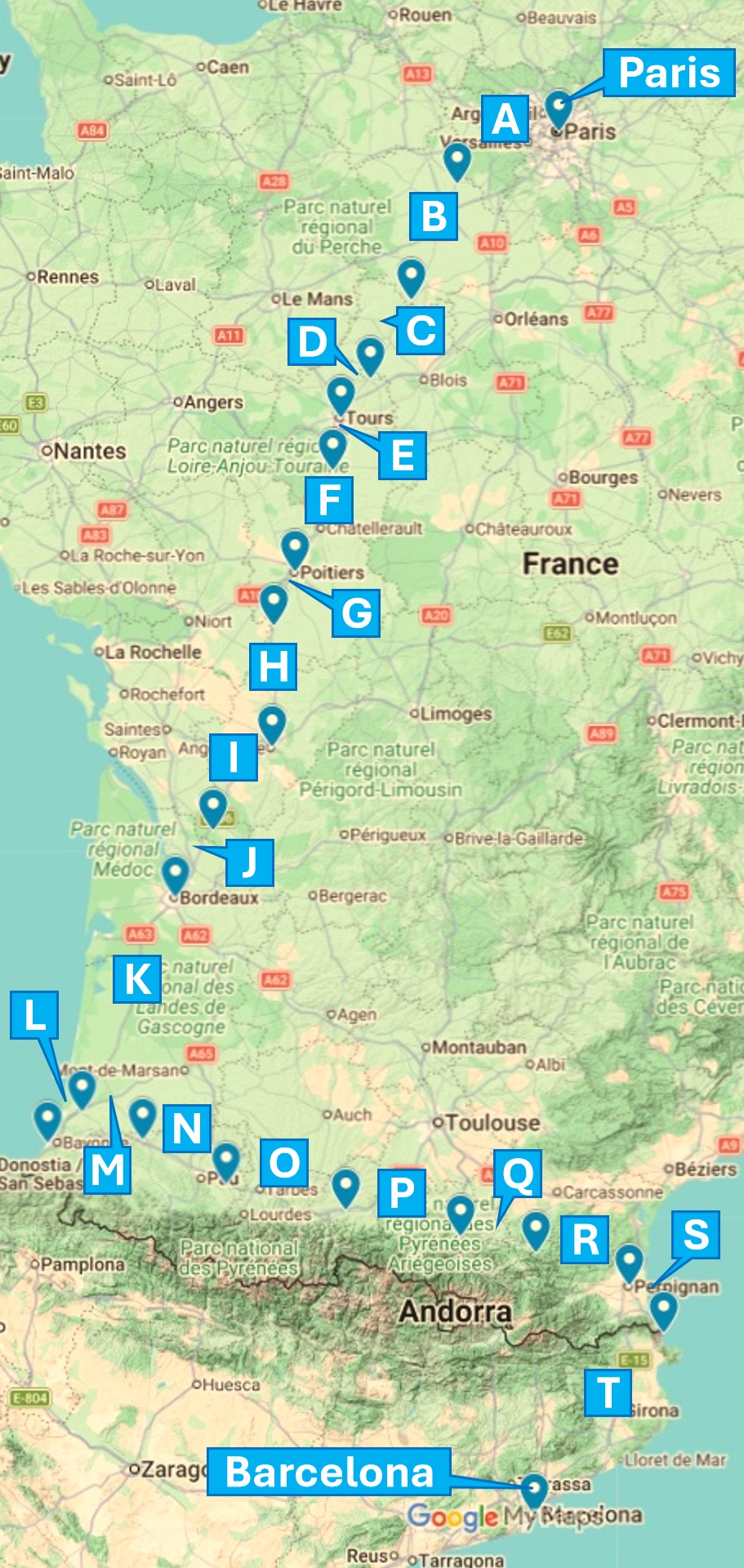
Above: Rachel Dorange's 22-day ride from Paris to Barcelona.
Source: Map created with Google My Maps.
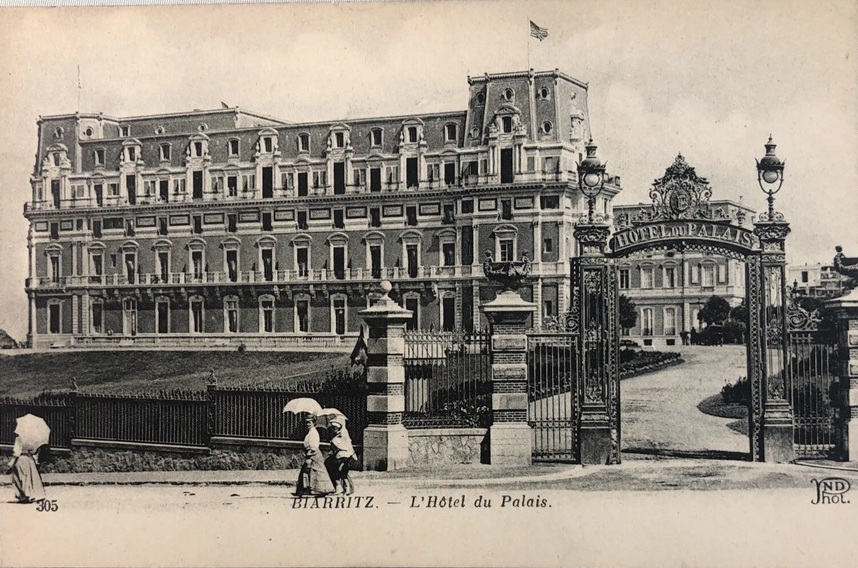
Above: Hôtel du Palais, Biarritz (postcard, circa 1910). This is where Rachel evidently stayed during her two days in Biarritz (September 14-15). See (L), right.
Source: "Anciens Etab[lissements?]", no. 304. Neurdein et Cie (Neurdein & Co.) via ebay (vendor: a & a quality).
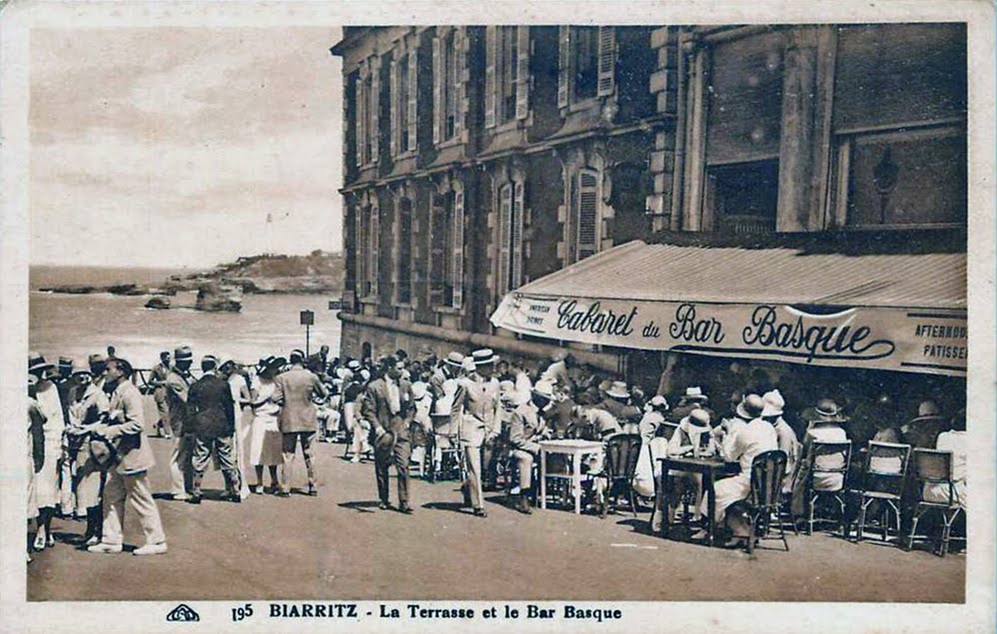
Above: "Biarritz - The terrace and the Bar Basque." Postcard, circa 1930. See (L), right.
Source: Compagnie des Arts Photomécaniques no. 195 via Pays Basque 1900: La Mémoire du Pays Basque.
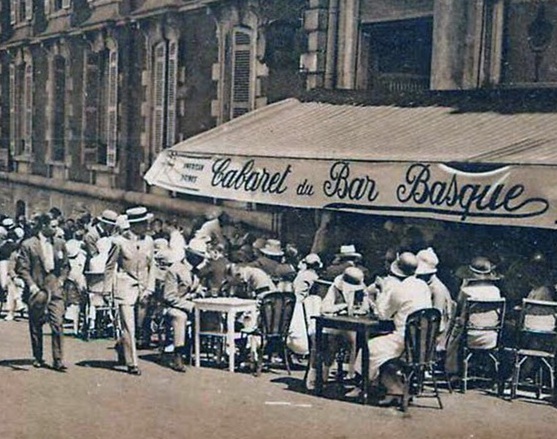
Above: Same photo.
11. Barcelona, 1929 (continued)
(L) / Saturday, September 14
Rachel must have spent the nights of Thursday, September 12 and Friday, September 13 somewhere between Bordeaux and Saint-Vincent-de-Tyrosse.
From Le Patriote des Pyrénées:
"On Saturday morning, coming from Saint-Vincent-de-Tyrosse, Mlle Dorange, the intrepid rider undertaking the Paris-Barcelona horseback ride, passed through Bayonne at 9:55 a.m. on her way to Biarritz. When interviewed, she said she was delighted with her journey and not at all tired, nor was her horse." (Le Patriote des Pyrenees)
Rachel arrived in Biarritz at about 10:30 a.m. From La Gazette de Biarritz:
"Mlle Rachel Dorange, who had spent the night in Saint-Vincent-de-Tyrosse, merely passed through Bayonne this morning, heading toward Biarritz on her good horse – skittish but valiant.
"She merely passed through Bayonne, but not quickly enough to avoid being recognized, congratulated, and indiscreetly questioned.
"Mlle Dorange is very unassuming and very kind. She is all smiles. And what a lovely smile! 'Tired?' she declares. 'Not at all, look.' It is certain that she shows no sign of it.
"She credits the success of her fine ride to her horses, whom she loves: the brave Le Huppé... and the newcomer – but already faithful – Va au Bout, who, Mlle. Dorange hopes, will live up to his name.
"'And now,' she says with a flick of the whip that feels like a caress to Va au Bout, 'off to Biarritz!'
"The arrival in Biarritz, around half past ten, of Mlle Rachel Dorange, provoked, as was to be expected, a great deal of friendly curiosity.
"Even though, after dismounting, the rider led her horse – which seemed much more docile than had been reported – up onto the sidewalk, her presence stirred such a commotion and such a gathering that car traffic was momentarily disrupted.
"Mlle Dorange drinks a glass of champagne, mounts her horse, receives a magnificent bouquet of flowers from Mr. Gibrac, who holds it out to her, and is about to leave when she is told that the photographers – the tyrants of the latest trend – have arrived.
"'Careful,' she says, "'don't take a picture of my horse from behind! That's where he looks his least handsome.' The sound of a shutter clicking...
"'Now to the Palais!' But not quite yet: "Mademoiselle Dorange had to stop again along the way to be welcomed and congratulated at City Hall by the mayor of Biarritz, over a glass of port."
Rachel was interviewed in Biarritz by L'Indépendant des Basses-Pyrénées:
"At the Bar Basque, during classic cocktail hour, after a dip in the sea or a sunbath, Mademoiselle Dorange – 'the most beautiful horsewoman in France' – appears, as simply as can be, in riding attire, like a young woman who has just taken a stroll through the Anglet forest, breathing in the fresh sea air and the scent of pine trees....
"On Sunday, it was thought she would take a good rest before embarking on the second leg of her trek and setting course for Barcelona via Pau and Tarbes. That was not to be.
"In Biarritz, people go to bed very late, and our horsewoman wanted to do as everyone else did. She didn't get home until an ungodly hour in the morning – 4 a.m. – but by 9 a.m. she was at the beach, introducing her 'Va-au-Bout' to the sea.
"It was a new kind of training, as the animal was wary of the waves and didn't seem to enjoy putting his hooves in the salty water very much.
"At the Bar Basque, we made sure to offer our warmest congratulations to Mlle. Dorange....
"With the greatest kindness, grace, and simplicity, the most beautiful horsewoman in France answered our questions and told us that she would be in Pau on Tuesday, after spending the night en route – perhaps in Orthez, depending on the condition of her mount....
"'I don't follow a set itinerary,' she added. 'I go a bit on a whim, but I always stop for lunch before reaching my destination.'" (M) / Monday, September 16
Rachel thought she might be able to reach Orthez, 86 kilometers from Biarritz, but stopped for the night a bit sooner at Baigts-de-Béarn.
(N) / Tuesday, September 17
From Gazette de Bayonne:
"Mlle Dorange, who had left Biarritz on Monday, arrived in Pau around noon on Tuesday, after spending the previous night in Baigts, near Orthez. A group of riders, including Mr. Larregain, had gone out to meet her on the road to Bayonne.
"A little past Lescar, "It is not that everything is easy for her. Mlle Dorange confided to us, in fact, that the drought has hardened the road, which tires 'Va-au-Bout's hooves, and that there are cars, ever more numerous, which frighten the brave chestnut when they rush past him.
"'Va-au-Bout' has made a few missteps, and one of them yesterday nearly proved fatal to his rider, who suffered a slight bruise on her leg after hitting a tree.
"Finally, in a neighboring department of the Basses-Pyrénées, the police themselves intervened, and Mlle Dorange was asked several times to state her identity.
"None of this prevents the rider from covering an average of 50 to 65 kilometers a day on her way to the capital of Catalonia, where her courage – we have no doubt – will be rewarded.
"Mlle Dorange enjoys these solitary rides, but is nevertheless beginning to find them arduous, and she has stated that this trek will be her last.
"No sooner had she arrived in Pau than the rider meticulously groomed her horse and bandaged a minor scrape on one of his legs. Then she decided to set off again to take advantage of the favorable weather.
"Around three o'clock, Mlle Dorange took her leave and prepared to cover the 18 kilometers separating her from Soumoulou.
"On Wednesday, she will continue her beautiful journey; she will travel through Saint-Girons, Foix, and Perpignan to reach Barcelona, from where she has vowed to return by train. But who can say whether the allure of a new ride might not prompt the courageous horsewoman to break that vow?" (O) / Wednesday, September 18
(P) / Thursday, September 19
"Saint-Gaudens, Sept. 19. The horsewoman Mlle Dorange passed through Saint-Gaudens, from where she set out this morning for Foix, Perpignan, and Barcelona." (Memorial de la Loire)
"Mlle Dorange, who is riding her horse Va-t-au-bout on the Paris-Barcelona route, arrived in Foix on Thursday at 10 p.m. The intrepid rider had come from Prat-Bonrepaux." (L'Avenir)
(Q) / Friday, September 20
"She set out early Friday morning to continue her trek via Perpignan." (L'Avenir)
(R) / Saturday, September 21
From L'Express du Midi:
"Perpignan, September 21. Mlle Renée [sic] Dorange, who is undertaking the Paris-Barcelona horse ride via Biarritz and Perpignan, arrived in Perpignan this afternoon at 4:30 p.m.
"She was greeted on the Espéra road by Mr. Fernand de Rovira, president of the Equestrian Society, and various sportsmen. The charming young woman showed no signs of fatigue from her last leg: Foix to Perpignan.
"She is a guest of Mr. Fernand de Rovira and was officially received this evening at 6:00 p.m. at City Hall.
"Mlle Dorange will leave Perpignan on Sunday morning at 9 o'clock, spend the night in Portbou, and hopes to arrive in Barcelona on Monday." (S) / Sunday, September 22
(T) / Tuesday, September 24
It took two days for Rachel to reach Barcelona from Portbou. We do not know where she spent the night in between. Girona, 74 kilometers south of Portbou, is one possibility.